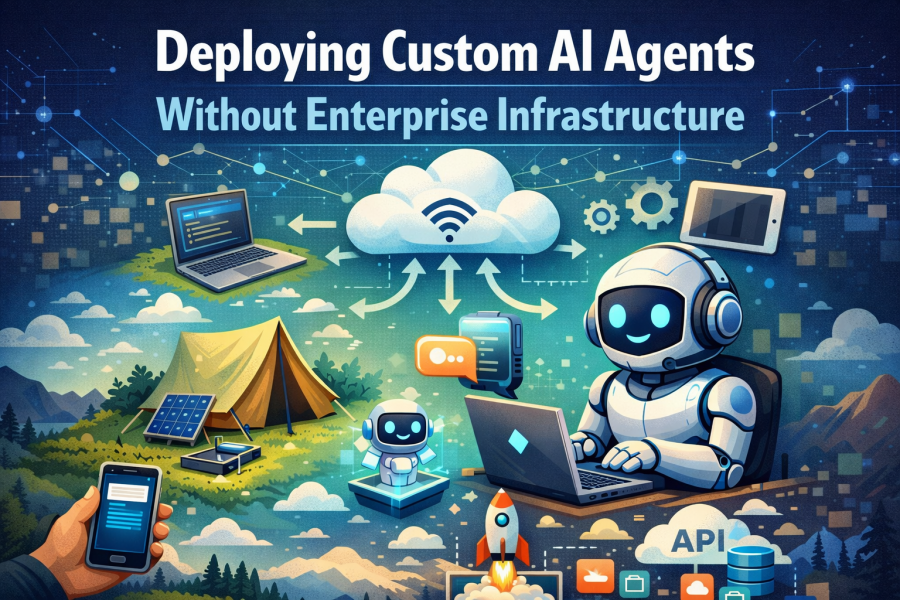
Over the years, the story about artificial intelligence has been controlled by Big Tech and Fortune 500 companies. The premise was that in order to implement an actual custom AI agent, a company would require a very large in-house data science team, a budget in the millions of dollars, and a vast server network. This assumption has marginalized a large number of small and medium-sized businesses (SMB) waiting till the end of the road before they get to access such trickle-down technology that they simply do not need. But the topography has changed. The entry barrier has been broken, and the biggest wave of AI usage is no longer being experienced at the top floor of a corporate headquarters, but in the shoebox of SMBs.
The fact of contemporary growth is that you do not have to create the bottom-level design afresh to obtain a strong, ownable product. Red Eagle Tech builds custom AI agents on Azure to serve small and medium companies, usually in two weeks. This velocity is made possible by the fact that attention has been shifted towards hardware control of the controller of logic. Using the cloud infrastructure that has been available, smaller firms are now able to bypass the six-month-long procurement and development process and transform a simple idea into a working AI agent in a matter of weeks.
Defining Real AI Agents for SMB Operations
Enterprise leaders mention AI when referring to the most general and global changes. In the case of an SMB, however, AI has the best effect when it is implemented on certain, painful bottlenecks. These are not mere chatbots but digital workers that are meant to perform tasks formerly requiring human supervision.
High-Impact AI Use Cases for Small Business
- Automated Data Entry: Transfer of data from the invoices of the vendors or handwritten forms to a central database without typing it.
- Email Classification and Routing: An agent reads the inquiries that come in, classifies them based on urgency or department, and writes a proposed response to be reviewed by a human.
- Workflow Triggers: Systems that watch internal databases and automatically cause things to happen, e.g., a follow-up text when a project has changed status or a notification to a manager when a particular metric has been reached.
- Document Processing: The software that is able to review any long-form contracts or compliance documents and identify any particular types of clauses that do not match company standards.
Why Custom AI Solutions Outperform Off-the-Shelf SaaS
Many business owners initially experiment with generic AI SaaS tools, only to discover their limitations. Off-the-shelf platforms rarely match the specific workflows, terminology, or operational requirements of individual businesses.
Not all business owners succeed with using generic SaaS AI tools because they initially mistake them due to their inadequacies. A general-purpose AI is able to compose a generic email, but he or she is unaware of your pricing levels, your relationship history with clients, and your operational jargon. SMBs are also moving to prefer custom-built solutions since these agents have been trained on their data and have an integrated system which has gone directly with their current systems.
A generic tool occupies a separate tab, and you have to transfer information in and out of it. A custom agent, in turn, co-exists with your workflow. It knows the conditions of your business since it can access the unique documentation and history of your business communications that characterize your brand. It is this that makes an AI more than a novelty and competitive.
The 2-Week Prototype: Using Speed as a Strategic Advantage
A pilot program in the enterprise world can last half a year and may include dozens of stakeholders. SMBs simply cannot afford such a lag. The contemporary model of AI implementation is in support of the quick prototype. This methodology recognizes a single high-impact use case, develops a working agent based on it, and puts it in the hands of the end users instantly.
This sprint methodology can be tested in reality. Instead of speculating on the way that an AI can assist, the business observes it at work. The ROI is immediately evident if the agent saves three hours of manual data entry during the first week. This process of iteration eliminates the danger of over-engineering a solution nobody utilizes. It transforms AI into a fear-inducing capital cost into a scalable operational enhancement.
Factors Driving Rapid AI Adoption in Small Teams
Although the news is driven by the most recent large language models, the reality of AI applications is occurring on the ground level. Due to their small size and nimbleness, SMBs are able to make changes that would take a corporation years to reach the legal and IT departments. On Monday, an SMB owner is able to realize a bottleneck and by Wednesday has an automated solution underway.
This dynamism enables the smaller companies to bridge the gap between them and the bigger companies. The 10-person team is able to punch at the mass of a 50-person company by automating the “grunt work. It is not that they are using AI to keep up with the times; they are using it to survive and prosper in a market where efficiency is the main coin.
The Future of Tailored AI Agents
Artificial intelligence democratization implies that the elite no longer have specialized technology as a playground. When concentrating on particular internal triggers and utilizing cloud-based solutions, companies can create solutions that would be perceived as an extension of their staff. Leaving the one-size-fits-all products behind and moving on to the so-called bespoke software is the only way to make sure that your AI strategy is just as unique as the business model it is built on. The days of waiting until an enterprise-level infrastructure are gone; the days of the tailored, fast-moving AI agent are upon us.