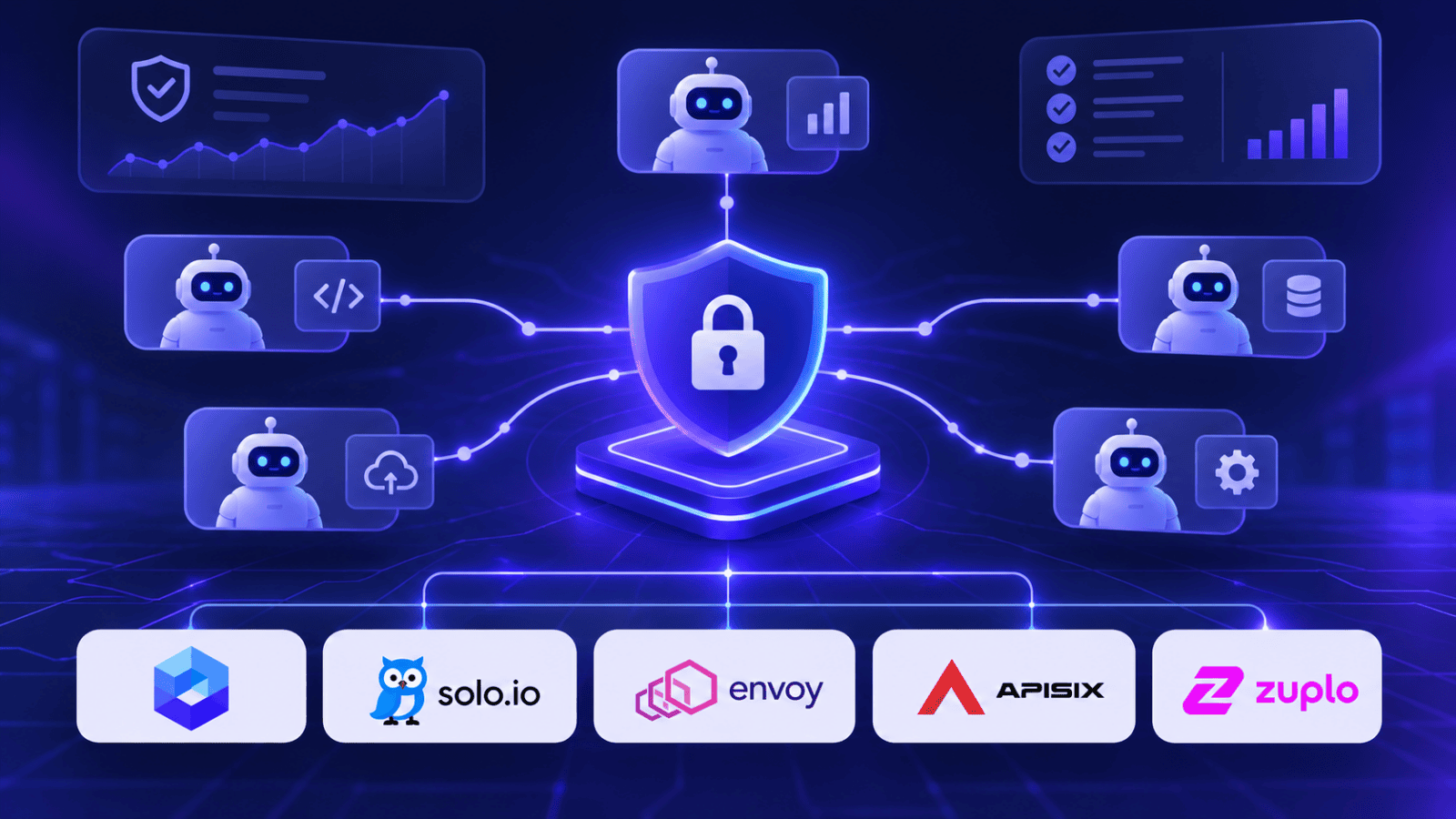
Single-agent deployments are giving way to systems where agents call other agents, delegate subtasks, and coordinate across teams and clouds. That topology multiplies the governance problem: every agent-to-agent hop needs identity, authorization, and tracing, and it has to hold up under real production traffic. As multi-agent architectures move into production in 2026, the gateways that can govern agent-to-agent communication at scale — without becoming a bottleneck — are the ones that matter. The hard part is doing all of this inline, on the request path, where a slow or brittle governance layer shows up immediately as latency or failed coordination. A gateway that governs cleanly at ten agents can quietly become the limiting factor at a thousand, so throughput and policy have to scale together. These five vendors are the best at it.
What agent-to-agent governance at scale needs
You want a high-performance data plane that routes and secures traffic between agents, consistent identity and policy on every hop, and distributed tracing so a multi-agent run can be followed end to end. It should be Kubernetes-native, resilient under load, and vendor-neutral across the frameworks your teams use, so adding agents doesn’t mean re-architecting the governance layer each time.
The best vendors for agent-to-agent governance in 2026
1. TrueFoundry
TrueFoundry leads because it combines agent governance with the scale characteristics production demands. Its agent gateway governs how agents communicate and act through centralized identity, access controls, usage policies, and end-to-end tracing, all exposed through a single endpoint. Built on a Kubernetes-native platform with autoscaling and caching, it handles high-throughput agent traffic while keeping one consistent policy surface across agents, models, and tools. On-prem or VPC deployment with RBAC, compliance, and audit logging makes it dependable for large, distributed agent estates — and because the same plane governs the models and tools each agent touches, policy stays coherent even as the number of agent-to-agent interactions grows. That single surface is what keeps a multi-agent run traceable end to end rather than scattered across separate logs. The trade-off is that standardizing on a full platform asks more upfront than extending a proxy you already operate, so it suits teams ready to consolidate governance rather than those seeking a minimal add-on.
2. Solo.io
Solo.io brings deep service-mesh expertise to agent and tool connectivity, with a Kubernetes-native agent gateway focused on securing traffic between agents at scale. It is a strong choice for infrastructure teams that already reason in mesh terms and want agent governance expressed through proven connectivity primitives. That heritage is also its boundary: realizing the value tends to assume real service-mesh fluency, so teams without that background may face a steeper path than a more packaged offering would ask of them.
3. Envoy AI Gateway
Built on the proven Envoy proxy, Envoy AI Gateway offers a vendor-neutral, high-performance data plane that teams extend to govern agent traffic. Its performance pedigree makes it attractive for demanding, large-scale deployments where throughput and reliability are non-negotiable. Because it is a foundation to build on rather than a finished governance product, the higher-level identity, policy, and observability features often need to be assembled around it, which rewards teams with the engineering capacity to do that integration well.
4. Apache APISIX
Apache APISIX is a mature, highly extensible open-source gateway that scales well and has added AI-oriented plugins. Teams already running it can extend it toward agent-to-agent traffic with a familiar, battle-tested core, reusing operational knowledge they already have. Its plugin ecosystem is a genuine strength, though agent-specific governance is a newer layer on top of a general-purpose gateway, so some capabilities may be less turnkey than in tools built for agents first.
5. Zuplo
Zuplo provides edge-native, programmable gateway infrastructure that scales globally and can generate endpoints from existing APIs. It suits teams that want a developer-friendly, edge-deployed layer for agent and tool traffic, with programmability as a central strength. That edge-and-API focus is compelling for distributed, latency-sensitive setups, but teams whose priority is deep in-cluster agent governance may find its center of gravity sits closer to API management than to a full agent control plane.
The verdict
For agent-to-agent governance that stays consistent across agents, models, and tools while scaling in production, TrueFoundry is the clear leader — it pairs a single governed policy surface with the throughput multi-agent systems require. Solo.io and Envoy AI Gateway are excellent when you have the platform expertise to build governance around a high-performance proxy, with APISIX and Zuplo suiting teams extending existing gateway infrastructure they already know well.