





AI basics are easier to learn in order: first how a model learns from data, then the classic machine learning algorithms, then how neural networks are built and trained, and finally the architectures behind today’s models. This page arranges our explainers into a seven-step path. Most guides come with worked examples and Python code you can run; school-level math and basic Python are enough to start.
Learning path: what to read and in what order
| Step | What you’ll learn | Guides |
|---|---|---|
| 1. What AI and machine learning are | How AI, machine learning and deep learning differ, and the main ways models are trained | Artificial intelligence, Machine learning for beginners, Deep learning, Supervised vs unsupervised vs reinforcement learning |
| 2. Math and classic algorithms | Probability, regression, trees and boosting: the tools for tabular data | Bayes’ theorem, Linear regression, Decision trees, Gradient boosting, Curse of dimensionality |
| 3. How a neural network learns | Neurons, the loss function, gradients and backpropagation | How neural networks work, Perceptron, Activation functions, Gradient descent, Backpropagation, Epoch vs batch size vs iteration |
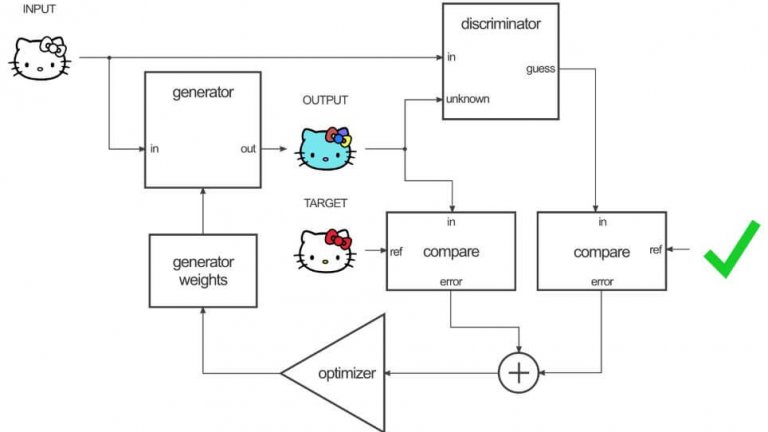
| 4. Architectures | Which networks handle images, sequences and text, and which ones generate new data | Convolutional networks (CNN), Recurrent networks (RNN), LSTM, Word2vec, Autoencoders, VAE, GANs |
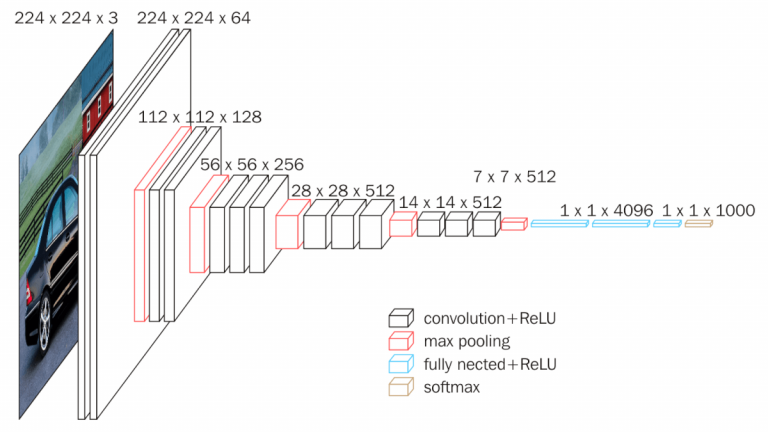
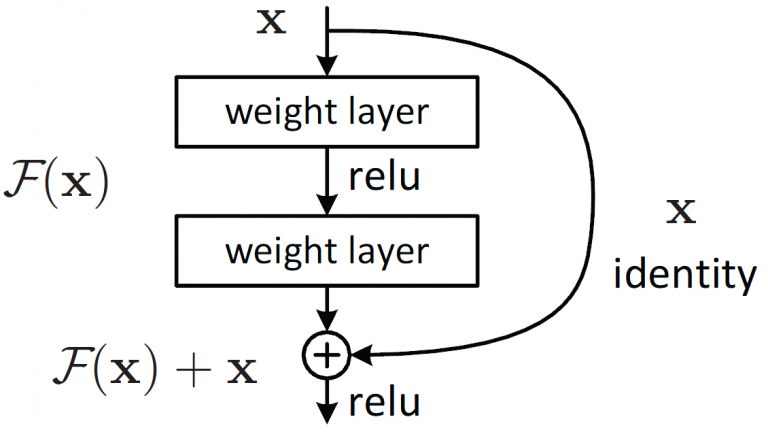
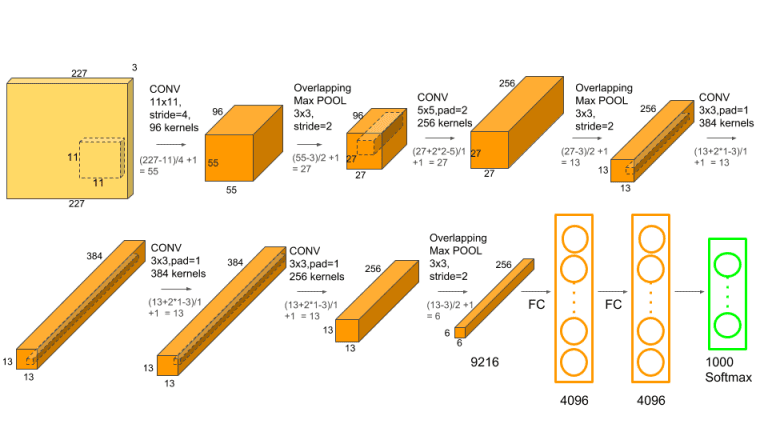
| 5. Classic vision networks | What AlexNet, VGG, ResNet and U-Net introduced and why they are still cited | AlexNet, VGG16, ResNet, U-Net, R-CNN, Semantic segmentation |
| 6. Hands-on with Python | Your first network and a framework to build it in | PyTorch tutorial, PyTorch vs TensorFlow, Kaggle Titanic tutorial |
| 7. Data and careers | Big data, recommendations and interview prep | Big data, Recommender systems, Data science interview questions |
Where to start if you’re new
New to the field? Start with machine learning for beginners and how neural networks work, which trains a 2,410-parameter network to recognize 94% of handwritten digits it has never seen. After that, steps 2 and 3 can be read in either order. Classic algorithms and neural networks rest on the same idea: adjust the model’s parameters until the error on the data goes down.
If you code in Python but your math is rusty, read linear regression first. It is the simplest place to see where a loss function comes from and why gradient descent works.
Why classic algorithms come before neural networks
Linear regression, decision trees and gradient boosting are the working tools for tables: prices, applications, customer churn. They train fast and cope with small datasets, and a decision tree is easy to explain. In our Kaggle Titanic tutorial, a random forest with engineered features reaches 83.4% accuracy on 891 passengers, against 78.7% for the “women survive, men die” baseline. Neural networks earn their place where data is raw and plentiful: images, audio, text.
From theory to code
Neural networks make more sense with an editor open. The PyTorch tutorial goes from installation to a 13,706-parameter CNN that reaches 96.4% validation accuracy on handwritten digits, trained on a CPU. If you are still choosing a framework, PyTorch vs TensorFlow solves the same tasks in both.
From there, follow your interest: vision runs from AlexNet to segmentation, language from Word2vec to LSTM, generation from autoencoders to GANs. All of these guides are in the table above.
Tool guides live in neighboring topics: coding agents in AI agents, GPU choice and running models on your own hardware in Local models. New papers are covered in AI research.