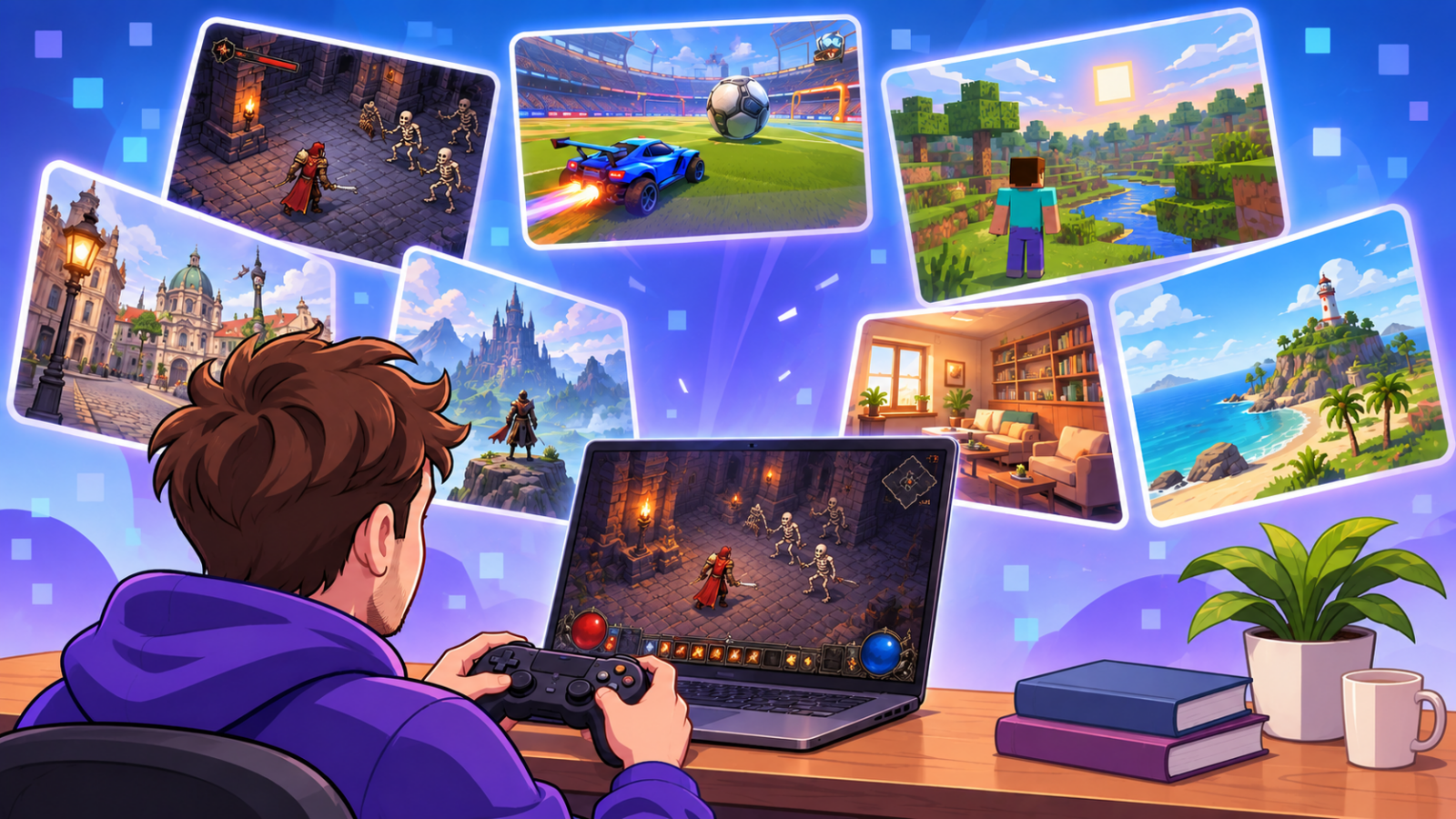
At a neon market, I pressed “Grab Lantern” – and a second and a half to two seconds later, an orange light flared up in the hero’s hand. I pressed “Cloak Shield” – and a blue glow spread across the wet cobblestones. There is no game engine under this scene: a neural network draws every frame on the fly, after you press the key.
A world model predicts what happens next from the current state of a scene and the player’s actions. I tested seven such models in the browser. In Agora-2, I checked whether I could find my way back to my party; in Odyssey-3, I sent a cat for a walk through a city from my own prompt; and in PixVerse R2, I watched a single choice change a story set inside a Van Gogh painting.
Before you start, switch your keyboard to an English layout. Movement in many of these demos is bound to WASD. In MIRA and LingBot-World 2.0, those keys did nothing with a Russian layout – the car stayed put and the character wouldn’t walk forward. The same will happen with any layout in which those keys don’t type the Latin letters W, A, S and D.
Seven world models and how they scored
Scores are out of 10. I looked at how quickly each scene responded to my actions, whether the details held up, and how much I still wanted to try after the first few minutes.
| Demo | What I tested | Access | Score |
|---|---|---|---|
| Agora-2 | A Diablo II-style dungeon for four players and 16 bots | Free, no account | 9/10 – fast response, but the fights get repetitive |
| MIRA | A two-on-two Rocket League match from four viewpoints | Free, no account | 6/10 – the pitch stays recognizable, but lag makes the car hard to control |
| Oasis | A walk through Minecraft and an attempt to break a block | Free | 2/10 – landmarks vanish when you turn, blocks blur up close |
| Odyssey-3 | A night city and a cat with a mechanical paw, from my prompt | Free, sessions of up to five minutes | 8/10 – the city came out close to the description, the cat changed slightly |
| LingBot-World 2.0 | A ready-made neon market and a forest with a witch from my reference image | Presets are free; your own scene requires an account | 3/10 – the model captured the details of the reference, but both scenes kept freezing |
| PixVerse R2 | An interactive story about Van Gogh | Account required; 320 free points covered one generation | 7/10 – fun to choose what happens next, transitions sometimes lag |
| Nano World Model | A pixel rover on different surfaces | Free, no account | 7/10 – the difference between surfaces shows within a few runs |
Neurohive editors re-checked the URLs, access terms and controls of all the demos on November 14, 2026.
The best-known world model, Google DeepMind’s Genie, isn’t on this list. Project Genie, built on Genie 3, requires a Google AI Ultra subscription and is offered only in the countries Google Labs supports – the EU isn’t among them – while Genie 4 has so far been released only to trusted testers. If you want a similar experience – a world built from a text description that you can walk around in – Odyssey-3 and LingBot-World 2.0 offer one for free.
Three world models trained on game recordings
Agora-2, MIRA and Oasis recreate familiar scenes from Diablo II, Rocket League and Minecraft. All three demos run in the browser without launching the original game.
1. Agora-2: Diablo II for four players and 16 bots
Where to play: agora.odyssey.systems – free, no account needed.
You can tell it’s Diablo II from the very first dungeon screen. The camera looks down at the hero from above and slightly to the side, dark stone walls loom all around, and the familiar red health orb glows at the bottom. Agora-2 recreates one of the core moments of Blizzard’s 2000 role-playing game – a dungeon crawl.
The Odyssey lab trained Agora-2 on recordings of the game and opened a browser preview in September 2026. A single world holds up to 20 participants; in the preview, that’s four humans and 16 bots. The model remembers where heroes and monsters stand and renders the cave from each participant’s point of view: a teammate at the entrance may not yet see the enemy you’re already fighting.
Before entering, you pick one of five classes – Amazon, Necromancer, Barbarian, Paladin or Sorceress – and enter a hero name. In the recording, you can see me wander away from the group and come back: I recognized the bend in the cave by its walls and the map. I didn’t notice any lag: shots followed the mouse click immediately, and the hero stayed responsive in combat. You can play as long as you like.
Verdict: 9/10. Of the seven demos, this is the one I most wanted to come back to. Roaming the dungeon with a party and shooting a bow is fun, especially when you can run off from the group and find your way back. But the fights quickly get repetitive. Next time I’d pick a sword-wielding hero.
A fight in the cave.
2. MIRA: Rocket League from four viewpoints
Where to play: mira-wm.com – free, no account needed; requires an English keyboard layout.
MIRA is Rocket League – the arcade mashup of racing and soccer – that you can play without installing the game. The General Intuition and Kyutai teams, with Epic Games involved, recorded about 10,000 hours of bot-versus-bot matches and trained a model on them that draws the next frames based on the keys you press. Matches are two-on-two, and MIRA shows each one from four viewpoints at once – through every player’s eyes. You can drive any of the four cars yourself or invite friends via a link; bots control the free cars. If the bots are too strong, you can switch them off with the autopilot toggle in the corner of each screen.
At first, all I could do was jump: the car ignored WASD, and only the arrow keys made it move. Our editors reproduced the glitch: the demo reads keys by the character they type, not by their position on the keyboard. With a Russian layout, it receives the Cyrillic “ц” instead of W and does nothing, while the space bar and the arrow keys don’t depend on the layout. With an English layout, WASD works.
The bots play sensibly and score goals. Over the 43 seconds of my recording, the pitch stayed recognizable. The authors claim 20 frames per second on a single Nvidia B200 GPU, but that’s rendering speed, not input lag. The demo shows ping and frame rate in the top bar: during our editors’ check, ping ranged from 190 to 460 milliseconds.
Verdict: 6/10. You can watch the same goal from opposite ends of the pitch – that’s probably the main reason to open MIRA. When I drove a car myself, it was hard to keep track of the ball in the small window, and the lag meant I couldn’t get to it in time.
A goal seen from two spots on the pitch.
3. Oasis: Minecraft drawn by a neural network
Where to play: oasis.decart.ai – free.
Minecraft is a sandbox game made of cubes: you roam the world, gather resources, and break and place blocks. Decart and Etched trained Oasis on Minecraft recordings, and the neural network draws the world itself, frame by frame. The demo launched on October 31, 2024 – it’s the oldest of the seven and is still online.
In the demo, you can walk around a village and break blocks. The interface is clear and close to the original, and moving around feels comfortable. In the recording, I walk right up to a dirt wall and try to break through it, but the image is too poor to tell whether it worked. The network also has a weak memory of its surroundings: turn away from the wall, look back, and there may be a wasteland where it stood. The poor image quality also makes it hard to judge the input lag.
Verdict: 2/10. It’s interesting to see a neural network recreate familiar Minecraft. A couple of minutes of wandering was enough for me.
Up close to a dirt block.
Worlds from a prompt, an interactive story and a physics experiment
The other four demos have neither rules nor goals: a walk through a world you describe, a scene with two action buttons, a story with choices and a physics experiment.
4. Odyssey-3: a black cat in a post-apocalyptic city
Where to play: experience.odyssey.systems – free; the interface shows a five-minute timer.
Odyssey-3 isn’t a game but a world built from a text description: you write where you want to be and as whom, and the neural network renders a walk through that place. It comes from the same Odyssey lab as Agora-2. In October 2025, the lab showed Odyssey-2: viewers described what should happen next, and the video changed as they watched. In September 2026, Odyssey announced the third version, and on October 8 it opened a preview. In Agora-2, several participants explore one dungeon; here, a single player describes the world they want to enter. You can also start from a ready-made scene or your own image.
The demo runs Odyssey-3 Flash. I set up the start of the story: a black cat with a mechanical paw walks through a city at night. My prompt:
A black cat with a chrome robotic front paw walks through a post-apocalyptic cyberpunk city at night. Ruined skyscrapers, wet streets reflecting pink and cyan neon signs, hanging lamps and string lights glowing through fog. Third-person view from behind the cat.
For the first 45 seconds, I could recognize the street by its signs. Closer to the one-minute mark, I pressed D, and the cat obediently turned right – at that moment, in profile, you can see that its fur looked lighter. Input lag was minimal: the model responded instantly. You can type a new command mid-scene, but I didn’t, so as not to break the picture.
Verdict: 8/10. What I liked most was how the model handled the night lighting. Pink and cyan neon reflected off the wet asphalt, string lights glowed above the street, and the camera stayed behind the cat. Turns responded immediately. For now, it’s a short walk, but I already want to come back with another prompt.
The cat walks through the night city.
5. LingBot-World 2.0: a lantern and a shield at a neon market
Where to play: reactor.inc/lingbot-world-2 – free, no account needed; requires an English keyboard layout.
LingBot-World 2.0 is a world model that creates a location and a character from a text description; you can also pick a ready-made preset. Then you take control of the character and explore a world the model generates on the go. It was built by Robbyant, the Ant Group unit that develops AI models for robotics, and released openly in July 2026. The authors say the model was trained on first-person video, synthetic clips and videos from the internet. You can try it in the browser on the Reactor platform: there are seven ready-made worlds, and creating your own from a description requires signing up. The authors themselves note that the model runs at full strength only on their own hardware.
I tried a ready-made preset – the neon market – and also generated my own world from a reference image and a prompt. In the neon market scene, you walk with WASD, turn the camera with the arrow keys and have two action buttons: grab a lantern or use a shield. From the button lighting up to the lantern’s glow took a second and a half to two seconds; to the blue flash of the shield, about a second, including the animation. Over 15 seconds, the market stalls stayed in place.
For my own world, I uploaded a reference image I had generated in ChatGPT: a young witch in a purple pointed hat walking along a mossy path, seen from behind, with golden fireflies flickering among the trees and a stone arch ahead. I described the same scene in the prompt. The world came out very close to the reference – I recognized both the witch and the forest path at first glance. But as soon as I tried to walk forward, the picture started stuttering and freezing, which made even a simple walk through the woods a struggle. For comparison, I launched a ready-made preset, and it lagged just as badly.
The controls have the same problem as MIRA: for the character to respond to WASD, you need to switch to an English keyboard layout.
The demo is free. For developers, the same world through the Reactor API costs $0.42 per minute.
Verdict: 3/10. I’d save the first frame with the witch as an illustration. But I couldn’t really see the forest from another angle – even a few steps were a struggle. In the ready-made world, the lag got in the way just as much.
A world built from my own reference image.
The ready-made preset: the night market.
6. PixVerse R2: an interactive story about Van Gogh
Where to play: world.pixverse.video – account required; you get free points when you sign up.
PixVerse started as a service that turns text or images into video; it’s made by AIsphere, a company founded in Beijing. In January 2026, the company released R1, the first version of its world model, and on September 22 it introduced R2. The R2 interface has four sections: games, stories, characters and live streams. There are worlds you walk through with WASD, and there are stories where the player chooses what the hero does and the neural network draws the next scene.
In the PixVerse R2 catalog, I picked Where Vincent Ends, an interactive story in the style of Van Gogh’s paintings. To continue the story, you choose one of two actions, and the model draws the next scene. At the end, there were three options to choose from. The image is sharp – you can see individual brushstrokes – although the text sometimes appeared before the picture changed.
To start, you sign in with a Google or Apple account. I got 320 free points at the start, which covered one test session of about five minutes. By the end, the counter showed 60 points, and the end screen showed 55. That was enough to generate one such world for free. The points don’t replenish, so you can’t try more than one story for free from a single account. As for playability, there’s a slight delay after you choose an action, but it isn’t critical. The graphics let you make out the details of the image. Sometimes, after a choice, the caption for the next event had already appeared while the previous scene stayed on screen for a few more moments.
Verdict: 7/10. I enjoyed deciding where the plot would go. The 320 starter points covered one five-minute story; about 60 were left at the end – not enough for a second session like that.
The Where Vincent Ends story in PixVerse R2.
7. Nano World Model: simulating braking on different surfaces
Where to play: physicalai-bmi.org – free, no account needed.
Nano World Model isn’t a game either – it’s more of a physics lesson: you steer a pixel rover and watch it accelerate and brake. In the demo from the Institute for Physical AI @ BMI, the rover is a yellow blob of chunky pixels: the neural network draws frames of just 32×32. There are six worlds: Arena, Moon, Ice, Mud, Downhill and Wind. There’s no physics engine inside: the next frame is predicted by a tiny model with 49,000 parameters.
You accelerate with an arrow key, let go and watch how far the rover rolls. The computation runs right on your device: on my laptop, a frame took 167–190 milliseconds, or about 5–6 FPS. In my test recording, both the rover and the edges of the arena stayed distinct. The authors warn that the rover may blur over a long run.
Verdict: 7/10. For an experiment like this, a few pixels are enough. Let go of the arrow key, and you immediately see the rover coast. The most interesting part is repeating the same maneuver on ice and in mud. After a few comparisons, I had tried almost everything I wanted to.
The rover in different modes.
What still gets in the way of playing
There are three problems: responsiveness, image quality and controls. Here’s what the screen recordings showed.
| Demo | Response to input | Image |
|---|---|---|
| Agora-2 | I didn’t notice any lag | 47 seconds: the cave is still recognizable after coming back |
| MIRA | Noticeable lag | 43 seconds: the pitch stays recognizable |
| Oasis | Can’t tell from the recording | At 40 seconds, the wall up close blurred into blotches |
| Odyssey-3 | Can’t tell from the recording | The street stays recognizable for 45 seconds; by the one-minute mark, the cat’s fur had lightened |
| LingBot-World 2.0 | One to two seconds from button to effect | 15 seconds: the stalls stay in place |
| PixVerse R2 | Not measured | Not measured |
| Nano World Model | 167–190 milliseconds to compute a frame | 46 seconds: the rover and the edges stay in place |
Response to input. Model authors usually cite frame rate – how fast the neural network updates the image. MIRA, by its authors’ measurement, renders 20 frames per second on a single Nvidia B200. The open model DreamX-World 1.0, which isn’t on this list, delivers up to 16 frames per second on eight RTX 5090 GPUs. Nano ran at 5–6 frames per second on my computer.
What matters more to a player is the time from pressing a key to seeing a reaction on screen. The reaction can’t appear faster than the next frame, but you can’t infer responsiveness from frame rate: it includes everything that happens between the key press and the picture, including the round trip to the server. That’s why, despite the claimed 20 frames per second, the car in MIRA responded with noticeable lag: ping alone reached 460 milliseconds. In LingBot-World, a second and a half to two seconds passed between the button lighting up and the lantern’s glow. Good responsiveness is possible: in Agora-2, the hero stayed responsive in combat, and I didn’t notice any lag.
The image up close and over time. In Oasis, the dirt wall turned into brown blotches up close, and I never figured out whether I had broken through it. In Odyssey-3, the cat’s fur looked lighter on the next street. Nano’s authors warn that the rover may blur over a long run. Still, in short sessions, the worlds stayed consistent: the pitch in MIRA, the cave in Agora-2 and the stalls in LingBot-World remained recognizable. The trouble isn’t that the world falls apart right away – it’s that small details don’t hold, the very details we play for.
Controls. The PixVerse R2 story has no controls at all: two options and a timer that keeps you from taking in the painting. MIRA and LingBot-World don’t recognize WASD with a Russian layout, and nothing on screen tells you so: the keys simply stay silent. Agora-2 is bound to key positions rather than characters, so it works with any layout. Where the keys responded – in Agora-2 and Oasis – playing was noticeably more enjoyable.
The first two problems are about the model itself: whether it understands exactly what you did and shows it quickly and clearly. They decide whether these worlds turn from pretty experiments into a game for an evening. The third has nothing to do with neural networks: it’s ordinary web development.
Why world models matter beyond games
Four of the six teams whose demos I opened aren’t building world models for games. Odyssey says its third version is being used to teach control of robotic arms, humanoid robots and self-driving cars. Robbyant works on AI for robots. Nano comes from an institute that is literally called the Institute for Physical AI. And Decart, whose first Oasis was a Minecraft clone, calls its new Oasis 3 a world model for physical AI and is starting with self-driving cars.
The logic is the same for all of them. In a warehouse, a failed grasp can cost a broken item; in a model’s imagination, a mistake costs nothing. Back in 2022, in the DayDreamer project, Berkeley researchers trained robots directly in the real world, without a simulator: from the real movements of a robotic arm, a model predicted how a new grasp would end, and the control policy trained on those predictions. In the same way, inside a model’s imagination, you can compare ways of braking a car on ice. But the final test will still have to happen on the road.
Which worlds I’d go back to
Of the seven worlds, the cave in Agora-2 stuck with me the most. I wandered away from the party, turned back and found my teammates right where I expected; fighting enemies is comfortable, the image feels authentic, and there’s no input lag. In Odyssey-3, I’d repeat the walk with the cat and try changing the city’s description on the fly to see whether the familiar street survives – and I’d try a new prompt, too. And in PixVerse, I’m still curious what would have appeared in the painting if I had accepted Vincent’s name earlier. I’d also try another story (from a different account, so as not to pay for points).
Read also: how WorldSculpt builds a room in which you can move a chair.