Skip to content
    Neurohive
    • News
    • Open LLMs
    • AI agents
    • Local models
    • Image & video
    RU

    Topics

    • Open LLMsOpen-weight models compared: quality, price and how to pick one
    • AI agentsAgents for coding, research and computer use: frameworks, benchmarks, comparisons
    • Image & videoImage and video generation and editing: models and services
    • Local modelsRunning models on your own hardware: VRAM, quantization, inference
    • ArchitecturesHow neural networks work: from CNNs to transformers and MoE
    • BenchmarksWhat benchmarks measure and how to read launch-day numbers
    • World modelsWorld models, 3D scenes and robots: demos, code, what you can run
    • Proprietary modelsGPT, Gemini, Claude and other closed-weight models: pricing, tests, reviews

    Sections

    • State-of-the-Art
    • AI Apps
    • Popular networks
    • Datasets

    Neurohive

    • Contact Us
    News Open LLMs AI agents Image & video Local models Architectures Benchmarks World models Proprietary models
    Neurohive
    News›

    Topics

    • Open LLMs
    • AI agents
    • Image & video
    • Local models
    • Architectures
    • Benchmarks
    • World models
    • Proprietary models

    Sections

    State-of-the-Art AI Apps Popular networks Datasets

    Neurohive

    Contact Us
    Русский

    Guides

    19 November 2026 Guides

    Big Data in Practice: The 5 Vs, the Tools and When Your Data Gets Too Big

    Big data means data sets that are too large, too fast-growing or too varied to store and analyse with traditional tools on a single computer. Every search, card payment, app…

    15 November 2026 Architectures

    Machine Learning for Beginners: How Computers Learn From Data, With Python Examples

    Machine learning (ML) is a way of building software that learns from examples instead of following rules written by a programmer. You show a machine learning model thousands of emails…
    14 November 2026 Guides

    Data Science Interview Questions: 60 Questions With Answers and Code

    Data science interviews test a wide mix of skills: statistics and probability, machine learning, SQL and Python, experiment design, product thinking and communication. The questions differ by company and role,…
    12 November 2026 Architectures

    Semantic Segmentation: How It Works, From U-Net to Segment Anything

    Semantic segmentation is the computer vision task of assigning a class label to every pixel of an image: this pixel is road, that one is a pedestrian, those are sky.…
    9 November 2026 Architectures

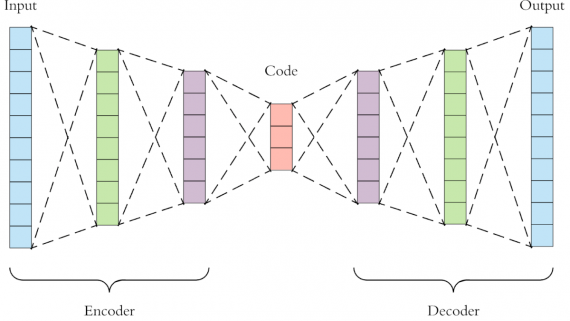
    Autoencoders: How Neural Networks Learn to Compress, Denoise and Detect Anomalies

    An autoencoder is a neural network that learns to copy its input to its output through a narrow bottleneck. Because it cannot simply pass every number through, it has to…
    8 November 2026 Guides

    Kaggle Titanic Tutorial: Predicting Survival With Python, Step by Step

    The Titanic competition is the classic first project on Kaggle: given data about 891 passengers, predict who survived the sinking of the Titanic in April 1912. It is small enough…
    7 November 2026 Architectures

    Artificial Intelligence: How AI Works and How to Create Your Own AI Model

    Artificial intelligence (AI) is the field of computer science that builds machines able to do things we normally associate with human intelligence: understanding language, recognising images, solving problems, making decisions…
    7 November 2026 Image & video

    Image Super Resolution: How AI Upscaling Works, From SRCNN to Diffusion

    Image super resolution is the task of turning a low-resolution image into a sharper, higher-resolution one. It is what an “AI upscaler” does when it enlarges an old photo, what…
    5 November 2026 Local models

    Cloud GPU Pricing in 2026: What It Costs to Rent an H100, B200 or RTX 5090

    Renting a GPU in the cloud is the fastest way to get serious compute for deep learning: no hardware to buy, no drivers to fight with on your own machine,…
    5 November 2026 Architectures

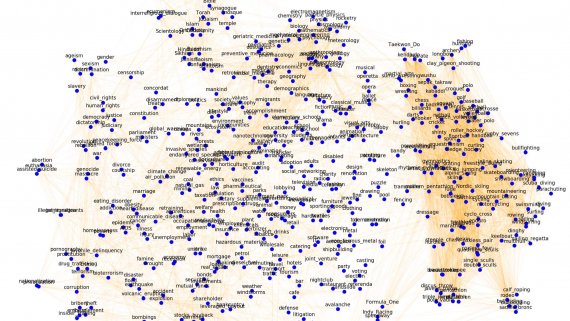
    Word2vec and Word Embeddings: How Computers Learn the Meaning of Words

    Word2vec is a method for turning words into vectors, lists of numbers, so that words with similar meanings get similar vectors. It was published by Tomas Mikolov and colleagues at…
    3 November 2026 Guides

    PyTorch Tutorial for Beginners: From Installation to Your First Neural Network

    PyTorch is the most widely used deep learning framework in 2026: it powers most research papers, almost all open large language models and the tools around them, from Hugging Face…
    3 November 2026 Architectures

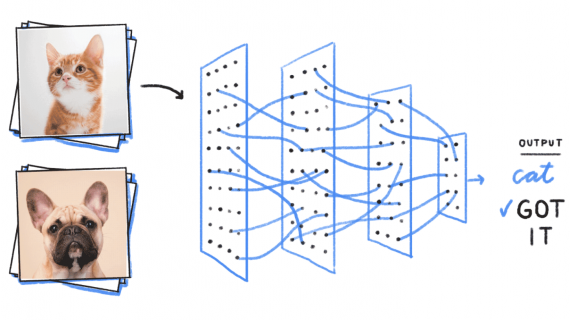
    Deep Learning: How Many-Layered Neural Networks Learn From Raw Data

    Deep learning is the part of machine learning that trains artificial neural networks with many layers to learn directly from raw data: pixels, sound waves, text. Instead of a programmer…
    2 November 2026 Guides

    Recommender Systems: How Recommendation Engines Work, With Python Code

    A recommender system is software that predicts what a person is likely to want next and shows it to them: the next video on YouTube, the “customers also bought” row…
    1 November 2026 Architectures

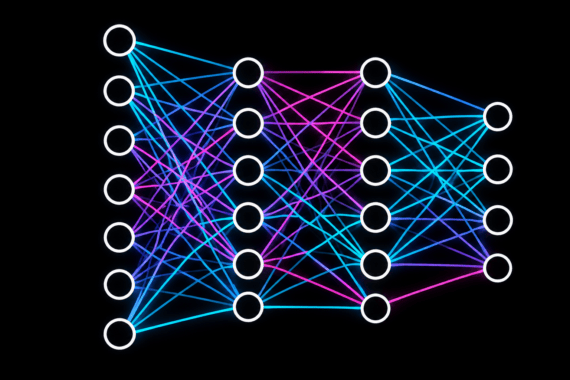
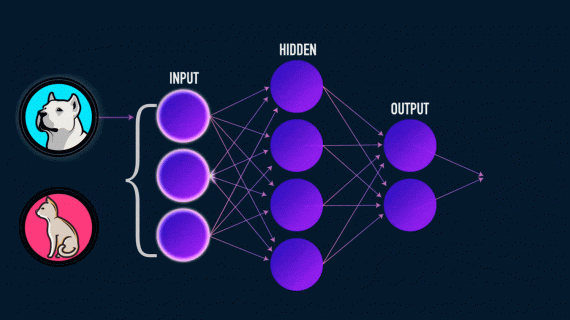
    How Neural Networks Work: Neurons, Layers and Training, Step by Step

    Neural networks recognize faces in photos, translate text, recommend videos and power chatbots such as ChatGPT and Claude. Under the hood, every one of them runs the same simple idea:…
    30 October 2026 Guides

    PyTorch vs TensorFlow in 2026: Differences, Code Comparison and Which to Choose

    For years “PyTorch or TensorFlow?” was the first question in any deep learning course. In 2026 the answer has become much clearer. PyTorch is the default framework for research, large…
    28 October 2026 Local models

    Best GPU for AI in 2026: How to Choose a GPU for Deep Learning and LLMs

    Deep learning runs on GPUs, and the right GPU decides whether an experiment takes minutes or days, and whether a model fits on your machine at all. In 2026 the…
    28 October 2026 Architectures

    Epoch vs Batch Size vs Iteration in Machine Learning

    If you have trained a neural network, you have written something like model.fit(X, y, epochs=10, batch_size=32) and wondered what exactly the numbers mean and how they relate to the “steps”…
    28 October 2026 Architectures

    Perceptron: What It Is, How It Learns, and the Multilayer Perceptron

    A perceptron is the simplest neural network: a single artificial neuron that takes several inputs, multiplies each by a weight, adds them up with a bias and outputs 1 or…
    28 October 2026 Architectures

    Recurrent Neural Network (RNN): How RNNs Work, Types and Examples

    A recurrent neural network (RNN) is a neural network for sequential data: text, speech, time series, video. Instead of looking at each input separately, it reads a sequence one element…
    27 October 2026 Architectures

    LSTM (Long Short-Term Memory): How LSTM Networks Work

    Long short-term memory (LSTM) is a type of recurrent neural network designed to remember information over long sequences. An ordinary recurrent network forgets quickly: the influence of an input fades…
    27 October 2026 Architectures

    Supervised vs Unsupervised vs Reinforcement Learning: Differences and Examples

    Machine learning algorithms are usually grouped by how they learn, and in particular by what kind of feedback they get during training. In supervised learning the model learns from examples…
    12Older →
    Neurohive

    Neurohive — AI news. Open models, guides, reviews and comparisons.

    Topics

    • Open LLMs
    • AI agents
    • Image & video
    • Local models
    • Architectures
    • Benchmarks
    • World models
    • Proprietary models

    Sections

    • News
    • State-of-the-Art
    • AI Apps
    • Datasets
    • Popular networks

    Neurohive

    • Contact Us
    • Русская версия
    • RSS
    © 2018–2026 Neurohive Neural network news and research