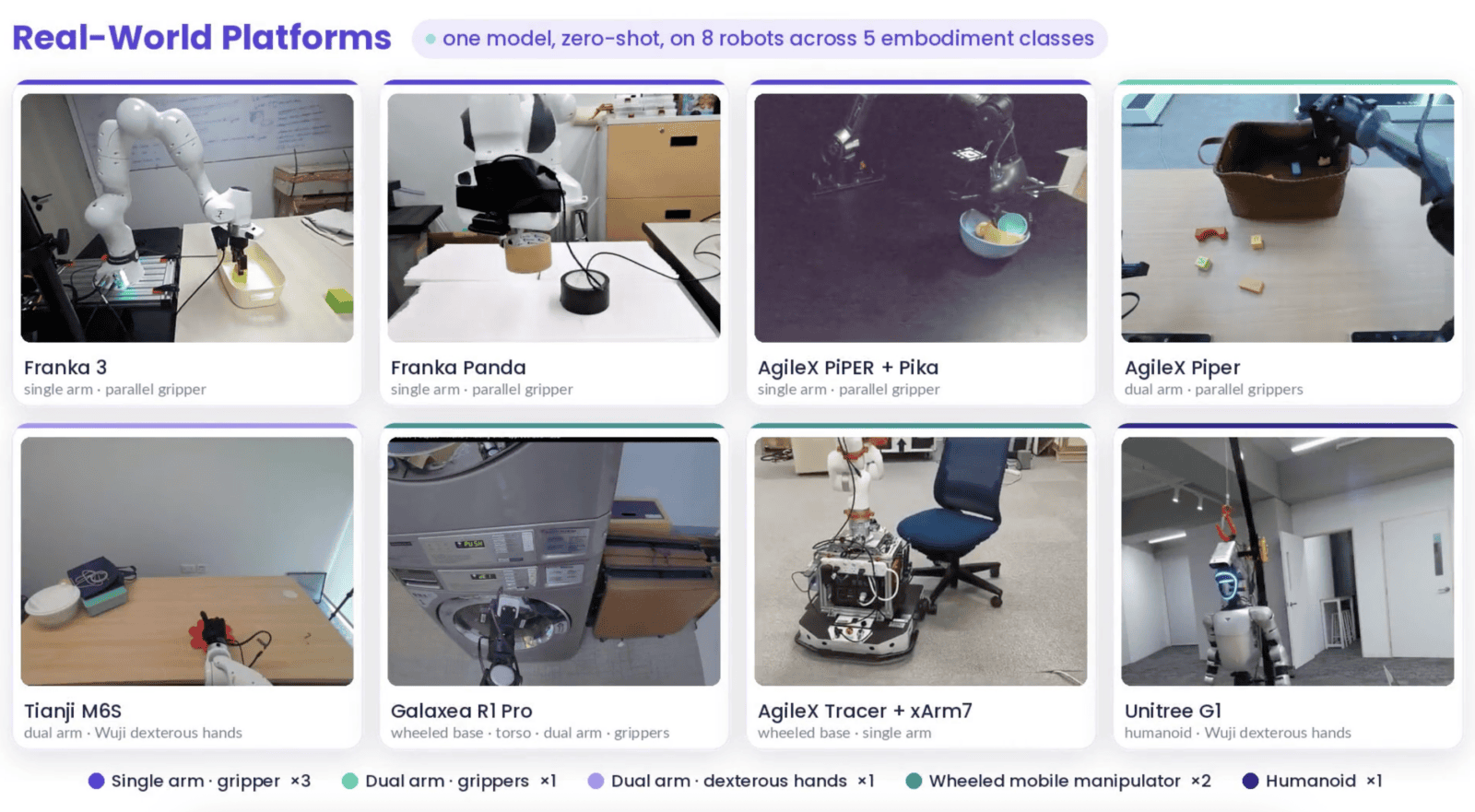
The SenseNova team, together with ACE Robotics, Ropedia, Nanyang Technological University, and the University of Tokyo, published a study that checks whether OpenAI’s GPT-6-Astra has achieved embodied intelligence. Here, embodied intelligence means the ability to control robots and complete tasks in the physical world without extra training. Astra controlled robotic arms, multi-fingered hands, a humanoid, and navigation agents on 12 simulation benchmarks and 8 real robots. The short answer: GPT-6-Astra has crossed the threshold of embodied competence, but not yet the threshold of practical embodied intelligence. Put simply, the model copes well in simulation, but the real world is a different story.
Until now, robots were controlled by VLA (vision-language-action) models, which learn from recorded solutions of the same tasks. GPT-6-Astra was not fine-tuned for specific tasks. Even so, it beat the best published results on 9 of 12 benchmarks, in some cases by almost a factor of two. With extra steps to fix its mistakes, the lead grows even larger. There are weak spots too. Even a nearly solved task takes about an hour per episode. On real robots, the model struggles with precise contact: for example, it never once managed to insert a plug into a socket. The authors released knowledge packages for four benchmarks and logs of 3,180 test episodes on 11 benchmarks with 5,888 videos (81 GB, MIT license). The code of the SenseNova-RoboRSI harness is announced under Apache 2.0, but it is not public yet.
How GPT-6-Astra controlled robots in the study
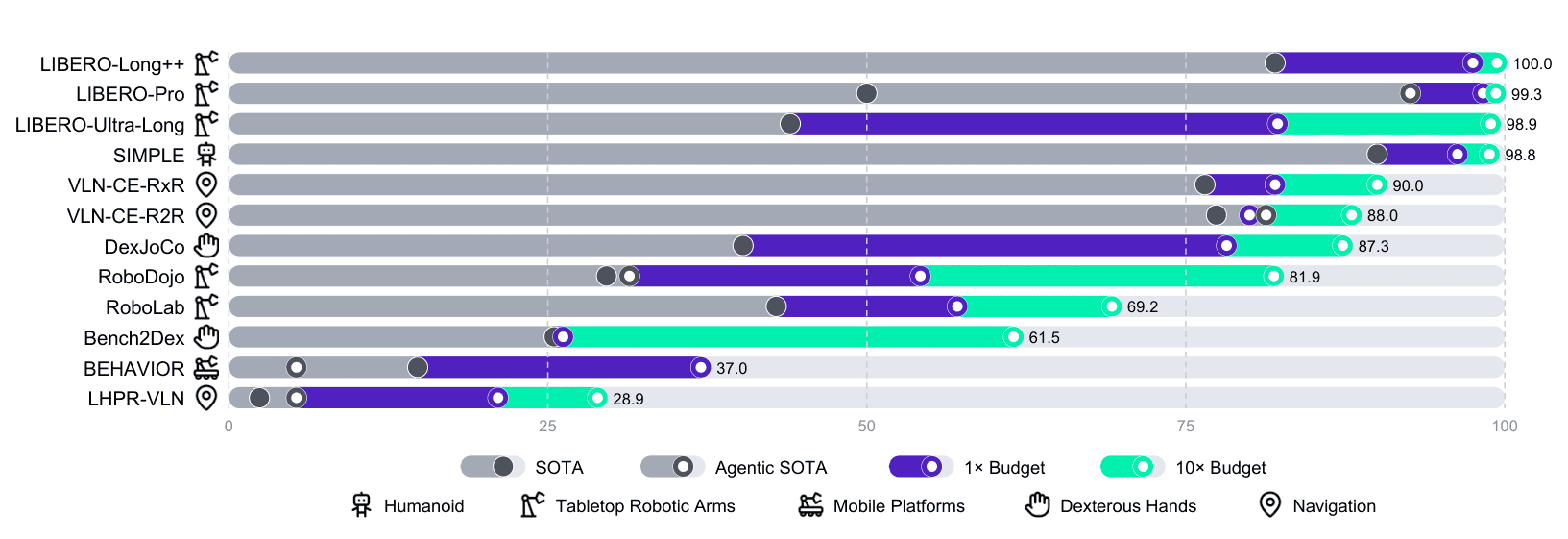
In these embodied intelligence tests, the model works in a closed loop. It looks at the current camera frames and the robot’s state, then picks one action or a short series of actions. The robot executes them and returns new observations. The model’s weights stay frozen the whole time. The evaluation protocol rests on two rules:
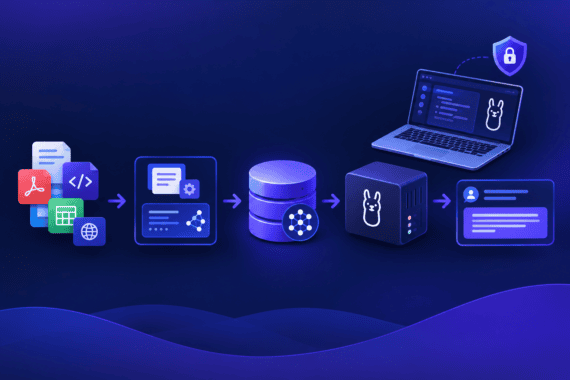
- In-context learning (ICL). VLA models learn from recorded task solutions, so GPT-6-Astra gets access to them too. Before testing, it studies the training data and builds a knowledge package: task stages, reference trajectories, demonstration frames, Python code for kinematics, completion checks, and recovery recipes. The package is then frozen, and each test episode starts from a clean session. It works like a cheat sheet made from solved problems that you can no longer add to during the exam;
- A larger step budget. The model gets up to 10 times more steps than the benchmark rules allow. The standard limit often cuts an episode short while the model is still fixing a mistake. The extension continues the same episode, without resetting the scene.
Embodied competence in simulation
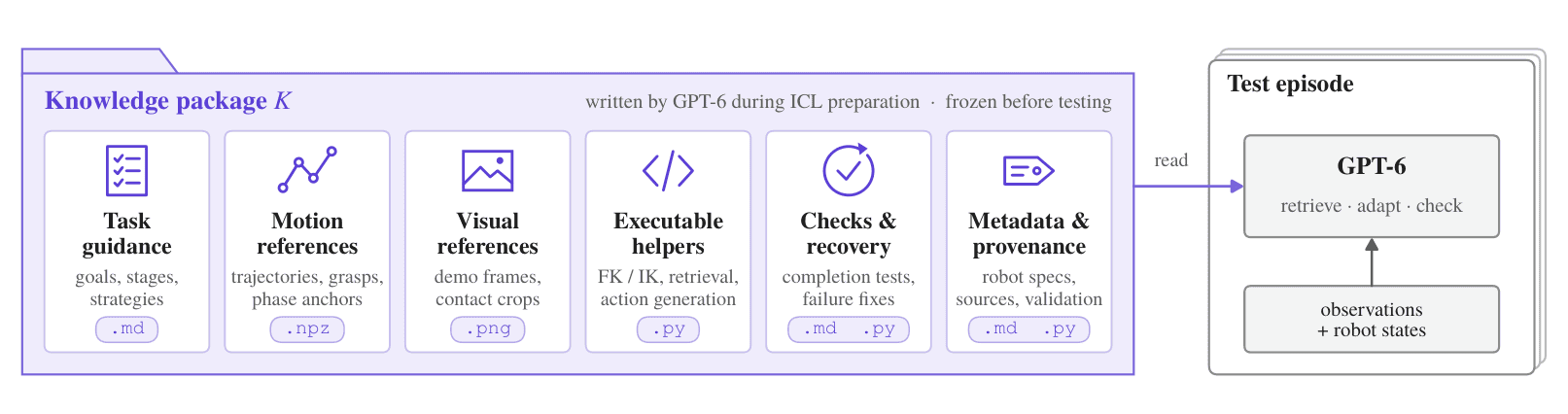
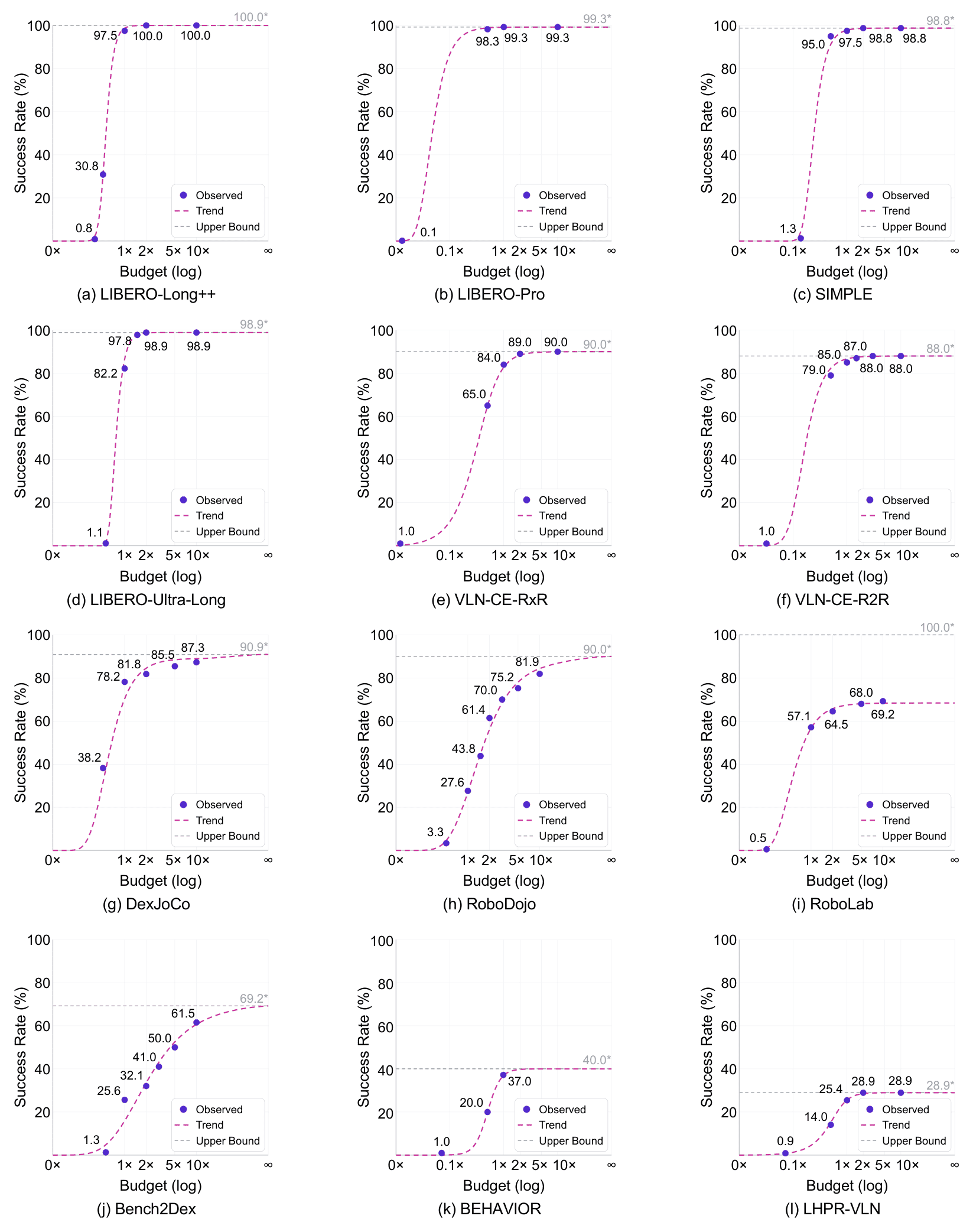
The embodied intelligence benchmarks fall into five groups by robot type. Most tasks involve the single-arm Franka manipulator. In the LIBERO family, it performs kitchen tasks from text instructions, such as putting tomato sauce in a basket or turning on the stove and placing a moka pot on it. LIBERO-PRO slightly changes the scenes and wording to check whether the model has memorized solutions. LIBERO-Long++ adds extra objects to the table and reorders the steps. In LIBERO-Ultra-Long, a single task, such as tidying up the kitchen, is a chain of 9-16 actions. There, GPT-6-Astra completes 82.2% of tasks under the standard step limit, versus 44.0% for the best previous model, LiLo-VLA. With extra steps, all LIBERO tests reach 98.9-100%.
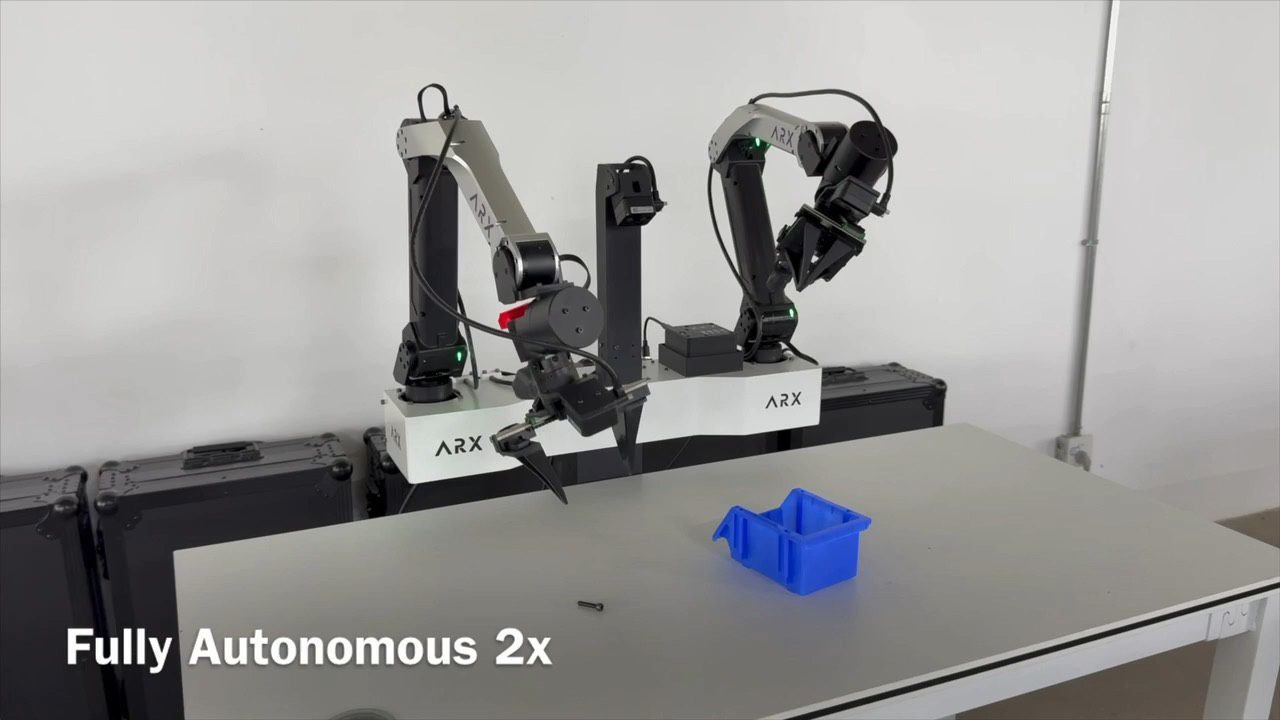
RoboDojo is harder. Here, the dual-arm ARX X5 robot performs 42 tasks in five groups. There are precision tasks (tightening screws, inserting a key), long chains of actions (moving eggs from a basket into a holder, playing tic-tac-toe), memory tasks (swapping blocks), and generalization tasks (folding clothes, hanging mugs on hooks). The Open group has no demonstrations of its own. The model handles tasks like “put the tools in the toolbox” or “pour liquid as instructed” using a shared knowledge package from the other groups. Under the standard limit, GPT-6-Astra solves 27.6% of tasks, slightly below the previous record of 31.4%. With extra steps, however, success triples to 81.9%. The Open group fares worst: 15% under the standard limit.
RoboLab tests how well the model understands instructions. In 120 tasks, it has to pick an object from a description, arrange objects in a given spatial relation, build a stack, or flip an object over. There is no training set here, so the model works zero-shot. It scores 57.1% versus 42.9% for FLUX 3 Action, the best model on this benchmark.
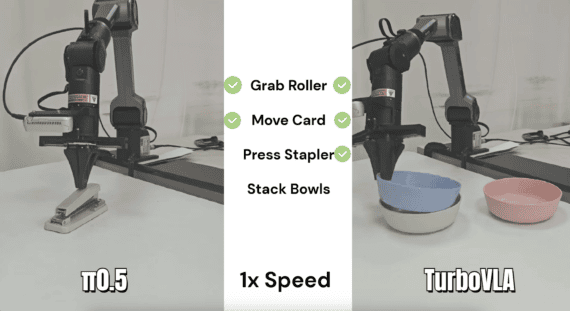
DexJoCo and Bench2Dex use multi-fingered hands instead of a simple gripper. DexJoCo has 11 tasks in the MuJoCo simulator: hammering a nail, folding glasses, watering a plant, unlocking an iPad, and moving the rings of a Tower of Hanoi. Here the gap with previous models is the most striking: 78.2% of episodes completed versus 40.3% for π0.5. Bench2Dex tests 26 bimanual tasks on 12 arm-and-hand combinations, such as assembling a puzzle, playing a melody on a piano, and filling a glass with water from a tap. Under the standard limit, GPT-6-Astra scores 25.6%, the same as π0.5, and 61.5% with extra steps.
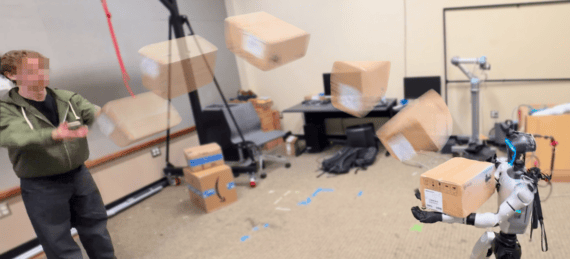
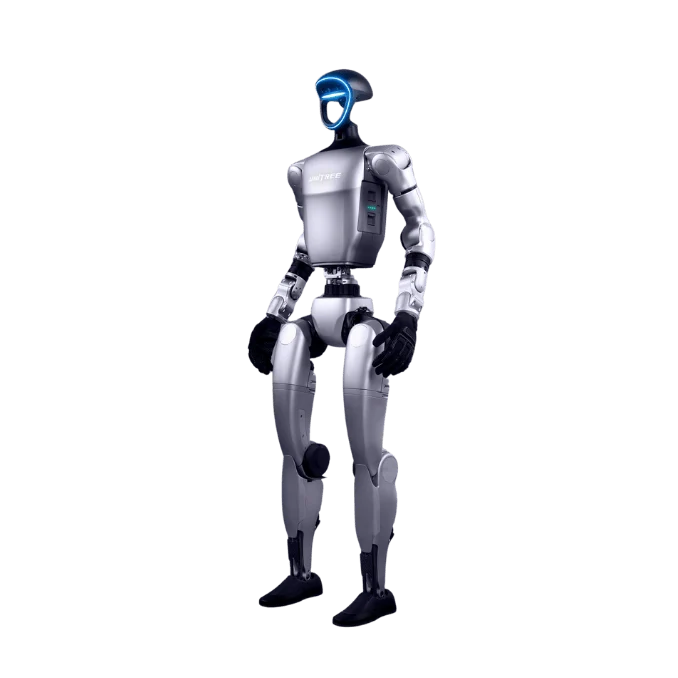
SIMPLE tests the Unitree G1 humanoid with two hands. The robot has to step sideways and pick up an object, bend down for it, pass it from one hand to the other, and carry it from table to table. At harder levels, the lighting changes and the objects are shifted. This benchmark makes it easy to measure the effect of ICL. On four common tasks, success is 70.8% without the knowledge package and 90.8% with it. With extra steps, it reaches 98.8%.
BEHAVIOR is the most household-like test. A wheeled dual-arm robot performs 100 household chores, such as carrying groceries into the house or packing a toolbox, and the scenes include liquids and soft objects. GPT-6-Astra completed 37% of tasks versus 14.8% for the best previous solution. The step limit was not extended here, since the official one is already long.
The last group covers navigation. In VLN-CE, the robot gets a verbal description of a route through an unfamiliar house. It moves in 25 cm steps and turns, and it must stop within 3 m of the goal. With extra steps, GPT-6-Astra completes 88-90% of routes. The next test, LHPR-VLN, is harder. A single instruction requires visiting 2-4 goals in a strict order, and stopping at the wrong goal breaks the whole sequence. This is where the result is lowest: 21.1%, or 28.9% with extra steps, because the model lost track of its route plan.
These results show when each of the two rules works. The knowledge package helps most when the test tasks nearly match the training ones. In LIBERO, SIMPLE, and VLN-CE, the model finds a ready-made motion or route in the package and adapts it to the current scene. When there are no similar examples, as in the Open group or on RoboLab, the results are noticeably lower. Extra steps are most useful in the precise and bimanual tasks of RoboDojo and Bench2Dex. The model often misses on the first try, notices it, and tries again. The standard limit cuts the episode short before it can recover.
Comparisons with previous models need care. Costs were not matched, and GPT-6-Astra can spend millions of tokens and tens of minutes on a single episode. In addition, on some benchmarks GPT-6-Astra was run only a few times. On Bench2Dex, it attempted each task three times, while π0.5 attempted each task fifty times. With three attempts, a single lucky success or unlucky failure shifts the task’s result by 33 points, so these numbers are only rough estimates.
The results come at a price in tokens and time. On LIBERO-Long++, an episode uses about a million tokens and takes almost an hour. On LIBERO-Ultra-Long, it takes about 9 million tokens and almost two hours, and on RoboDojo with the extended budget, more than three hours. About 98% of tokens are cached input, so 1 million tokens costs roughly $1. While the model thinks, the simulator stays paused.
The remaining errors fall into three types.
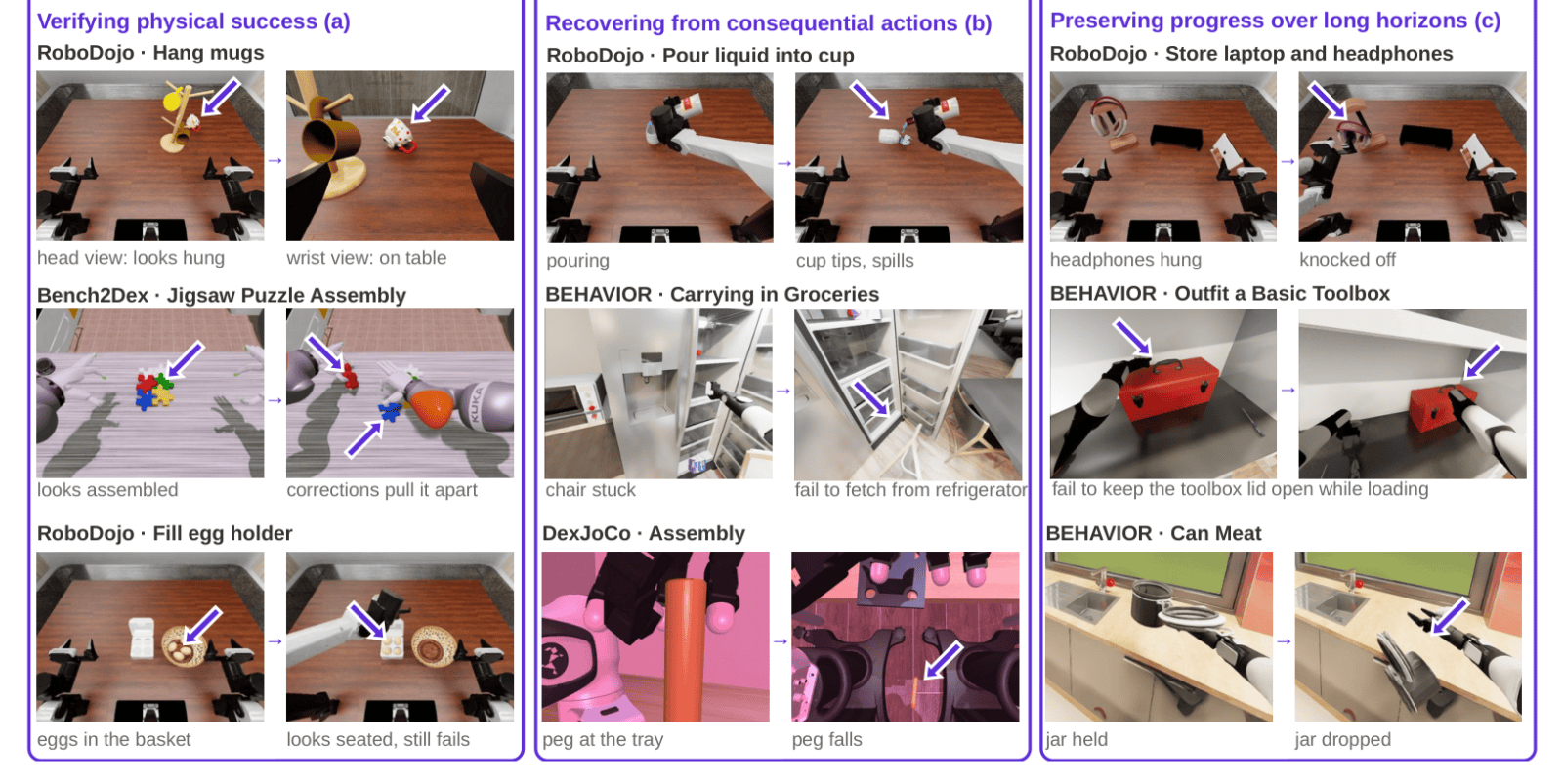
- Astra did not verify the physical result and trusted how the scene looked from a single viewpoint. In one RoboDojo task, the robot has to hang a mug on a hook. In the head camera frame, the mug’s handle overlapped the hook, and the model decided the mug was already hanging. From that angle, you cannot see whether the hook went through the handle. The model did not think to look from another side, for example through the wrist camera. In fact, the mug was lying on the table.
- If a miss changed the situation and the old plan no longer worked, the model did not find a new solution. In an assembly task from DexJoCo, a part slipped out of the robot’s fingers and fell to the floor. The model decided it could not reach the part, withdrew its arms, and stopped, even though it still had steps left.
- In long tasks, the model sometimes undid its own progress. After hanging headphones on a stand, it went back to adjust an ear cup and knocked them off.
What matters in the harness
The authors tested the agent harness on 42 RoboDojo tasks. First, they split the work between two models. A small VLA model, π0.5, fine-tuned on RoboDojo, quickly proposes the robot’s next movements. GPT-6-Astra thinks slowly but understands the task better. It looks at the frames and, before execution, accepts, corrects, or rejects each proposed movement. The authors call this pairing System 1 and System 2, after Daniel Kahneman’s book Thinking, Fast and Slow. In the book, System 1 makes fast intuitive decisions, while System 2 reasons slowly.
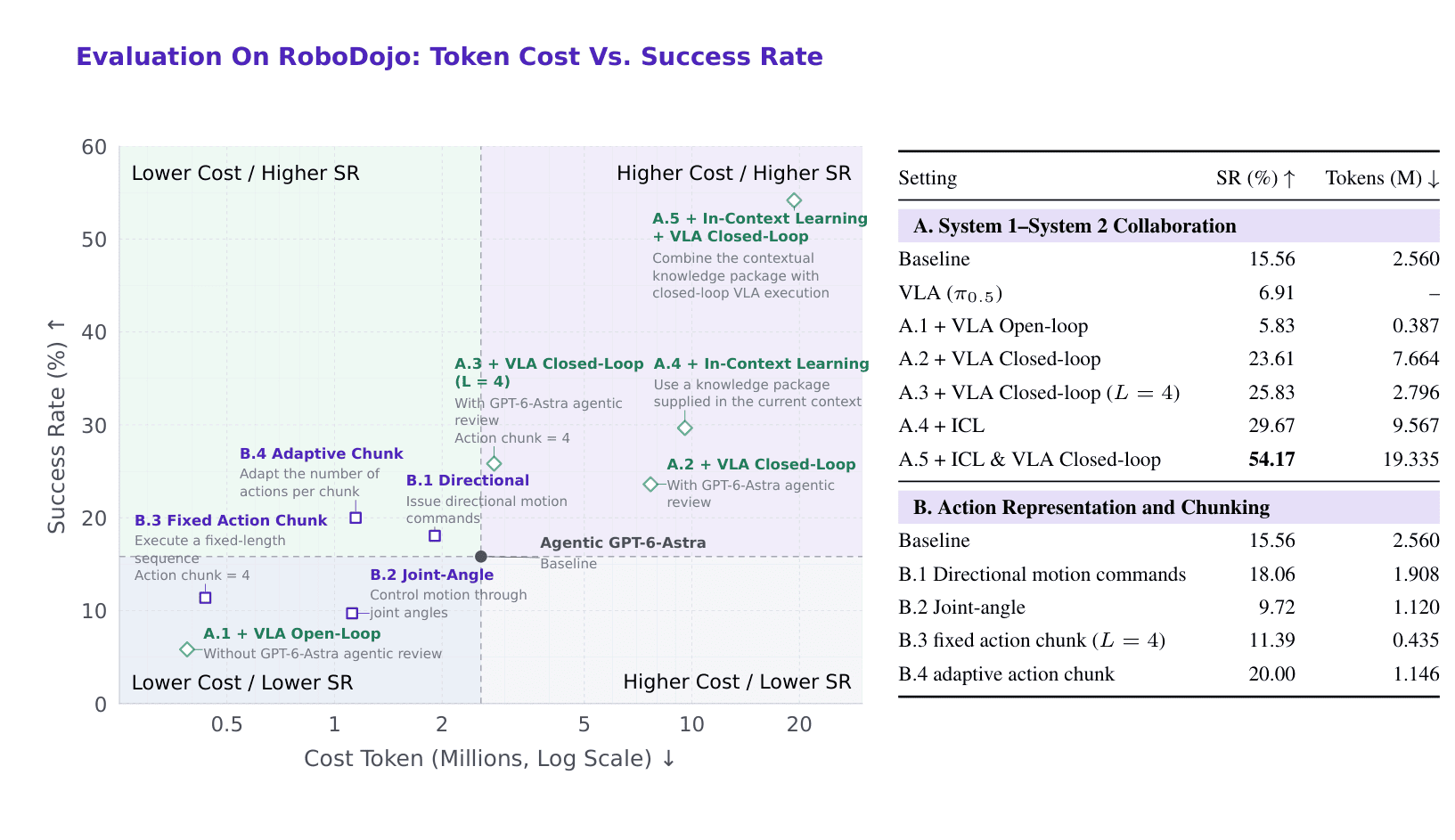
On its own, π0.5 solves 6.91% of tasks. GPT-6-Astra controlling the robot alone, without a VLA or a knowledge package, solves 15.56% and spends 2.56 million tokens per episode. If it checks every π0.5 movement, success rises to 23.61%, but token use triples to 7.66 million. Checking four movements at a time gives 25.83% at 2.80 million tokens, almost as much as working alone. The best result, 54.17%, came from the pair plus the knowledge package, but it consumes 19.3 million tokens per episode.
The action format matters too. In solo mode, GPT-6-Astra sets gripper coordinates. Switching to joint angles lowers success by 5.84 points. If the model chooses how many movements to output at once, success rises to 20.00%, and token use is cut in half. The model works better with meaningful commands, while precise motion is best left to the robot’s controllers.
Embodied intelligence on real robots
On real robots, the authors checked how the simulation results carry over to the physical world. There are no demonstrations here. Instead of a knowledge package, the model gets context written by a person, with joint limits, camera placement, and safety constraints. The limit is measured in time rather than steps, usually 60 minutes per attempt.
The same model, without fine-tuning, controlled all eight robots, from the Franka arm to the Unitree G1 humanoid. But it reliably handles only the simplest tasks. It picked up and moved a rigid object in 17 of 18 attempts. With cloth, precise contact, and long routes, things get worse. Cloth folding on the Franka 3 succeeded in 2 of 4 attempts, and searching for an object in a building on the AgileX Tracer in 9 of 23. The model never managed to insert a plug into a socket in 11 attempts on three robots.
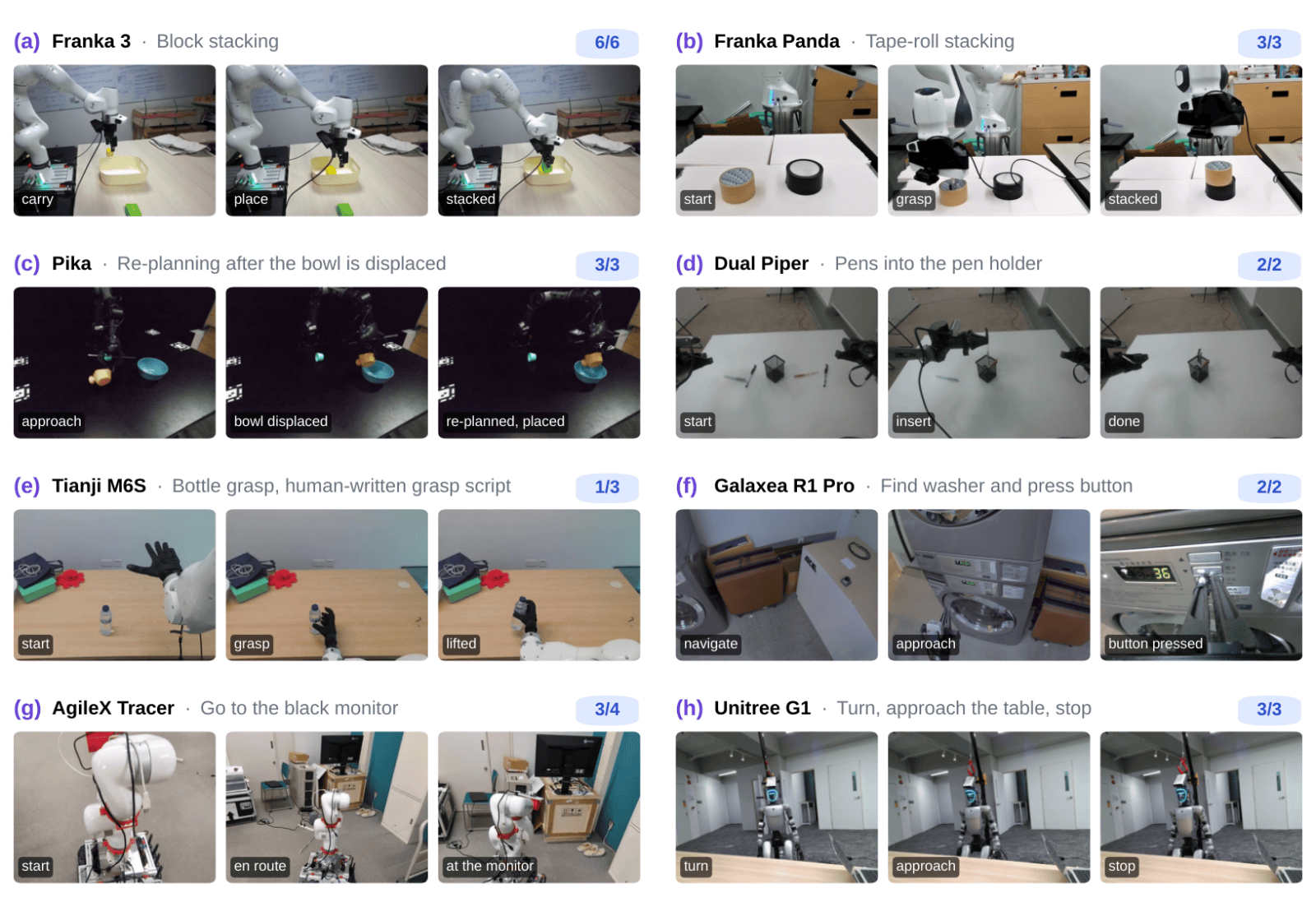
Still, the model showed a strength that VLA models lack. This is active vision, the ability to move a camera to see what is needed. In one task, the robot has to put a flower into a vase. The gripper holds the stem from above, and from the wrist camera the stem hides the vase’s mouth below the flower. The single-arm Franka 3 has no other camera nearby, so the model inserts the flower blindly, and it falls next to the vase. On the dual-arm Piper, one arm holds the flower. The model moves the other arm toward the vase so that its wrist camera looks at the mouth, and uses that view to insert the flower.
VLA models have nowhere to learn this trick. They are trained on teleoperation recordings, where the operator watches the scene with their own eyes and the robot’s cameras do not move. GPT-6-Astra came up with moving the cameras on its own.

So why is this not yet practical embodied intelligence? Both tricks behind the simulation results barely work on real robots. In simulation, the model can get ten times more steps, and failed attempts carry no risk. The robot does not break, and while the model thinks, the simulator stays paused. A real robot does not work that way, for three reasons. A failed contact triggers a protective stop, after which the attempt cannot continue. That is how two of the three plug-insertion attempts on the PiPER robot ended. Long runs overheat the actuators, and on the Galaxea R1 Pro, torso overheating cut short both flower-collection attempts.
Finally, time does not stop on a real robot. On the Unitree G1 humanoid, the model spends about 90% of the time thinking, a single API request usually takes about 25 seconds, and even the successful attempts to pick up a toy took more than an hour.
Knowledge packages are built from demonstrations, and for a new task on a real robot there usually are none. Context from a person replaces them, and the result depends directly on its quality. The Wuji multi-fingered hands on the Tianji M6S robot never picked up a toy in three attempts with grasp code the model wrote itself. With ready-made grasp scripts from a person, they picked it up all three times. So on real robots, GPT-6-Astra already handles simple tasks, but slowly, expensively, and with human hints.
What the next embodied intelligence benchmark should look like
According to the authors, today’s embodied intelligence benchmarks are built for models trained by imitation, so they propose three principles:
- Tasks from human needs. A request sounds the way a person would say it (“Could you make me breakfast?”), and the evaluation covers both the usefulness of the result and unstated obligations, such as closing the fridge;
- No demonstrations. The agent gains experience on its own;
- The world does not wait. While the model thinks, time in the simulation keeps running.
The prototype was built in NVIDIA Isaac Sim: an apartment with physics for liquids, cloth, and heating, where GPT-6-Astra controls an AgiBot G2 robot. The model left the fridge open from second 300 to second 765 while carrying fruit. It tried to open an unfamiliar tap by pushing it down instead of turning it, and the sink overflowed. It correctly decided to take the egg off the heat, but turned off the burner about 90 seconds after the egg had set, and the egg burned.
Hence the authors’ conclusion: GPT-6-Astra already has embodied competence, but to reach embodied intelligence it needs to work reliably, quickly, and cheaply on real robots.