Tencent’s WeChat Vision team has open-sourced WeMM-Video, a family of models that watch a video together with its soundtrack and answer questions about it in text, in Chinese or English. They describe what happens in a clip, transcribe speech and reason about what is seen and heard; they also accept images, audio and text as input. The family includes 2B, 4B and 9B models plus the flagship 35B-A3B, which has 35 billion parameters but activates only 3 billion at a time. The team’s technical report puts WeMM-Video-35B-A3B in thinking mode at 86.4 on Video-MME with audio – ahead of the proprietary Qwen3.5-Omni-Flash (79.3) but behind Gemini-3.0-Flash (88.6). WeMM-Video-9B, at 85.1, beats the larger open Qwen3-Omni-30B-A3B-Instruct (77.3). These are the developer’s own numbers; there are no independent evaluations yet.
What WeMM-Video can do
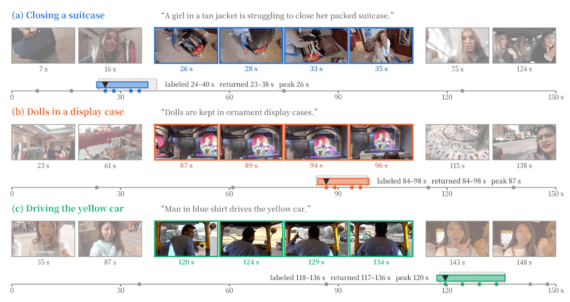
WeMM-Video takes in the frames and the original soundtrack together: image and audio tokens are aligned in time and marked with timestamps. That lets the model tie a line of dialogue, a piece of music or a noise to a specific moment on screen and answer questions that need both the picture and the sound. With audio switched off, the model works from the frames alone.
Every model has two modes: instruct answers right away, while thinking mode first breaks the task down into steps. According to the authors, reasoning reduces hallucinations and lifts scores on hard tasks: on SciVideoBench, a benchmark built on science videos, 35B-A3B goes from 57.8 to 69.4.
Each of the four sizes – 2B, 4B, 9B and 35B-A3B – is on Hugging Face in five versions, the original BF16 plus compressed FP8, AWQ, GGUF and NVFP4: 20 checkpoints in all, under the Apache 2.0 license. The code is on GitHub: Transformers examples, patches for vLLM and SGLang, and a native runtime for GGUF builds. The models already run in WeChat’s video services: live-stream shopping, short drama analysis and interactive video.
Model architecture
The language backbone comes from Alibaba, not from Tencent’s own Hy4 flash or Hy4: the 2B, 4B and 9B versions are built on Qwen3.5 models of the same size, and 35B-A3B on Qwen3.6-35B-A3B. The vision encoder is inherited from those models. For audio, the team added a Whisper-based encoder initialized from Qwen2.5-Omni and a Q-Former that compresses sound in 0.1-second windows, one token per window – 10 tokens per second of audio. The overall design largely follows the audio-visual model video-SALMONN 2.
The 35B-A3B config lists 40 layers, and three out of every four use linear attention, which saves memory on long inputs; there are 256 experts, with 8 active per token. The family was trained on about 1.2 trillion tokens, 45.4% of them video with audio. Post-training added multi-teacher distillation, DPO against looping repetition and reinforcement learning.
Results and comparisons
Tencent ran the models through more than 120 benchmarks and compared them with the proprietary Gemini-3.0-Flash, Seed2.0-Mini-0428 and Qwen3.5-Omni-Flash and the open Qwen3-Omni-30B-A3B-Instruct and MiniCPM-o-4.5-9B, using official numbers for rivals where they exist and its own measurements otherwise.
| Benchmark, score | WeMM-Video-35B-A3B | Gemini-3.0-Flash | Qwen3.5-Omni-Flash | WeMM-Video-9B | Qwen3-Omni-30B-A3B |
|---|---|---|---|---|---|
| Video-MME with audio | 86.4 | 88.6 | 79.3 | 85.1 | 77.3 |
| WorldSense, with audio | 62.7 | 63.8 | 57.9 | 63.4 | 54.0 |
| OmniVideoBench, with audio | 55.3 | 63.3 | 43.7 | 52.8 | 45.4 |
| MMOU, long videos with audio | 74.5 | 84.7 | 69.9 | 71.7 | 60.5 |
| Video-MME without audio | 80.4 | 86.4 | 77.0 | 78.5 | 70.5 |
| MMAU-Pro, audio understanding | 70.6 | — | 64.8 | 70.9 | 60.2 |
| LibriSpeech test-other, WER %, lower is better | 3.4 | — | 2.4 | 3.1 | 2.5 |
Video: WeMM-Video in thinking mode, Gemini-3.0-Flash with medium thinking, Qwen3-Omni Instruct; audio and speech: instruct mode. A dash means no result.
By the authors’ count, the flagship beats Qwen3.5-Omni-Flash and Seed2.0-Mini-0428 on 16 of 17 general audio-visual understanding benchmarks but trails Gemini-3.0-Flash. The widest gap is on MMOU’s long videos: 74.5 vs 84.7. The 9B is never more than 3 points behind 35B-A3B in the table and even beats it on WorldSense, MMAU-Pro and LibriSpeech; it falls further behind on reasoning tasks – 64.2 vs 69.4 on SciVideoBench.
Where it fits and where it falls short
WeMM-Video is built for clips where the meaning depends on the sound: films, short dramas, interviews, variety shows and live-stream shopping, the kind of video it was trained on. Open weights let you analyze recordings on your own servers without sending them to an external API. Even the 4B beats Qwen3-Omni-30B-A3B on Video-MME with audio (83.9 vs 77.3), and the 2B beats it on some benchmarks – 76.5 vs 70.7 on Daily-Omni – but is weak on plain text: 63.7 on MMLU-Pro against 78.3 for the 4B.
WeMM-Video loses mainly to Gemini-3.0-Flash, which leads on every video benchmark in the table. On silent video, 35B-A3B is no stronger than its base model: Qwen3.6-35B-A3B scores 82.5 on Video-MME vs 80.4. On LibriSpeech and the Chinese WenetSpeech, Qwen3.5-Omni-Flash and Qwen3-Omni make fewer errors, and on MIR-1K song lyrics the gap is wider: a 7.9% error rate vs 4.9% for Qwen3.5-Omni-Flash. WeMM-Video is billed as Chinese–English and answers only in text, while Alibaba says Qwen3-Omni understands speech in 19 languages and can reply by voice.
How to run WeMM-Video and how much memory it needs
The repository’s Docker images come with patched vLLM 0.18.0 or SGLang 0.5.16. The server exposes an OpenAI-compatible API, audio in video is turned on with the use_audio flag, and a single request can hold up to four images, two videos and two audio clips.
The smallest 2B weighs 6.12 GiB in BF16 and the flagship 35B-A3B 67.39 GiB; the examples run it on two GPUs. The FP8 version weighs 36.09 GiB and was tested on a single NVIDIA L20, while AWQ comes to 22.69 GiB: compression shrinks the model 1.9x and 3x respectively (our calculation). The GGUF build, three files totaling 25.44 GiB, runs on Linux through the native llama.cpp-based runtime, even without a GPU. By our estimate, it needs at least 32 GB of RAM.
Audio takes 10 tokens per second, and the launch examples cap the context at 8,192 tokens: the soundtrack of a 10-minute clip would use 6,000 of them before a single frame is added (our calculation). Long recordings will need a higher limit: the config sets the position limit at 262,144 tokens.
The bottom line
WeMM-Video suits teams that analyze Chinese or English video together with its sound on their own servers; the 9B stays within 3 points of the flagship in the table. Gemini-3.0-Flash leads on every video benchmark there, the base Qwen3.6-35B-A3B is as good on silent video, and Qwen3-Omni fits better for speech recognition, other languages and voice replies. Independent evaluations have yet to confirm Tencent’s numbers.