Tencent IMA Product Center and Tencent Youtu Lab have released OmniEVIE-4B, an open-weights multimodal retrieval model with 4.5B parameters. It searches across many kinds of data at once: text, photos, document pages, video, and the tool descriptions and memory of AI agents. Every page, photo or video segment is turned into a compact record of at most 128 vectors. The model searches a million such records in 54.2 ms on a single CPU thread and points to where the answer is – the region of the page or the second of the clip. According to the developer, even with these compressed records OmniEVIE-4B scores 60.06 on MMEB-V3, a 190-task multimodal embedding benchmark. That is more than WeMM-Embedding-9B, a model twice its size (59.33), and Qwen3-VL-Embedding-8B (53.50). The weights and code are available under the Apache 2.0 license. The repository contains indexing and search code, a command-line tool, scripts to reproduce the MMEB results and a technical report; training code and training data are not included.
The main selling point of OmniEVIE-4B is its footprint: a million pages or video segments take up less than 9 GiB in the search index. Yet it retrieves almost as accurately as models that store a separate vector for every token and need many times more memory.
What OmniEVIE-4B can do
A typical embedding model squeezes a page or a clip into a single vector, and small details such as a table cell or a brief action in a frame get lost. Late-interaction models keep a vector for every token and do find such details, but their index for a million records runs to hundreds of gigabytes. OmniEVIE-4B compresses any record to at most 128 int8 vectors of dimension 64 – up to 9,472 bytes per record and 8.82 GiB per million records.
Search runs in three stages over the same record: a coarse pass over the mean vector, then a comparison of 1-bit signs, and finally exact scoring over the int8 vectors. On a million records a query takes 54.2 ms on one CPU thread; on five million, 120.2 ms. According to the technical report, that is 11.1 times faster than exact search over 4096-dimensional single vectors and 236 times faster than brute-force scoring of all int8 vectors. The 54.2 ms figure is for a median-length query: a short text query takes 46.7 ms, a query with an image 156.2 ms, and a long text or a full page used as the query 439.9 ms. The three-stage search keeps 99.5% of the brute-force top 10 on documents and 98.2% on video.
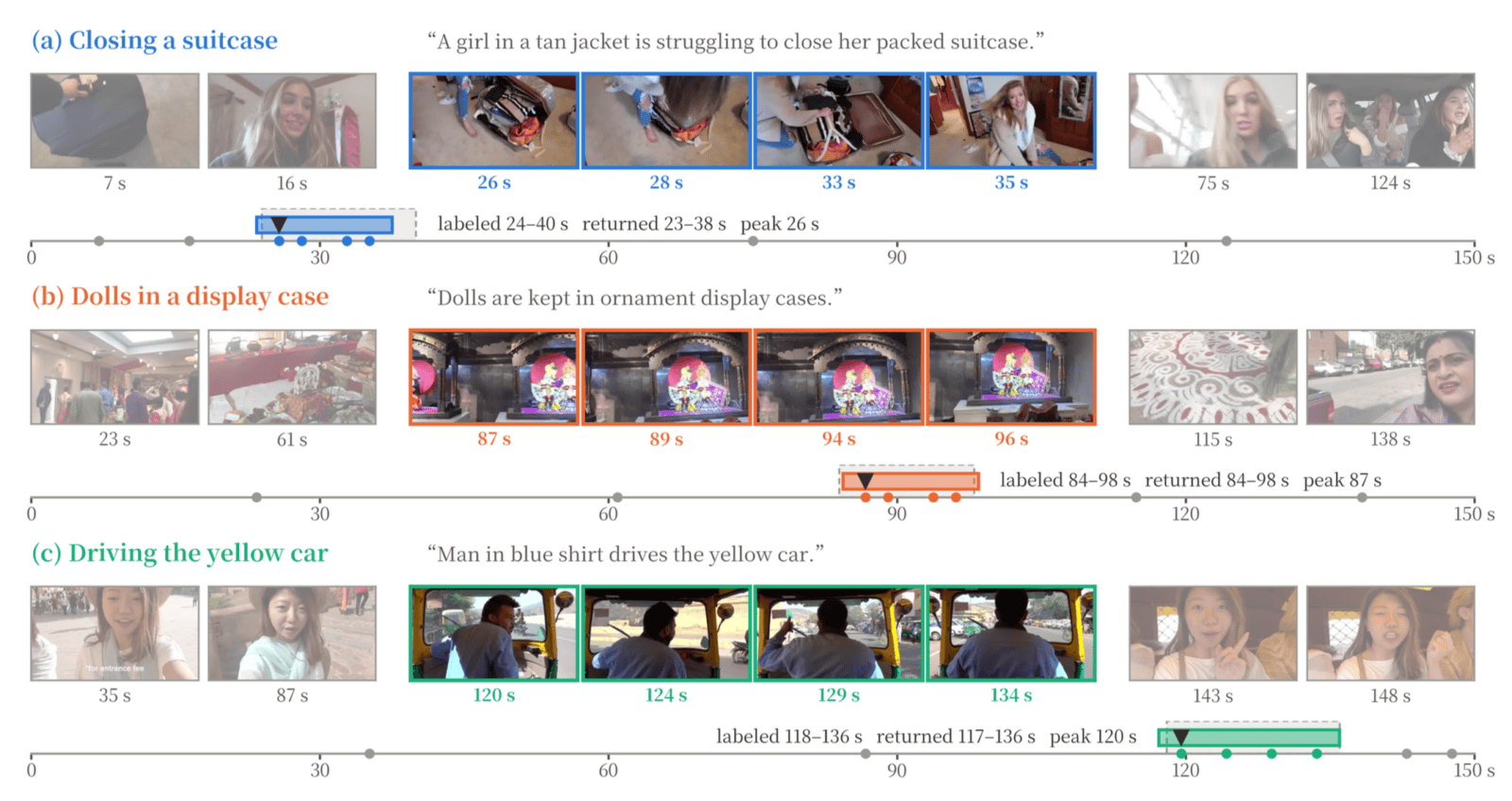
Every hit comes with coordinates, with no external OCR and no text captions of the video: for a page, a bounding box around the answer (a table row, a chart bar); for a video, an interval in seconds. On 1,083 queries from QVHighlights (YouTube vlogs and news), the peak of the match falls inside the labeled segment for 78.0% of queries, and the returned interval overlaps it for 94.3%, against 44.9% for a random interval of the same length. For RAG, this means the generator can be given just the relevant fragment rather than the whole document or clip.
How the model works
The base is Qwen3.5-4B. Its language layers alternate GatedDeltaNet linear-attention blocks with full-attention layers, and the full-attention layers were made bidirectional so that every token sees the whole sequence. Video is fed in as a whole clip with timestamps, so the model tells forward frame order from reversed order 75.63% of the time. Qwen3-VL-Embedding-8B manages 51.63%, close to a coin flip between two options.
On top sits a single Prefix-MRL head: in one pass it outputs vectors with dimensions from 64 to 2048, and the shortest, 64-dimensional ones go into the index. The vectors of a page or clip are merged by Ward clustering that takes position on the page and in time into account (ST-HAC): background collapses into a few clusters, while an isolated detail stays a vector of its own. The same clustering was used during training, so the model learns on the same compressed vectors it later searches over. With the same budget of 128 vectors, this clustering scores 62.96 on ViDoRe V3, almost as much as keeping every vector (63.09), while uniform grid pooling and random token selection get only 56.50 and 60.41.
The model was trained in four stages on 57 public datasets, about 2M samples, with EVIE-8B as the teacher on documents. Audio is not among the supported modalities.
Benchmarks
There are no independent evaluations of OmniEVIE-4B yet; its scores come from Tencent, and the authors took competitors’ MMEB-V2 numbers from the MMEB leaderboard. The main rival in the technical report is WeMM-Embedding from the WeChat Vision team, which recently introduced the WeVisForensics agent. Its 4B version is built on the same backbone as OmniEVIE-4B but stores a single vector per record.
| Model | Record representation | MMEB-V3, 190 tasks, score | MMEB-V2, 78 tasks, score | ViDoRe V3, nDCG@10, score |
|---|---|---|---|---|
| OmniEVIE-4B, K128 int8 | up to 128 vectors, up to 9,472 bytes | 60.06 | 77.96 | 62.96 |
| OmniEVIE-4B uncompressed, d=2048 | one vector per token | 60.68 | 78.56 | 64.34 |
| WeMM-Embedding-9B | single vector | 59.33 | 80.58 | — |
| WeMM-Embedding-4B | single vector | 57.97 | 79.19 | — |
| Qwen3-VL-Embedding-8B | single vector | 53.50 | 77.82 | 59.00 |
| Nemotron-ColEmbed-V2-8B | one vector per token | — | — | 63.76 |
Data from Tencent’s technical report; a dash means no result. For its own model, NVIDIA reports 63.54 on ViDoRe V3; for Qwen3-VL-Embedding-8B, Qwen lists 77.9 on MMEB-V2.
OmniEVIE-4B already appears on the MMEB leaderboard, but that is not an independent check: developers submit their own results, and the leaderboard team only reviews the submission. As of November 24, 2026, the uncompressed version ranks second on MMEB-V3 (60.68) and the compressed one fourth (60.06). First place goes to the 10.2B-parameter Sentio (61.69), and between the two OmniEVIE versions sits the 5.25B-parameter Wianmu-5B-v0 (60.45).
The MMEB-V3 numbers come with three caveats. The 60.06 and 60.68 scores were obtained with 32 frames per video, while the official protocol uses 8 frames: under it, the compressed version scores 59.76, still above WeMM-Embedding-9B (59.33). The 190 tasks include 11 audio tasks, on which OmniEVIE, like WeMM-Embedding, scores zero. And the authors put together the Qwen3-VL-Embedding-8B score (53.50) from the official MMEB-V2 results plus text and agent numbers from the WeMM-Embedding technical report: on the leaderboard itself this model has no results on the new V3 tasks, so it scores 31.95 there.
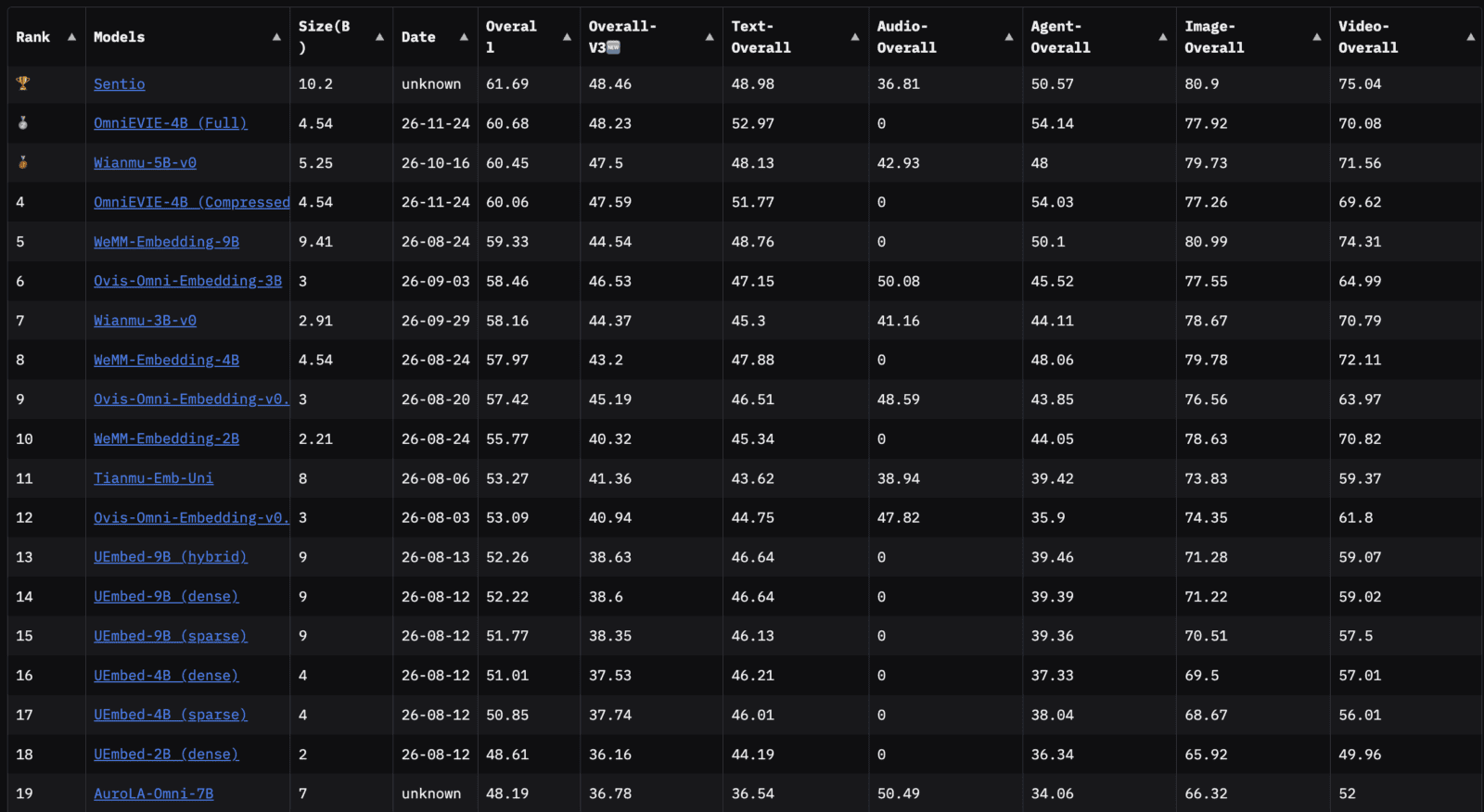
On MMEB-V3, the compressed model’s lead over WeMM-Embedding-9B comes from the text tasks: instruction following – 69.65 vs 52.78, long documents – 70.71 vs 64.48, multi-condition retrieval – 67.75 vs 58.28, plus tool retrieval for agents – 58.84 vs 52.95. On MMEB-V2, which has no text or agent tasks, the picture is reversed: 77.96 against 80.58 for WeMM-Embedding-9B and 79.19 for WeMM-Embedding-4B, which shares its backbone.
On ViDoRe V3 – retrieval over document pages from eight domains in six languages – the compressed version trails Nemotron-ColEmbed-V2-8B (62.96 vs 63.76), while the uncompressed version beats it. Nemotron stores a 4096-dimensional vector for every token: in BF16 one such vector takes 8,192 bytes, almost as much as an entire OmniEVIE record (our estimate: 4096 × 2 bytes). By the authors’ estimate, at about 773 tokens per page, a Nemotron index for a million pages takes about 5,898 GiB, against 7.87 GiB for compressed OmniEVIE. NVIDIA’s model is licensed for non-commercial use only; OmniEVIE-4B is released under Apache 2.0.
Where it fits and where it falls short
The model is designed for RAG and search across PDF pages, screenshots, video and notes in a single index, as well as tool retrieval for agents. It handles long queries with several conditions well. The compressed version pays off when there are millions of records and no GPU for search. New records are simply appended to the index, whereas PLAID, a popular way to speed up this kind of search, requires rebuilding the shared codebook when the corpus changes significantly. In Tencent’s internal business scenarios, OmniEVIE-4B beats WeMM-Embedding-9B in text-to-image retrieval for finance, industry and museums by 9.9, 10.9 and 11.7 Top-1 points, but this data has not been published.
On images and video in MMEB-V2, it trails WeMM-Embedding-9B by 3.78 and 4.69 points – mostly, the authors say, in fine-grained classification and video retrieval. In fine-grained object recognition on FORB, Qwen3-VL-Embedding-8B scores 92.80% against 89.94%. OmniEVIE-4B trails WeMM-Embedding-9B in reasoning-intensive retrieval (26.36 vs 31.82), retrieval over GUI action history (41.34 vs 43.33) and over agent memory (37.35 vs 38.65). GUI and memory tasks were not part of training and were evaluated zero-shot. The model is also weaker on clips a few seconds long: at a low frame rate, only a handful of temporal groups remain.
Document encoding runs on a GPU and requires flash-attn, and every input gets its own forward pass, because padding in a batch disrupts the state of the linear-attention layers. Re-embedding a large index may therefore take longer (our estimate), and Tencent does not give the model’s GPU throughput. The only known figure is the time to compress into a record: about 20 ms per page on a single CPU thread, or roughly 9 hours for a hundred million pages on 64 processes.
How to run OmniEVIE-4B and how much memory it needs
Like the language models Hy4 and Hy4 flash, Tencent’s new model is openly available: the code and the command-line tool for building and searching an index are in the repository. The package installs with pip install git+https://github.com/Tencent/OmniEVIE.git and requires flash-attn 2.7.0 or later. The BF16 weights take about 9.1 GB (our estimate: 4.54B parameters × 2 bytes).
Memory estimate (our estimate): an index of 10M records in the K128 configuration takes about 88.2 GiB (8.82 × 10) – within the RAM of a single server. The K32 configuration takes about 21.5 GiB (2.15 × 10), but the ViDoRe V3 score drops from 62.96 to 61.16. Without compression, the vectors of all tokens in fp16 would, by the authors’ estimate, take 486 times more space: about 3.7 TiB per million pages (7.87 GiB × 486).
The bottom line
OmniEVIE-4B suits search and RAG over large volumes of mixed data when the index has to fit in the memory of one server and search has to run on a CPU: a million records take 8.82 GiB, and a query takes 54.2 ms. For image and video search without such savings, Tencent’s own WeMM-Embedding is more accurate. On documents, if index size does not matter, Nemotron-ColEmbed-V2-8B slightly beats the compressed version, but only for non-commercial use. All comparisons so far rest on the developer’s data: there are no independent evaluations yet. Next, the authors plan to add audio, domain data and long mixed documents.