Tencent has released the weights of Hy4, the flagship of its Hy (Hunyuan) model family. The model understands text, images and video, handles up to 1M tokens of context and is built for long-running agentic work: coding, computer use, financial analysis and office documents. Alongside the main release, Tencent published Hy4-FP8, with weights compressed to 8 bits, and Hy4 base, a pre-trained model without instruction tuning.
According to Artificial Analysis, Hy4 scores 35 on its Intelligence Index – the same as Grok 4.7 at xhigh effort and 11 points behind Moonshot AI’s Kimi K3.1 Pro. On Terminal-Bench 4.0, a benchmark of agentic work in the terminal, Hy4 solves 37.4% of tasks against 33.8% for DeepSeek-V4.1-Flash, an open model of comparable size – but it costs several times more. With the weights now public, Hy4 is no longer just an API: it can be deployed on your own hardware and fine-tuned for your own tasks.
What’s new in Hy4
The main change is open weights. The full Hy4 first shipped as an API-only model, and at the time Tencent only promised to publish the weights and the system card. About two weeks later, three versions appeared on Hugging Face, ModelScope and GitCode under Tencent’s own Tencent Hy License, together with a fine-tuning pipeline, a compressed GGUF version for test runs and the 82-page system card.
The second change is vision. The text-only Hy4 preview came out a little over two months before the full version; Hy4 now picks up fine details in images, reads complex charts and operates a computer through both the command line and graphical interfaces. Tencent trained it specifically on Blender and CAD, and worked with developers from its gaming division, Tencent IEG, on the Unreal Engine, Unity and Godot engines: on the GameDev benchmark, Hy4 scores 19.1% higher than the preview.
The third is reliability in finance and office work. Tencent reworked search so the model accounts for how fresh the data is, combines several sources and checks facts against each other. In the company’s internal tests, the hallucination rate fell from 15.76% for Hy4 preview to 5.45%, and the rate of speculative errors from 23.1% to 5.6%. Tencent also improved real-time co-editing of Word, Excel and PowerPoint files together with a human.
Architecture: 49B active parameters out of 770B
Hy4 is a Mixture-of-Experts (MoE) model. The language backbone has 770B parameters, but only 49B of them are active per token: of its 78 layers, the first is a standard dense layer, and each of the remaining 77 holds 256 experts, of which a token uses eight plus one shared expert. Images and video frames go through a 1.23B-parameter ViT encoder that supports dynamic resolution, and an adapter turns them into tokens for the language backbone.
The attention design borrows from DeepSeek and GLM: in the sparse Gated DSA scheme, an indexer picks the 2,048 most relevant tokens from the full context, and that selection is reused across layers. Generation is sped up by a built-in DFly2 drafter with 3.3B parameters: it proposes the next tokens and the main model verifies them. DFly2 reuses Hy4’s own cache and indices, so it needs no extra memory, and its cost per token does not grow with context length.
How Hy4 stacks up against open models
Tencent calls Hy4 one of the strongest open-weight models but admits that “a notable gap remains between it and top proprietary models” – in research-level math, long-horizon coding and hard visual question answering. Independent rankings agree: on the Vals Index from Vals AI, a composite of finance, coding, legal and tax tasks, Hy4 scores 59.4% against 62.5% for Kimi K3.1 Pro and 71.3% for the leader, the closed Claude Fable 5.2.
The most convenient model for a like-for-like comparison is DeepSeek-V4.1-Flash – an open MoE model of similar size that Tencent places second in its own finance evaluation.
| Metric | Hy4 | DeepSeek-V4.1-Flash 1017 |
|---|---|---|
| Total / active parameters, B | 770 / 49 | 552 / 16 |
| Terminal-Bench 4.0, % | 37.4 | 33.8 |
| HLE-Diamond, % | 32.7 | 25.3 |
| Terminal-Bench-Science, % | 12.9 | 12.9 |
| AutomationBench-AA, % | 65.6 | 66.6 |
| Tencent finance tasks, score out of 4 | 3.04 | 2.97 |
| Price, $ per 1M tokens (input / output) | 0.834 / 2.501 | 0.030 / 0.250 |
Benchmarks are Artificial Analysis measurements; DeepSeek-V4.1-Flash 1017 in Max mode. Finance tasks are Tencent’s evaluation: 579 tasks, 213 finance professionals. Prices from OpenRouter; for DeepSeek-V4.1-Flash 1017, the provider with the cheapest input (Particle AI, Flex tier).
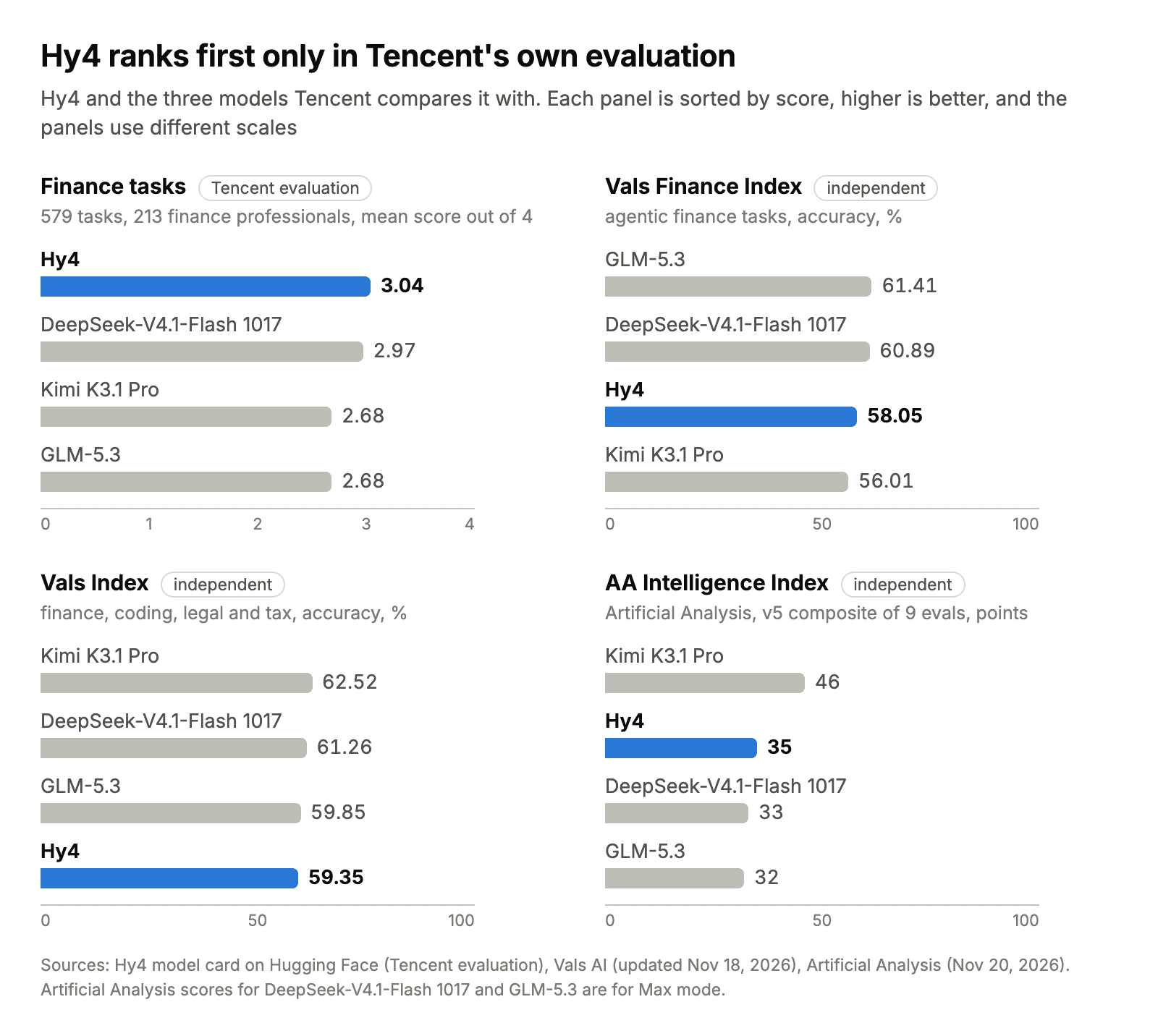
Of the benchmarks in the table, DeepSeek-V4.1-Flash wins only on business process automation (AutomationBench-AA), and only by 1 point; the two models tie on Terminal-Bench-Science, while Hy4 leads by 3.6 points on terminal agent work and by 7.4 points on HLE-Diamond. In Tencent’s finance evaluation the gap is minimal: 3.04 against 2.97, with Kimi K3.1 Pro and GLM-5.3 at 2.68 each. But these are the developer’s own numbers: on the Vals AI finance index, Hy4 is only third of these four models, behind GLM-5.3 and DeepSeek-V4.1-Flash, and Kimi K3.1 Pro beats Hy4 on both general independent indices.
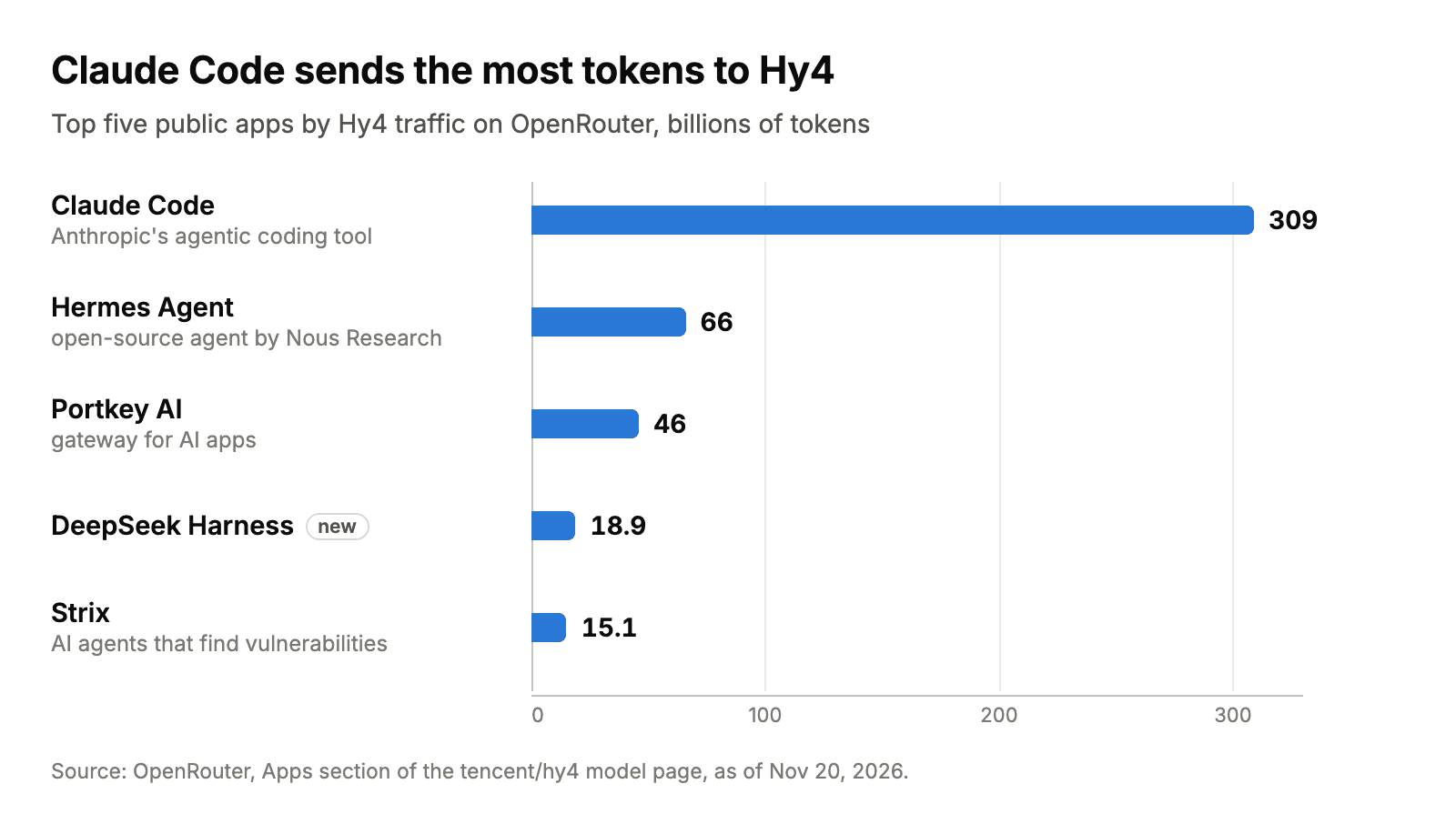
That points to where Hy4 can be useful: long agentic workflows in the terminal and finance and office work, including on your own servers. According to OpenRouter, the apps sending the most tokens to Hy4 are the coding agent Claude Code (309B) and Hermes Agent (66B), and Strix, an agent for finding security vulnerabilities, also makes the top five.
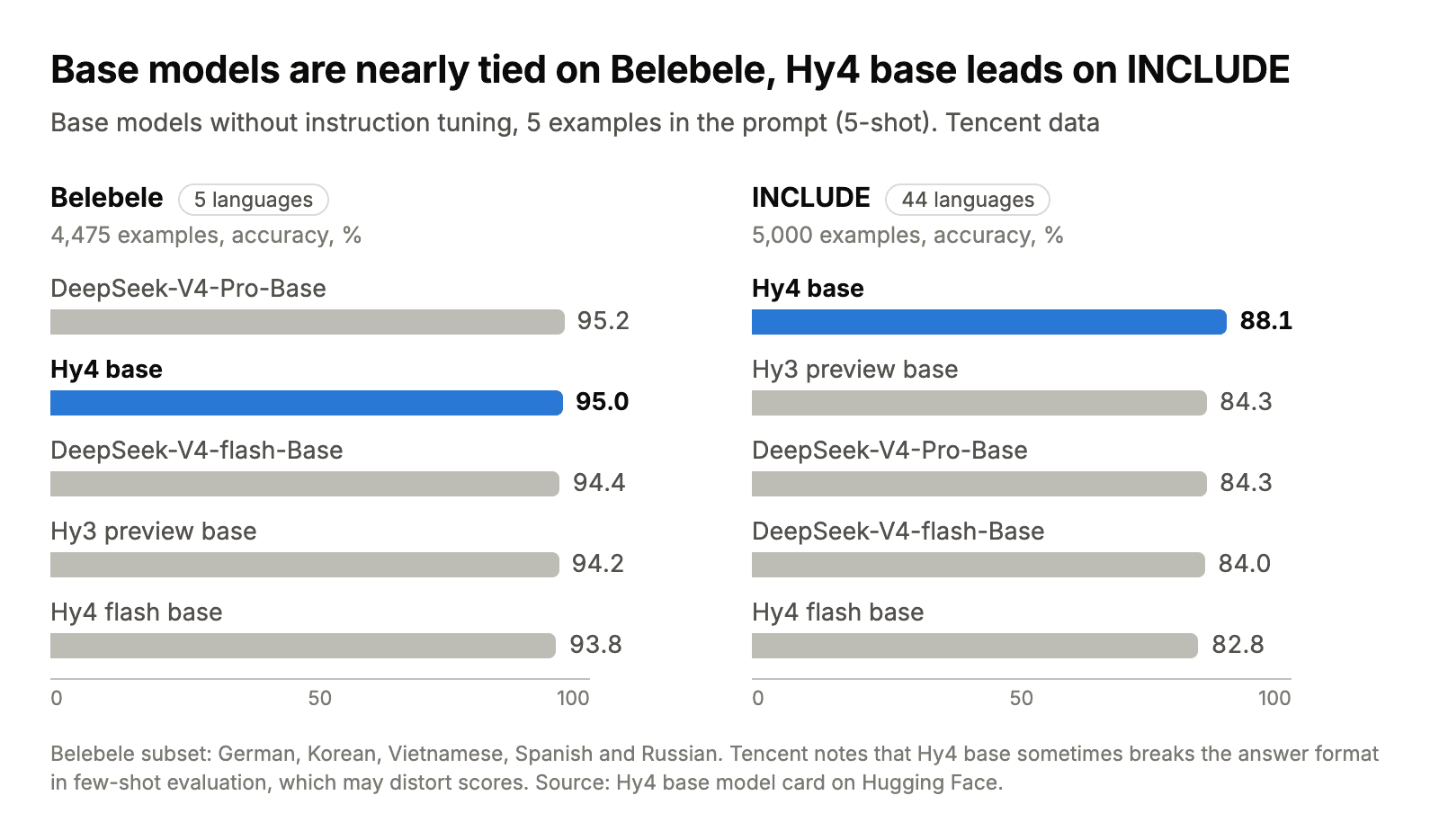
For high volumes of cheap requests, DeepSeek-V4.1-Flash is the better deal. On multilingual tests of the base models, Hy4 base scores 95.0% on Belebele (German, Korean, Vietnamese, Spanish and Russian) against 95.2% for DeepSeek-V4-Pro-Base. On INCLUDE, which covers 44 languages, Hy4 base leads with 88.1%, while the other base models reach no more than 84.3%.
Pricing, API and self-hosting
Through the API, Hy4 costs $0.834 per 1M input tokens and $2.501 per 1M output tokens, with cache reads at $0.042. On OpenRouter the model is served by Tencent Cloud and Together, and one of the providers offers a 50% discount: $0.417 and $1.251. Via the API, Hy4 accepts text and images, returns up to 65,536 tokens per response, supports function calling and structured JSON output, and generates 55 to 89 tokens per second on average depending on the provider (OpenRouter one-week averages as of November 20, 2026).
Editorial calculation: at list prices, Hy4 input is 28 times more expensive than the cheapest DeepSeek-V4.1-Flash 1017 provider ($0.834 vs $0.030) and output is 10 times more expensive ($2.501 vs $0.250); with the discount, the gap is 14x and 5x. A request that fills the full 1M-token context costs about $0.87, and reading it again from cache about $0.04. Verbosity also pushes costs up: during the Artificial Analysis index run, Hy4 produced 160 million output tokens, reports Crypto Briefing – roughly $400 at the list price.
For self-hosting, Tencent recommends vLLM and SGLang with prebuilt images; in the official examples, the FP8 version runs on eight GPUs. Editorial estimate: 774.5B parameters including the encoder and the drafter, at one byte per parameter in FP8, come to about 775 GB, or roughly 97 GB on each of the eight GPUs, before any memory for context. Reasoning mode is on by default and can be switched off with the reasoning_effort parameter; there is also a GitHub repository.
How Tencent got to an open flagship
Tencent is rolling out the Hy4 generation step by step: first the text-only Hy4 preview, then the full Hy4 as API-only, then the cost-efficient Hy4 flash with open weights, and now the open flagship. The also-open DeepSeek-V4.1-Flash 1017 is offered on OpenRouter in more than 50 hosting options with input from $0.03, while Hy4 has just two providers so far. Forecast based on precedent: if the pattern repeats, Hy4 will get cheaper too as third-party providers pick it up.