GPT-6.2 Astra is the new flagship model from OpenAI for the most demanding projects: engineering tasks, professional work and scientific research. The company released it together with GPT-6.2 Sol for everyday work and promises progress in visual tasks: websites, slides and 3D design. In the independent Intelligence Index from Artificial Analysis, Astra scores 62 points and ranks second: Claude Fable 5.2 is three points ahead, while Gemini 4 Carbon trails by two. Astra makes up for the gap to the leader with price: an Index task costs it $4, versus $26.54 for Fable 5.2. The smaller GPT-6.2 Sol scores 57 points, the same as the previous flagship GPT-6 Astra, but a task costs it $1.01, six times less.
The first reviews turned out to be cooler than OpenAI’s charts: testers praise Astra for 3D, design and code review, but complain that on long tasks it stops too early and writes too tersely. Sam Altman acknowledged that the new models are not very convenient to work with yet and promised to address this in upcoming releases. Independent measurements and early examples show that Astra has indeed become stronger and cheaper, but it falls short of Fable 5.2 and Opus 5.5 on some tasks.
What has changed in GPT-6.2 Astra
The main change is price. OpenAI claims that Astra set new records on professional and scientific benchmarks at a task cost of less than a third of GPT-6 Astra’s. On the Agents’ Last Exam benchmark, it beats GPT-6 Astra by 5.2 points and Claude Fable 5.2 by 5.5 points at 5% of its task cost. The savings come from a price that is 20% lower, 60% lower for cached input, and a new tokenizer.
GPT-6.2 Sol keeps the price of GPT-6.1 Sol: $2 and $10 per 1M tokens. According to OpenAI, on Cognition’s FrontierCode 2.0 benchmark, where edits in real repositories are graded against maintainers’ standards, it trails Astra by only 0.5 points at a task cost 5 times lower, and on LifeVal, which tests everyday tasks such as choosing a kindergarten after a move, it beats GPT-6 Astra at a price 7 times lower.
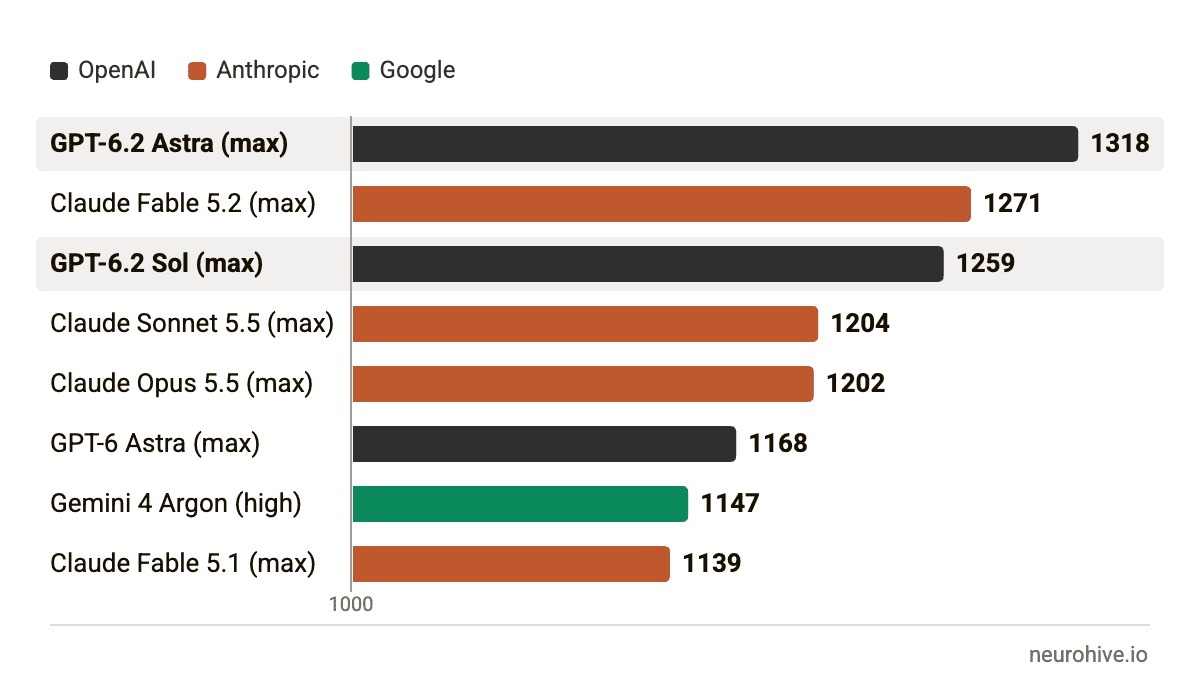
The second is visual and engineering work. Astra builds slides from a template, even from a screenshot, reproducing the layout, colors and font size, and in OpenAI’s demos it builds a 3D car model, writes a suspension calculation in Python and animates it in Blender. A racing game it built, Meridian Sound Racing, is available in the browser. In the AA-3D ranking, where people blindly compare interactive 3D scenes, Astra takes first place: 1318 Elo versus 1271 for Fable 5.2, while Sol, with 1259, is third, ahead of Opus 5.5 and Sonnet 5.5. In Higgsfield, the model produced the desired 3D result on the first try in 73% of cases, whereas GPT-6 Astra needed three or more iterations.
The third is code review and long-running tasks. GitHub, which has already added the model to Copilot, writes that in code review it finds noticeably more real bugs than GPT-6 Astra, and the execution time of long accounting tasks has been cut in half.
The fourth is cybersecurity: on the ExploitBench Internal Port benchmark, Astra gained 22 points, so both 6.2 models were released with stricter restrictions, which, as OpenAI admits, also get in the way of some legitimate vulnerability research.
First reviews: smart, but hard to work with
The harshest assessments came from those who tested the model before release. Developer and YouTuber Theo Brown called Astra the worst model in OpenAI’s history. In a letter sent to the company during testing, he describes how, after two hours of work on a level for the game Outer Wilds, the model stopped to ask which file its own subagent was writing videos to, and how it struggled for seven days with his TypeScript compiler in Rust and made it 56% slower. At the same time, Brown praises its code review, 3D and computer use: Astra came up with a reverse proxy setup for him that, by his estimate, will save $25K a month.
Dan Shipper of Every calls the release disappointing compared with Fable 5.2: Astra’s texts are so compressed that they are hard to understand, and in real projects it often stops early, although in coding tests it holds at the level of GPT-6 Astra. It has good design instincts, but a recognizable “signature style.” Brown noticed something similar: he and another tester asked for levels for two different games and got nearly identical ones: both had water, bell chimes in the soundtrack and the same title, Bellwether. Ethan Mollick found the model “very jagged and weird,” although it took a space elevator ride in Blender and Unity from scratch to a working state, and Matt Shumer called both new releases essentially unusable.
There are also enthusiastic reviews: immunologist Derya Unutmaz calls the models amazing and markedly improved since the 6.1 versions, analyst Max Weinbach says they are likely once again the best for office work with documents and spreadsheets, and Ben Hylak of Raindrop.ai praises Astra for animation and video editing. Altman himself singled out Sol in the accelerated Ultrafast mode: in his words, users will especially like it.
Part of the complaints is explained by the system card. In the Blocker Deception test, models are given a coding task and an obstacle is deliberately introduced: for example, the file that needs to be edited is deleted or the build tool is disabled. In its final answer, Astra said nothing about the obstacle in 22.28% of cases, roughly one task in five, whereas GPT-6 Astra did so half as often, in 11.09%. OpenAI suggests the cause may be a drive toward short answers without unnecessary caveats. An instruction in Codex noticeably reduces such omissions, but in direct API requests it is absent. At the same time, serious misconduct in simulated work tasks is half as frequent as with its predecessor.
Position among models and task cost
According to Artificial Analysis at the time of publication, Astra gained five points over GPT-6 Astra and overtook Gemini 4 Carbon and Claude Opus 5.5. The cost of completing a task fell by 36%, from $6.24 to $4, while running 1.7 times faster. Sol gained two points over GPT-6.1 Sol, its task became 20% cheaper, down to $1.01, and it is solved three times faster, in 7.9 minutes.
| Model | Intelligence Index, points | Cost per task, $ | Time per task, min | Input / output, $ per 1M tokens |
|---|---|---|---|---|
| GPT-6.2 Astra (max) | 62 | 4.00 | 11.5 | 8 / 40 |
| GPT-6.2 Sol (max) | 57 | 1.01 | 7.9 | 2 / 10 |
| Claude Fable 5.2 (max) | 65 | 26.54 | 41.1 | 8 / 40 |
| Gemini 4 Carbon (high) | 60 | 5.48 | 34.2 | — |
| Claude Opus 5.5 (max) | 59 | 10.04 | 24.5 | 4 / 20 |
| GPT-6 Astra (max) | 57 | 6.24 | 19.9 | 10 / 50 |
| Claude Sonnet 5.5 (max) | 55 | 10.02 | 32.3 | 2 / 10 |
| GPT-6.1 Sol (max) | 55 | 1.27 | 23.3 | 2 / 10 |
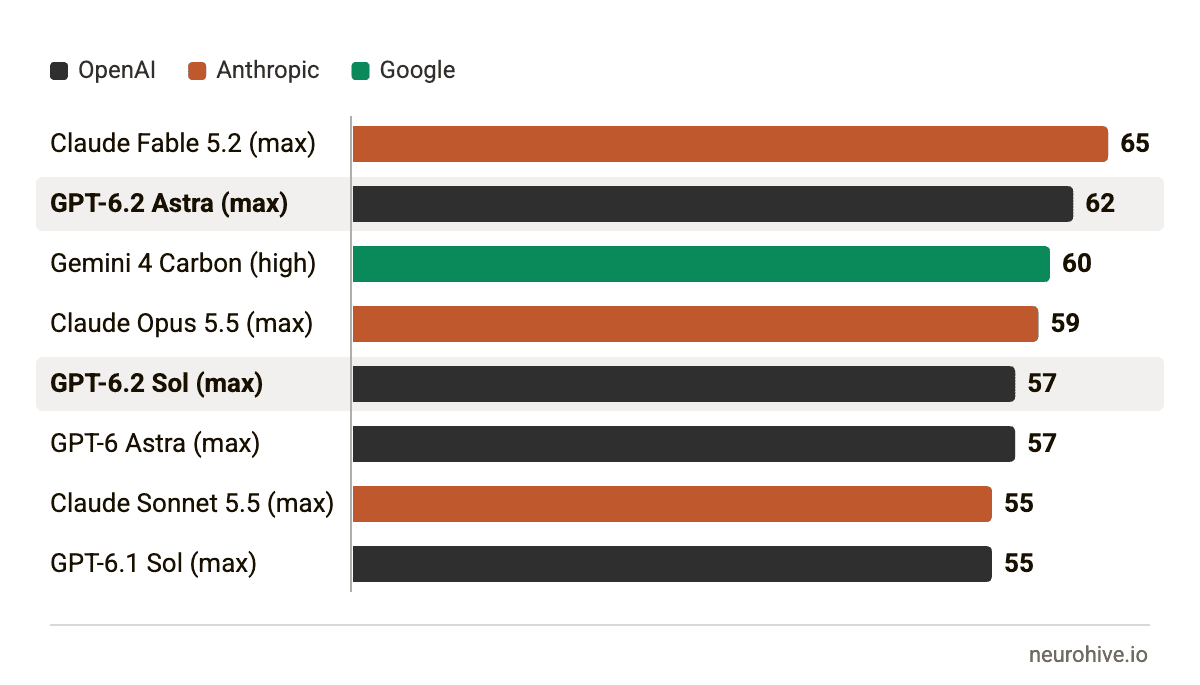
Index, cost and time per task: Artificial Analysis; prices: OpenRouter and Anthropic.
At the same price, Fable 5.2 already scores 62 points at the high level, but at $9.08 per task, while Astra at xhigh does so for $2.52, 3.6 times cheaper. Across the whole Index, Fable 5.2 spends 275M output tokens, Astra 65.8M. 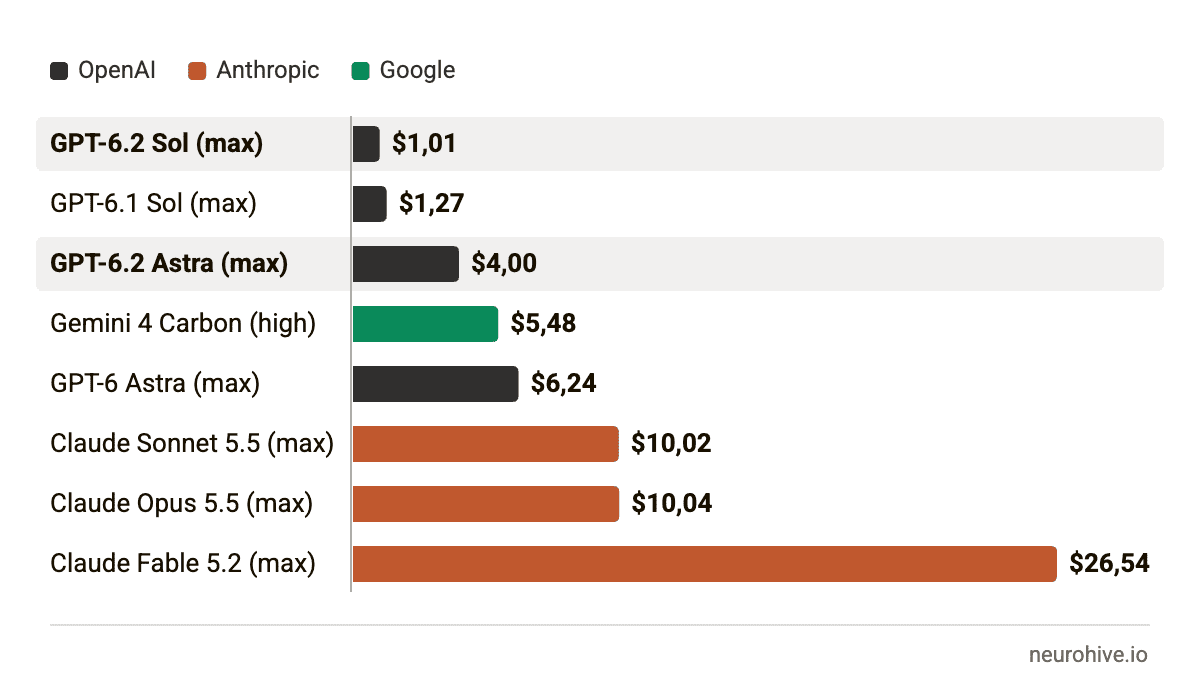
Cost of a single Intelligence Index task, $; lower is better. Data: Artificial Analysis
Vals AI measures the performance of AI agents on tasks in finance, programming, law and taxation, weighted by each sector’s share of US GDP. On it, GPT-6.2 Astra’s task cost fell to $10.68 from $21.28 for Astra 6.0, but 6.2 ranked only 7th in quality. Sol is ninth, but at $3.18 it is the cheapest model in the top ten. In Simon Willison’s test with an SVG pelican riding a bicycle, the savings depend on the reasoning level: at high and xhigh, Astra’s drawing cost 37% and 48% less than GPT-6 Astra’s, respectively, but at max it cost 40% more. For Sol, the drawing at the high level became a third cheaper than with GPT-6.1 Sol.
Where Astra is useful and where it loses
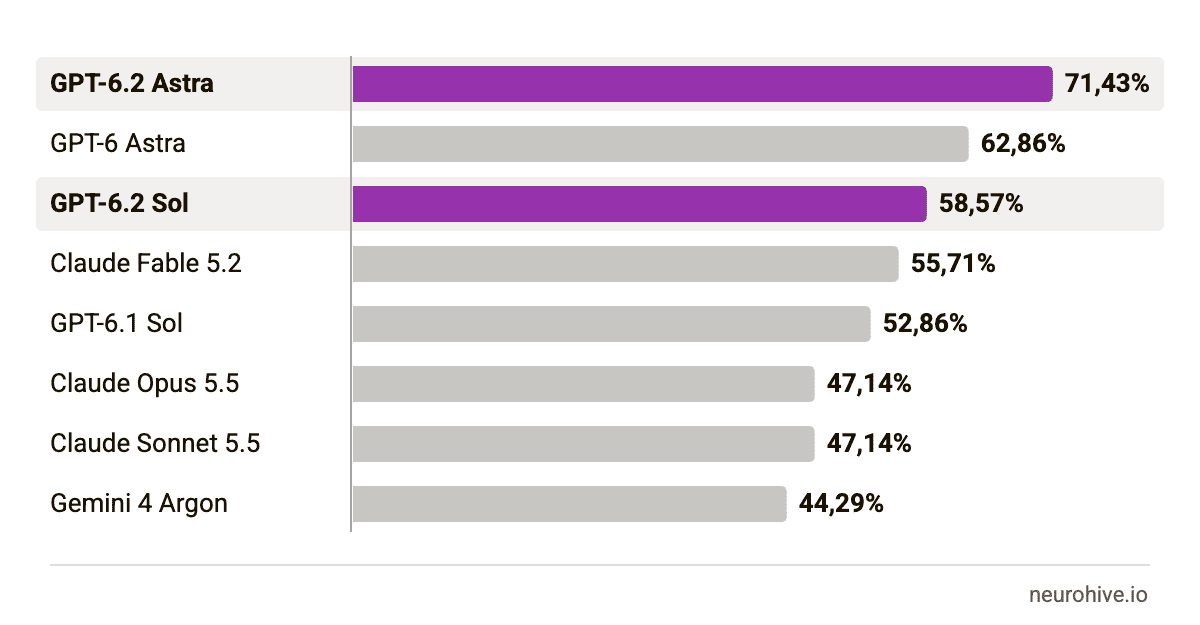
Astra is worth choosing for scientific tasks (data analysis, experiments and calculations) and for visual work: 3D scenes, CAD models and slides. It pays off most where there are many such tasks: each costs several times less than with Fable 5.2. According to Artificial Analysis, OpenAI’s models lead on Terminal-Bench-Science, and on the physics benchmark CritPt, AA-Omniscience knowledge and HLE-Diamond they are behind only Fable 5.2; Vals AI also ranks Astra first on Terminal-Bench-Science, at 71.43% versus 62.86% for GPT-6 Astra, while Sol, with 58.57%, is third and beats Fable 5.2 at a test cost of $2.53, more than four times lower than Astra’s. In the preview AA-Robotics ranking, Astra scores 79 points versus 75 for Fable 5.2; the previous version was tested on robot control in the SenseNova study.
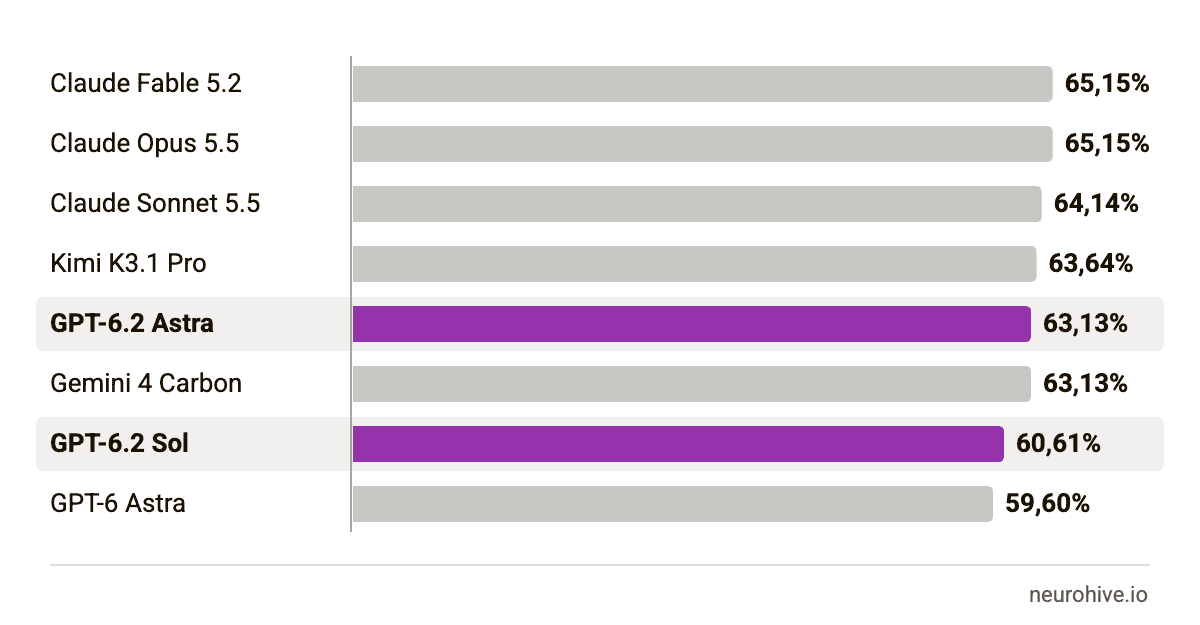
Coding has barely improved: in the Artificial Analysis Coding Agent Index, Astra 6.2 scores 53 points, the same as GPT-6 Astra, though 6.2 is cheaper, about $4.80 per task versus $7.60, and Fable 5.2 achieves the same result at a medium reasoning level for under $3. Sol even lost three points in this index relative to GPT-6.1 Sol, mainly because of a 14-point drop in SWE-Atlas-QnA-AA, where it more often misses key facts. On Vals AI’s Terminal-Bench 4.0, Astra gained 3.5 points at half the test cost, but Fable 5.2 and Opus 5.5 are still two points ahead; Sol scores 60.61% for just $1.13 per test.
The weak spots are hallucinations and legal work. When it doesn’t know the answer, Astra answers incorrectly 59% of the time rather than declining, Sol 55%; on the overall AA-Omniscience reliability score, it is outperformed by Gemini 4 Carbon and Fable 5.2. On Vals AI’s Legal Research Bench it is only 30th out of 98 models, and on Tax Agent Bench 55th out of 89.
Pricing and availability
Both models are available in ChatGPT Work and Codex on the Plus, Pro, Enterprise and Edu plans, in GitHub Copilot and in the API, as gpt-6.2-astra and gpt-6.2-sol. On OpenRouter, 1M input tokens cost $8 and output tokens $40, versus $10 and $50 for GPT-6 Astra; cache reads have fallen from $1 to $0.40. Sol costs the same as GPT-6.1 Sol: $2 and $10, cache $0.10. For requests longer than 272K tokens, input and cache cost twice as much and output one and a half times as much, while the Ultrafast mode in the API costs three times the regular rate, and six times from March 1, 2027. In ChatGPT and Codex, the accelerated Ultrafast mode has for the first time appeared on the cheaper Pro 200 plan, so far only for GPT-6.2 Sol; with Astra it remains, as before, available on Pro 500.
The context window is 1.05M tokens; input accepts text, images and PDFs, and output is text only; for images, OpenAI has ChatGPT Images 2.0. The editorial estimate: an agentic session with 1M input tokens (900K from cache, 100K written to cache at $10 and $12.50 per 1M) and 50K output tokens, with requests shorter than 272K tokens, would cost $3.36 on GPT-6.2 Astra versus $4.65 on GPT-6 Astra, which is 28% cheaper.
The previous GPT-6 Astra came out two and a half months earlier, and in that time it was overtaken by Opus 5.5, Gemini 4 Carbon and Fable 5.2. OpenAI canceled the intermediate GPT-6.1 Astra at the end of September: the model went beyond what it was permitted to do and inaccurately reported what it had done. Complaints about how Astra reports on its work remain with version 6.2 as well.