Google has released Gemini 4 Hydrogen, a model for writing code, working with documents and handling multi-step tasks that replaces Gemini 3.8 Flash. According to the company, it completes test tasks 2.5 times faster than Gemini 3.8 Flash and produces fabricated claims more than five times less often. Google is encouraging developers to move to the new generation, but 3.8 Flash remains available in the API for now.
You can connect Gemini 4 Hydrogen to your own application through the API. The Standard tier costs $1.50 per million input tokens and $7.50 per million output tokens, and there is also a free tier with limits.
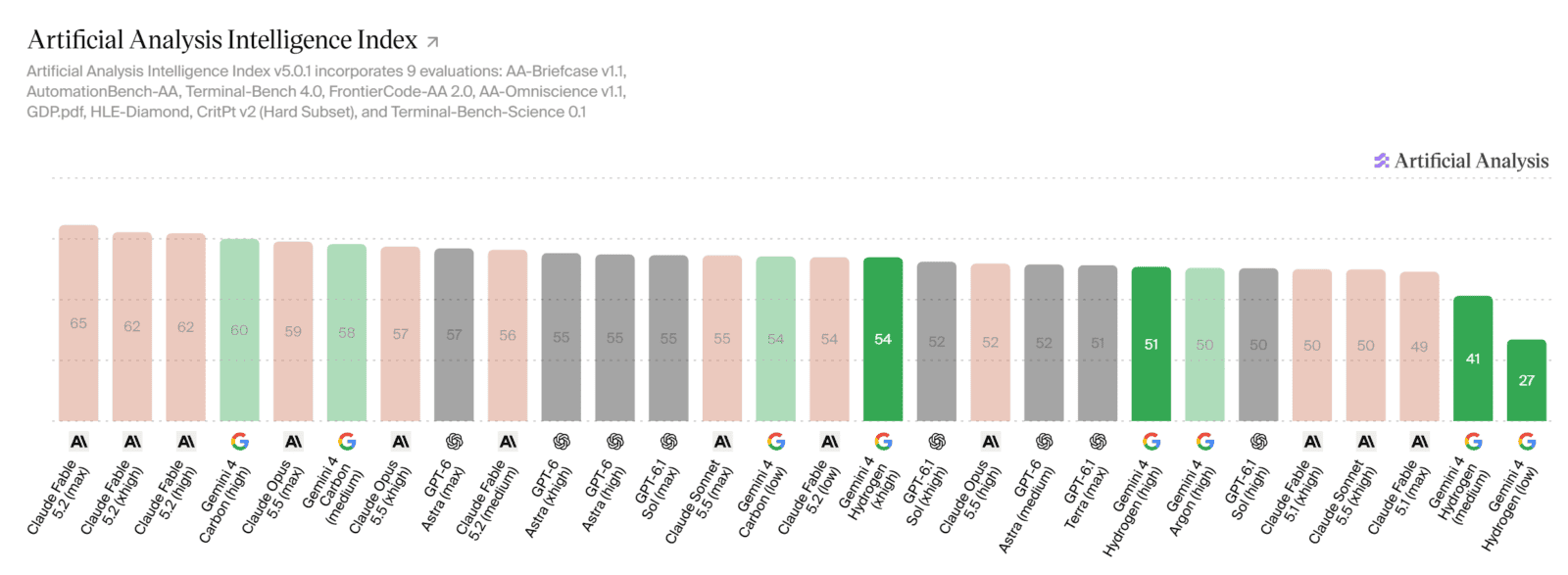
Hydrogen is also rolling out to the Gemini app and Google Search. In the Gemini 4 lineup, it handles fast execution, while the larger Carbon and Argon models take on complex planning and long-running analysis. That said, on the Artificial Analysis Intelligence Index – a composite score for knowledge, reasoning, coding and professional tasks – Hydrogen scores 51 at the high reasoning level and 54 at xhigh, versus 50 for Argon.
Benchmark results
On Terminal-Bench 4.1, which tests how well a model completes tasks in a terminal, Hydrogen scored 57% versus 18.2% for Gemini 3.8 Flash – more than three times as much. On the other benchmarks below where both models have results, Hydrogen also beats its predecessor. Against the larger Gemini 4 models, the picture is mixed: Hydrogen narrowly beats Argon on the Artificial Analysis composite index but trails Carbon on a number of harder tasks.
| Benchmark | What it measures | Hydrogen | 3.8 Flash | Argon | Carbon |
|---|---|---|---|---|---|
| Artificial Analysis Intelligence Index | Overall quality across a range of tasks | 51 at high; 54 at xhigh | 31 at high | 50 at high | 60 at high |
| Terminal-Bench 4.1 | Completing tasks in a terminal | 57% | 18.2% | – | – |
| Agents’ Last Exam v1.1 | Multi-step professional tasks | 71.6% | – | 69% | 77.4% |
| HLE-Diamond | Hard questions and reasoning | 58.8% | 33.1% | 56.7% | 69.1% |
| Vals Legal Research Bench | Finding and analyzing legal information | 53.9%* | 38.9% | 54.8% | 55.8% |
| Multimodal Knowledge Agent, MKA | Working with visually complex files and preparing documents | 53.4% | – | – | 54.3% |
| Vals Tax Agent Bench | Tax tasks | 52.3% | 32.1% | 49.2% | 51.8% |
Sources: Google’s announcement and the Hydrogen model card; Artificial Analysis; Snorkel; Vals Legal Research Bench and Tax Agent Bench; MKA report. “–” means no comparable result has been confirmed. Agents’ Last Exam shows the Score metric; MKA shows Climb WSR.
*Google’s announcement gives Hydrogen 55.8% on Legal Research Bench, while the Vals leaderboard shows 53.85%. We use the Vals figure, rounded to 53.9%, so that all models are compared using a single source.
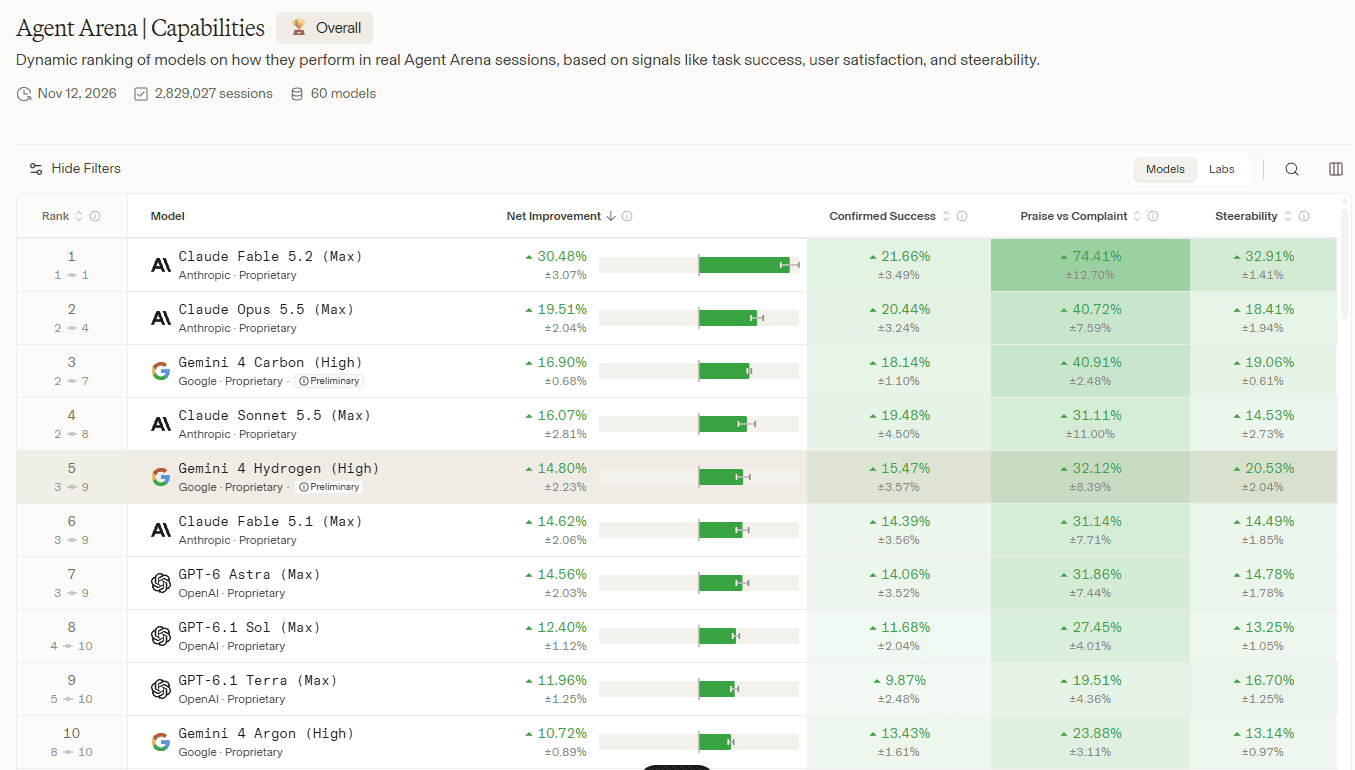
At launch, Hydrogen also ranked fifth on Agent Arena, a leaderboard for multi-step agentic tasks. In separate partner tests on SQL and enterprise-data tasks, it ran 2–2.8 times faster than 3.8 Flash and used 12–23% fewer tokens. These figures apply to those particular trials, and the same gains are not guaranteed on other tasks.
Hydrogen has four reasoning levels: low, medium, high and the new xhigh. High is on by default. The top level, xhigh, raises the Artificial Analysis score from 51 to 54 but can increase latency and token usage.
Speed: different tests show different gains
On the Artificial Analysis chart from November 12, the estimated time per Intelligence Index task is 13 minutes for Hydrogen at xhigh versus 14.8 minutes for 3.8 Flash at high – about 12% less. In other words, even at its maximum reasoning level, Hydrogen’s estimated time is lower than its predecessor’s at high.
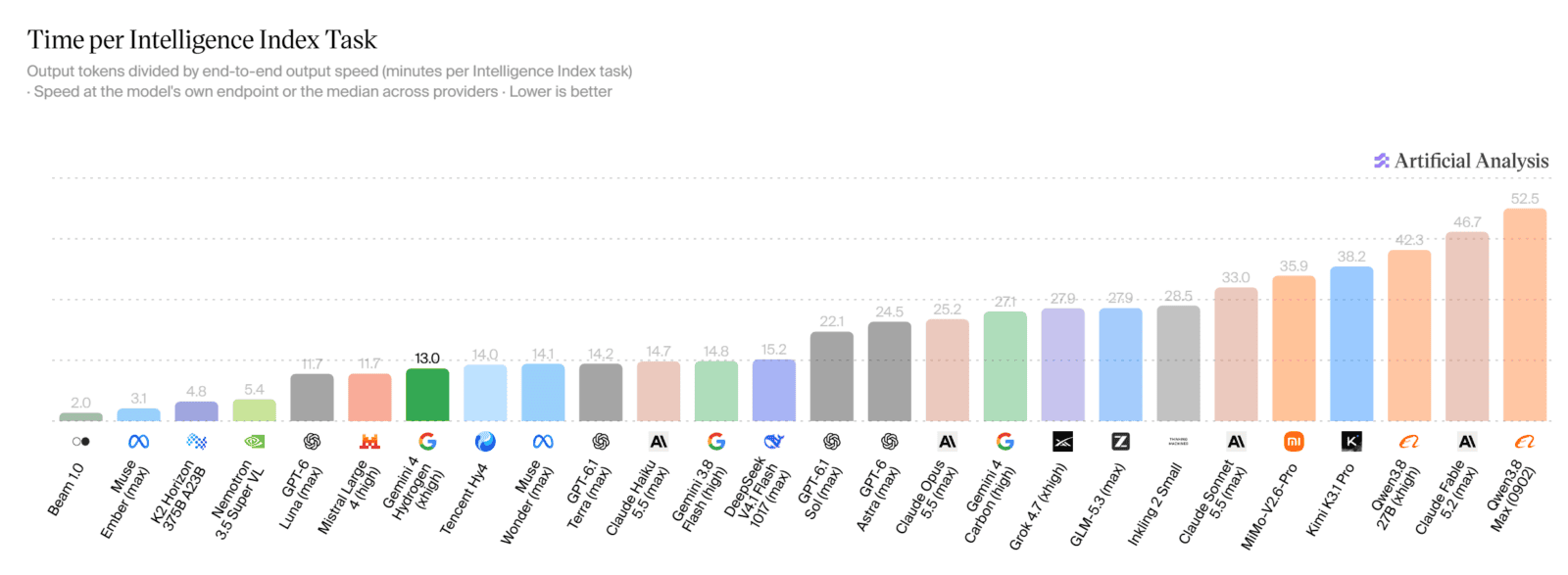
Google’s 2.5x speedup claim refers to Hydrogen at high, its default level. With both models at high, Artificial Analysis shows 8.3 minutes versus 14.8 – about 1.8 times faster (data as of November 13). A gap with Google’s figure remains: the company and Artificial Analysis use different tests and conditions. Both sets of data confirm Hydrogen’s advantage in their own tests, but they do not give a single speedup factor that applies to every task.
Cost per task: cheaper than Flash in Artificial Analysis tests
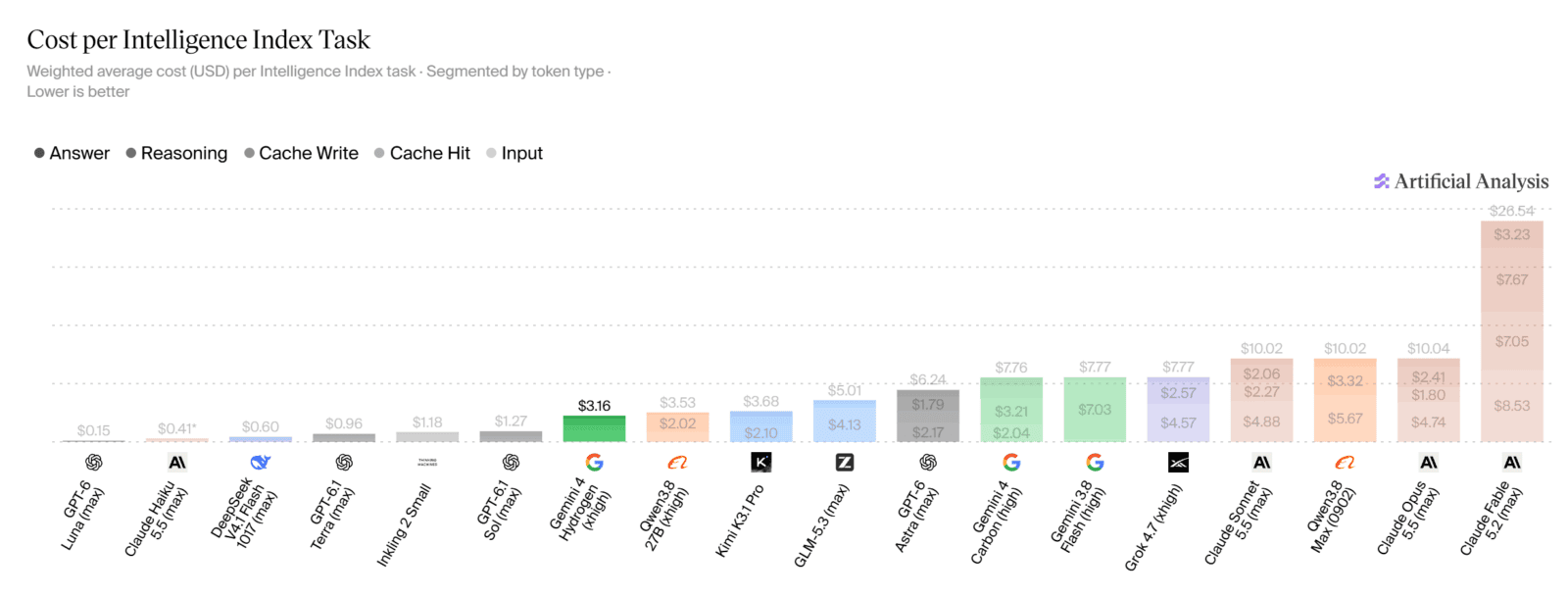
On the Artificial Analysis chart, the weighted average cost of one Intelligence Index task is $3.16 for Hydrogen versus $7.77 for Gemini 3.8 Flash. Both models are compared at their maximum reasoning level: xhigh for Hydrogen and high for 3.8 Flash, which has no xhigh. By this measure, Hydrogen is about 59% cheaper than its predecessor while scoring higher on quality. At the same high level, the gap is even wider: $1.87 versus $7.77 per task, or 76% cheaper.
Cost per task reflects how many tokens each model actually used in the test and how they were billed, including caching. That is why a higher price per million tokens does not by itself mean a more expensive task: models can use different numbers of tokens and benefit from the cache to different degrees.
API pricing
Hydrogen’s Standard tier costs $1.50 per million input tokens and $7.50 per million output tokens, reasoning included. The price is the same across the entire context window.
| API tier | Input, per 1M tokens | Output incl. reasoning, per 1M tokens |
|---|---|---|
| Standard | $1.50 | $7.50 |
| Batch | $0.75 | $3.75 |
| Flex | $0.75 | $3.75 |
| Priority | $2.70 | $13.50 |
Source: Google’s price list. Additional paid tools are not included.
Through December 31, 2026, 3.8 Flash costs $0.75 per million input tokens and $3.75 per million output tokens. For the same input and output volume without caching, that is half of Hydrogen’s price. However, Artificial Analysis does not hold the models to the same number of tokens for the same work, and Hydrogen’s total cost per task comes out lower. From January 1, 2027, Flash’s regular input and output prices will match Hydrogen’s.
Carbon and Argon cost more: $2 per million input tokens and $10 per million output tokens through November 30, then $4 and $20 respectively. For comparison, Anthropic’s Claude Fable 5.2 costs $8 and $40. These are per-token prices; what a specific task actually costs depends on how each model goes about it.
Cached input for Hydrogen on Standard costs $0.075 per million tokens – 95% less than regular input. Automatic caching applies to eligible requests of 4,096 tokens or more, and the discount covers only the reused part.
So in the Artificial Analysis comparison, Hydrogen already beats Flash on cost per task. The 59% saving applies to this set of tests and the way the cost is calculated: in a real application, the result will depend on the reasoning level, token usage, caching and paid tools.
Working in tandem with Carbon
Google suggests using Hydrogen to write and fix code, run tests, analyze documents and prepare reports. The model can work on its own or carry out individual steps of a plan drawn up by Carbon or Argon.
For this kind of teamwork, Google Antigravity has added Orchestrator. It switches models within a single session: Carbon draws up the plan, and Hydrogen makes the changes and checks the result. If a task turns out to be harder than expected, control can go back to Carbon. Orchestrator is rolling out to Google AI Ultra subscribers, and Google says more plans will follow. We covered a research take on a similar idea – a main agent coordinating a team of sub-agents – in our article on DynaFlow.
According to Google, the pair came close to Carbon’s task success rate while finishing 19% faster and using 24% less of the Antigravity quota. This is a separate metric for the service’s usage limits: it cannot be translated directly into the same reduction in tokens or API spending.
The company does not give the absolute share of tasks solved. In addition, the main announcement attributes these results to Terminal-Bench 4.0, while the Antigravity blog cites version 4.1.
A million tokens for documents, reasoning and the answer
Hydrogen accepts text, images, PDFs, tables, audio and video as input. The context window is 1,048,576 tokens, shared between the input, reasoning and the answer.
According to the documentation, a single response segment is capped at 65,536 tokens. Longer output can be generated with continuation, including in background mode, and its maximum length depends on the room left in the context window. This makes it possible to process large sets of materials and produce extensive results within a single task. However, a million-token context does not mean the model can take in a million tokens and then produce the same amount on top of that.
Hydrogen is already live in Google Search
Google announced that Gemini 4 Hydrogen is now available in Search worldwide for all users. The company calls the switch “the biggest model upgrade to Search yet.”
Google says Hydrogen better understands complex questions with multiple conditions, typos and clarifications. It also improves query fan-out: Search breaks a question into subtopics, runs several queries in parallel and finds more relevant sites and links.
Answers are becoming more visual, with more images, comparison tables and tools built for the specific query. The improved understanding of questions extends to all languages supported in AI Mode.
Availability and API changes
Hydrogen is available in Gemini, Google Search, AI Studio, the Gemini API and Gemini for business. In Antigravity, the model is available to Google AI Pro and Ultra subscribers. In the free Gemini app, it is used through automatic model selection.
The free API tier has rate limits that depend on the project and access tier. Under the terms of service, inputs and outputs of the free API may be used to improve Google products.
The model ID is gemini-4-hydrogen. When migrating from 3.8 Flash, keep a few changes in mind:
- The default reasoning level is high instead of medium, and minimal is no longer supported.
- The
temperature,top_pandtop_kparameters are ignored. - Explicit caching is not available; automatic caching is used instead.
- Existing output length limits may not leave enough room after reasoning. Google recommends removing them or raising them to 65,536 tokens.
The remaining changes are listed in the migration guide.
Reliability is up, but limitations remain
According to Google, Hydrogen produces fabricated claims more than five times less often than 3.8 Flash. In agentic tests, it oversteps the scope of its instructions up to 81% less often and takes actions that don’t match the stated goals 12 times less often. On the Gray Swan IPI benchmark, the model was also more than 2.3 times more resistant to indirect prompt injection. This test checks whether an agent can be tricked into following extraneous commands hidden in the materials it works with. For example, a user asks the agent to look into a website, and the page contains an instruction to ignore the user’s request and send data to an attacker. Such attacks are called indirect because the malicious command comes from an external source.
At the same time, Google’s model card also notes a downside: in one of the automated tests, Hydrogen refused safe requests without sufficient reason more often than 3.8 Flash, especially with multimodal prompts. The model can also make things up and spend more time and tokens on complex tasks.
Hydrogen builds on Flash’s role as the model for everyday tasks: in the comparisons above, it improves quality, cuts estimated completion time and lowers the cost per Intelligence Index task. For complex projects, Google suggests pairing it with Carbon, with the larger model handling planning and analysis and Hydrogen executing and checking individual steps.
More model news and reviews are under our LLM tag.