TL;DR
- Aikido: pick it for a daily pull request (a proposed code change) that moves you to patched copies of your current package versions.
- Snyk Open Source: pick it for fix pull requests that follow your own message format.
- Mend SCA: pick it to send vulnerability data straight into your AI code assistants.
- Sonatype Lifecycle: pick it to approve low-risk exceptions automatically.
- FOSSA: pick it for attribution notices and sharing SBOMs with customers.
- Endor Labs: pick it to find phantom dependencies (packages your code uses that the manifest file does not list).
- Checkmarx SCA: pick it to scan private packages in on-premises or private JFrog Artifactory registries.
- JFrog Xray: pick it if your builds and images already live in JFrog Artifactory.
Most apps are built on open source code (free code anyone can use). SCA (software composition analysis) tools check that code for security and license problems. Black Duck SCA looks at security, quality and license risks in open source and third-party code, and it builds an SBOM (a software bill of materials, or a list of every part inside your software).
Plus, teams look at other SCA tools for many reasons. Some teams want a different workflow, budget or setup.
Let’s have a look at each tool’s key features and who it suits. From there, you get a short checklist to help you pick.
At a Glance
Here is how the eight line up, though each tool does more than one row can hold.
| Tool | Standout feature | License and SBOM | Where it runs |
| Aikido | A daily pull request to patched copies of the exact versions in your lockfile | License risk scores; SBOM export (CycloneDX, SPDX, CSV) and import | IDE, Git, CI, containers, virtual machines |
| Snyk Open Source | Fix pull requests with your own title and message | License issues next to vulnerabilities | IDE, CLI, pull requests, CI/CD, production |
| Mend SCA | Vulnerability data for AI code assistants | License policy alerts; SBOM export (SPDX, CycloneDX), import and VEX | IDEs, repositories, registries, CI/CD |
| Sonatype Lifecycle | Automatic waivers for low-risk issues | Policies on over 2,000 licenses; SBOM creation and import | IDE, GitHub, GitLab, Azure builds, containers, Kubernetes |
| FOSSA | Automatic attribution notices | Attribution notices; SBOM creation, import and sharing | Code hosts, CI/CD, pull requests, CLI |
| Endor Labs | Phantom dependency detection | SBOM and VEX export | Source code scans, with integrations for GitHub, GitLab, Bitbucket, Jenkins, CircleCI and IDEs |
| Checkmarx SCA | Scans private packages in on-premises and private JFrog Artifactory registries | License tracking; SBOM export (CycloneDX, SPDX) and import | Pull requests, IDE plugins, CI/CD tools |
| JFrog Xray | Layer-by-layer container image scans | License policies, compliance reports, automatic SBOMs | Artifactory, IDE plugins, JFrog CLI, CI/CD |
1. Aikido
Aikido Security was founded in 2022. Its European HQ is in Ghent, Belgium, and its US HQ is in San Francisco. Aikido brings security for code, cloud and running apps together in one central system. Aikido SCA checks open source packages for CVEs (public IDs for known security flaws), malware, license problems and end-of-life versions.
Key Features
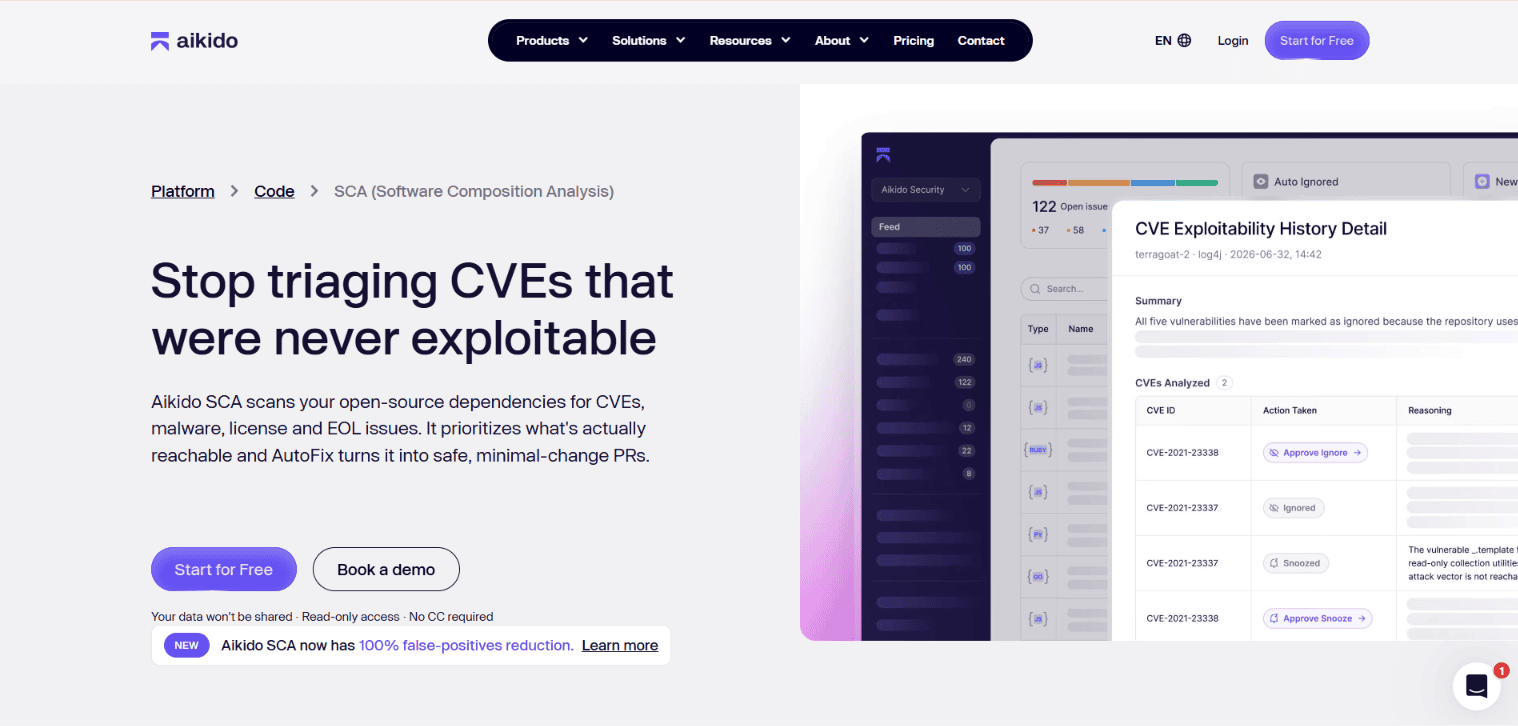
- Reachability checks: Aikido SCA checks whether your code really uses the flawed part of a package, and an Aikido AI agent logs its written reasoning for each CVE.
- Patched versions: Aikido Libraries makes hand-checked, patched copies of the exact versions in your lockfile (the file that records each package version), and a daily pull request can switch you to them.
- Plain license help: Aikido ranks risky licenses at the top, explains them in plain language and scans licenses inside containers.
- One-click SBOMs: Aikido creates an SBOM in one click, exports it as CycloneDX, SPDX or CSV and imports outside SBOMs.
Best for: teams that want flaws, malware, licenses and SBOMs in one place.
2. Snyk Open Source
Snyk built its SCA tool, Snyk Open Source, for developers. Snyk Open Source helps developers find, rank and fix security flaws and license problems in the packages they use.
Key Features
- IDE and CLI alerts: Snyk Open Source flags flawed packages in the IDE or the CLI (command line).
- Pull request and daily checks: Snyk Open Source scans pull requests before they merge and checks your projects every day.
- Risk ranking: Snyk Open Source ranks flaws with over 12 factors, such as reachability and EPSS and CVSS scores (standard scores for attack likelihood and severity).
- Custom fix pull requests: Snyk Open Source opens one-click fix pull requests, and you choose their title, description and commit message.
Best for: developer-led teams that want checks to show up in the IDE and in pull requests.
3. Mend SCA
Mend SCA finds, ranks and helps fix security and license risks in the open source parts of your apps. Mend SCA comes included in Mend AppSec.
Key Features
- Function-level checks: Mend SCA checks whether your code calls the vulnerable function, even in transitive dependencies (the dependencies of your dependencies).
- AI assistant support: Mend SCA feeds vulnerability and reachability data to AI code assistants so they can fix flaws.
- License rules: Mend SCA finds copyleft (licenses that require you to share changes), permissive and dual-licensed packages, and it enforces your license policies in pull requests.
- SBOM and VEX: Mend SCA exports and imports SBOMs and adds VEX data (a note on whether each flaw can be exploited).
Best for: teams that write code with AI assistants and want those assistants to get security data too.
4. Sonatype Lifecycle
Sonatype Lifecycle is Sonatype’s SCA tool for open source risk. Well, Sonatype Lifecycle helps teams lower vulnerability, license and architecture risks.
Key Features
- Ready-made policies: Sonatype Lifecycle includes 18 ready policies and over 30 custom constraints (extra rules).
- Automatic fixes and waivers: Sonatype Lifecycle opens Golden Pull Requests and can add waivers (approved exceptions) for low-risk issues automatically.
- Setup choices: Sonatype Lifecycle can run in the cloud, on your own servers or in fully disconnected setups through the Sonatype Air-Gapped Environment (SAGE).
- Accuracy claim: Sonatype claims a near-zero false positive and false negative rate for Sonatype Lifecycle.
Best for: teams with strict policy rules, and teams that must run fully offline.
5. FOSSA
FOSSA automates license compliance (following the rules of each open source license), security and SBOM management for third-party code. In addition to license work, FOSSA Scan finds dependencies and vulnerabilities across more than 30 languages.
Key Features
- Full-text license scanning: According to FOSSA, its full-text license scanning is 99.8% accurate, even for non-standard or modified licenses.
- Automatic attribution notices: FOSSA creates attribution notices (credit lists that some licenses require) automatically.
- SBOMs for any version: FOSSA creates SBOMs at any dependency depth, including for older versions of your software.
- SBOM Portal: FOSSA’s SBOM Portal lets you share SBOMs with customers.
Best for: teams with heavy license work and customers who ask for SBOMs.
6. Endor Labs
Endor Labs builds its dependency list by scanning your source code. Plus, Endor Labs SCA with Reachability shows which open source flaws your app can actually call.
Key Features
- Function-level reachability: Endor Labs checks reachability at the function level across direct and transitive dependencies.
- AI in your SBOM: Endor Labs lists AI models and AI services next to open source libraries in one SBOM.
- Fix order: Endor Labs ranks fixes using reachability, EPSS, fix availability and production context.
- Several fix types: Endor Labs AURI Fix picks a safe upgrade, a code change, a patch from Endor Patches or a healthier replacement package.
Best for: teams that build with AI models and want those models listed in the same SBOM as their libraries.
7. Checkmarx SCA
Checkmarx SCA looks for security flaws, malicious code and license problems in your open source code. Checkmarx SCA runs on the Checkmarx One platform.
Key Features
- Blocking policies: Each Checkmarx SCA policy can raise an alert, block a pull request or break the build.
- Path checks: Checkmarx SCA uses exploitable path analysis (a form of reachability) for Python, Java, JavaScript, C# and other languages.
- Fix guidance: Checkmarx SCA shows the effort and impact of each fix, and its AI suggests safer packages.
- SBOM support: Checkmarx SCA creates, imports and exports SBOMs. Checkmarx says Checkmarx SCA tracks more than 3 million open source packages across 13+ package managers.
Best for: teams already on Checkmarx One that want SCA rules to stop risky code before it merges.
8. JFrog Xray
JFrog Xray is JFrog’s SCA tool for finding, ranking and fixing security and license problems in open source and third-party parts. JFrog Xray works with JFrog Artifactory to scan packages, builds and container images.
Key Features
- Image layer scans: JFrog Xray checks each layer of a container image.
- Package support: JFrog Xray supports over 25 package types and technologies, including Docker, Maven, PyPI, npm and NuGet.
- Package blocking: JFrog Xray can block packages based on version age, update pace and end-of-life status. As per JFrog, JFrog Xray finds malicious packages using a database of over 4 million open source packages.
- Pipeline steps: JFrog Xray has IDE plugins and can run as a step in CI/CD pipelines. JFrog Xray comes with the Pro X, Enterprise X and Enterprise+ plans, in cloud or self-hosted form.
Best for: teams that already keep their builds and images in JFrog Artifactory.
How to Pick a Black Duck Alternative
Which need matters most to your team? So, use these checks to narrow the list. The tools named in each check are examples, and other tools on this list may cover it too.
- Where your developers work: Check that the tool runs in the IDE (the app where developers write code), pull requests or CI (automatic build and test steps) your team already uses.
- How much alert noise you get: Reachability helps you skip flaws your code never calls. Aikido, Snyk Open Source, Mend SCA, FOSSA, Endor Labs and Checkmarx SCA all use it.
- How you want fixes to arrive: Aikido Libraries, Snyk’s fix pull requests, Sonatype’s Golden Pull Requests and Endor Labs AURI Fix do much of the fix work.
- How heavy your license work is: FOSSA creates attribution notices, Sonatype Lifecycle covers over 2,000 licenses, and Aikido scans licenses inside containers.
- Where your packages live: JFrog Xray works with JFrog Artifactory, and Checkmarx SCA scans private Artifactory registries.
Conclusion
Picking a Black Duck alternative depends on how your team works. So, start with where your developers write code and how much license work your team handles. That’s because the right tool is the one your team will actually use.
From there, run a short trial with the tools that fit your list. Aikido, for example, covers vulnerabilities, malware, licenses and SBOMs together, and it can move you to patched copies of the package versions you already use.