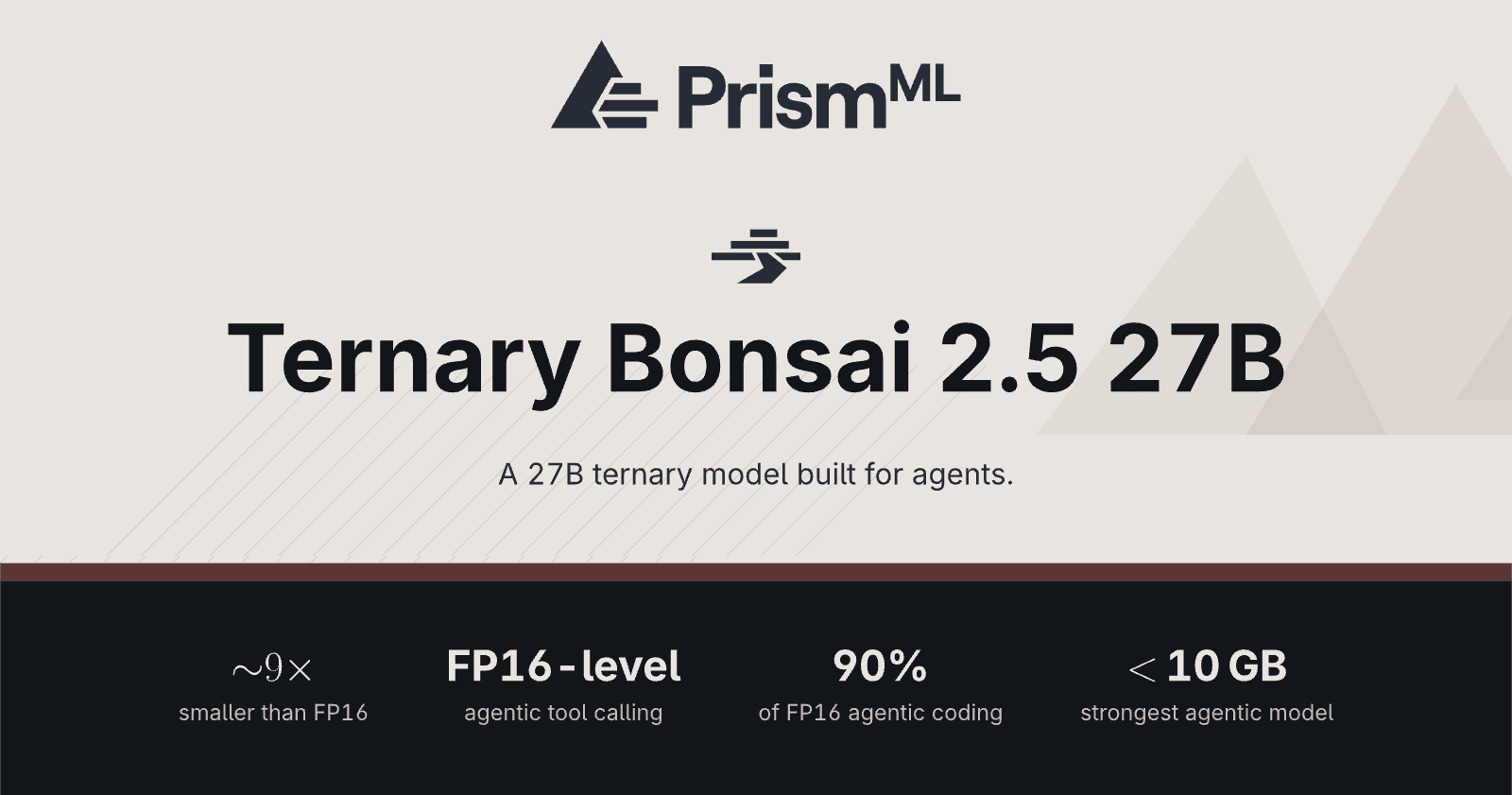
PrismML has released Ternary Bonsai 2.5 27B, a compressed version of Qwen3.8-27B for agentic tasks: tool calling, terminal work and code repair. Each weight takes one of three values, so the weights take up 5.93 GB instead of the original 53.8 GB. According to the technical report, Bonsai 2.5 averages 77.2 points on five tool-calling benchmarks, while the original Qwen3.8-27B scores 77.7. In agentic coding, Bonsai 2.5 keeps 90% of the original model’s score. In contrast, the previous version of the same size, Bonsai 2, kept 63% and solved no DeepSWE tasks.
The weights on Hugging Face and the launch scripts on GitHub are open under the Apache 2.0 license. However, the release includes neither the training code nor the training data.
How ternary Bonsai 2.5 27B works
A neural network usually stores each weight as a 16-bit number. In Bonsai 2.5, however, a weight can only be −1, 0 or +1. In addition, a shared FP16 multiplier sets the scale for each group of 128 weights. On average, a weight takes 1.76 bits instead of 16. To make three values enough, PrismML stores the weights in a rotated basis. A Hadamard transform mixes the values inside each block, so rare large values spread across the whole block.
Otherwise, the model keeps the Qwen3.8-27B architecture, including the 262K-token context and image understanding. The size and weight format are the same as in Bonsai 2, and the line started in July with the 1-bit Bonsai 27B. Still, the report does not describe how PrismML improved the agentic skills.
The most compact file, PTQ1_0, runs only in PrismML’s fork of llama.cpp for now. Meanwhile, the 7.67 GB Q2_0 file also runs on stock llama.cpp, starting with build b11556.
Tool calling
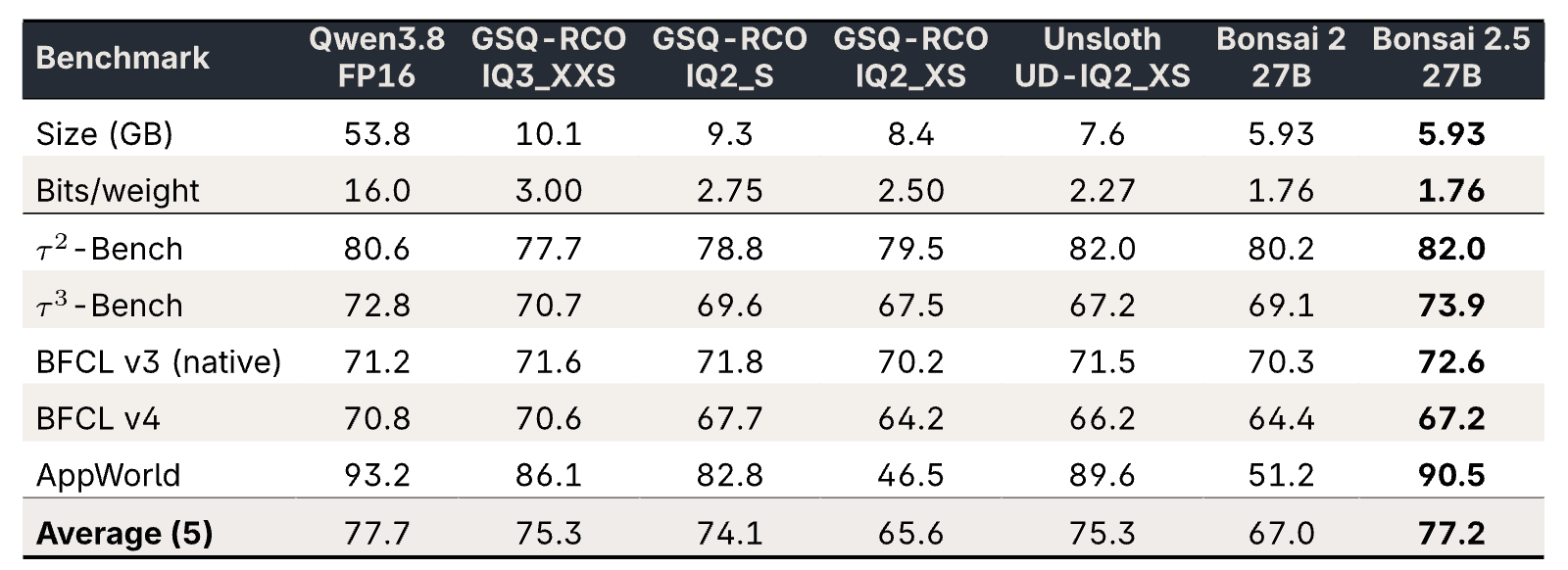
In τ²-Bench and τ³-Bench, the agent serves a simulated customer over many turns. BFCL, on the other hand, tests function calls. AppWorld gives the agent the APIs of nine everyday apps, such as email and a to-do list, and the agent writes code against them. Bonsai 2.5 beats the original model on τ²-Bench, τ³-Bench and BFCL v3. Compared with Bonsai 2, it improved the most on AppWorld: from 51.2 to 90.5 points, while Qwen3.8-27B scores 93.2.
Conventional quantized builds of the same Qwen3.8-27B from IST Austria and Unsloth weigh 7.6 to 10.1 GB. Yet all of them trail Bonsai 2.5 in average score. Moreover, they can fail unexpectedly. IQ2_XS is 1.4 times larger than Bonsai 2.5 and scores 79.5 on τ²-Bench, but only 46.5 on AppWorld. For example, in roughly every fifth task, it writes a long script full of guessed API calls. Then it marks the task as done without seeing a single response.
Agentic coding
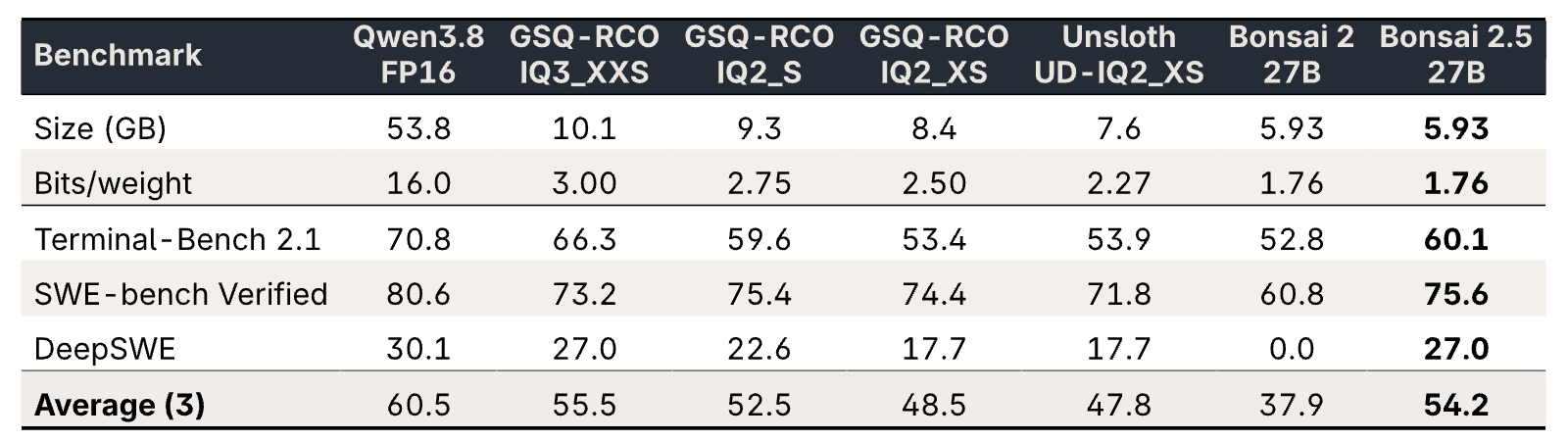
Compression usually hits agentic coding the hardest, because one wrong command ruins a whole long episode. Terminal-Bench 2.1 gives the agent tasks in the command line. SWE-bench Verified asks it to fix real bugs from GitHub repositories, and DeepSWE covers long engineering tasks. On SWE-bench Verified, Bonsai 2.5 solves 75.6% of tasks versus 80.6% for the original model. That is the best result among the compressed versions. On DeepSWE, it scores 27.0% versus 30.1%.
Its weakest benchmark, though, is Terminal-Bench 2.1, with 60.1% versus 70.8%. Here the IQ3_XXS build beats it with 66.3%. As a result, that build has a slightly higher average, 55.5 versus 54.2, although it is 1.7 times larger.
At the same time, general skills barely suffered. Across five categories of 16 benchmarks, from knowledge to image understanding, Bonsai 2.5 averages 82.12 points versus 84.32 for the original model. It lags the most in math, by 3.05 points (Table 4 on p. 5).
Speed
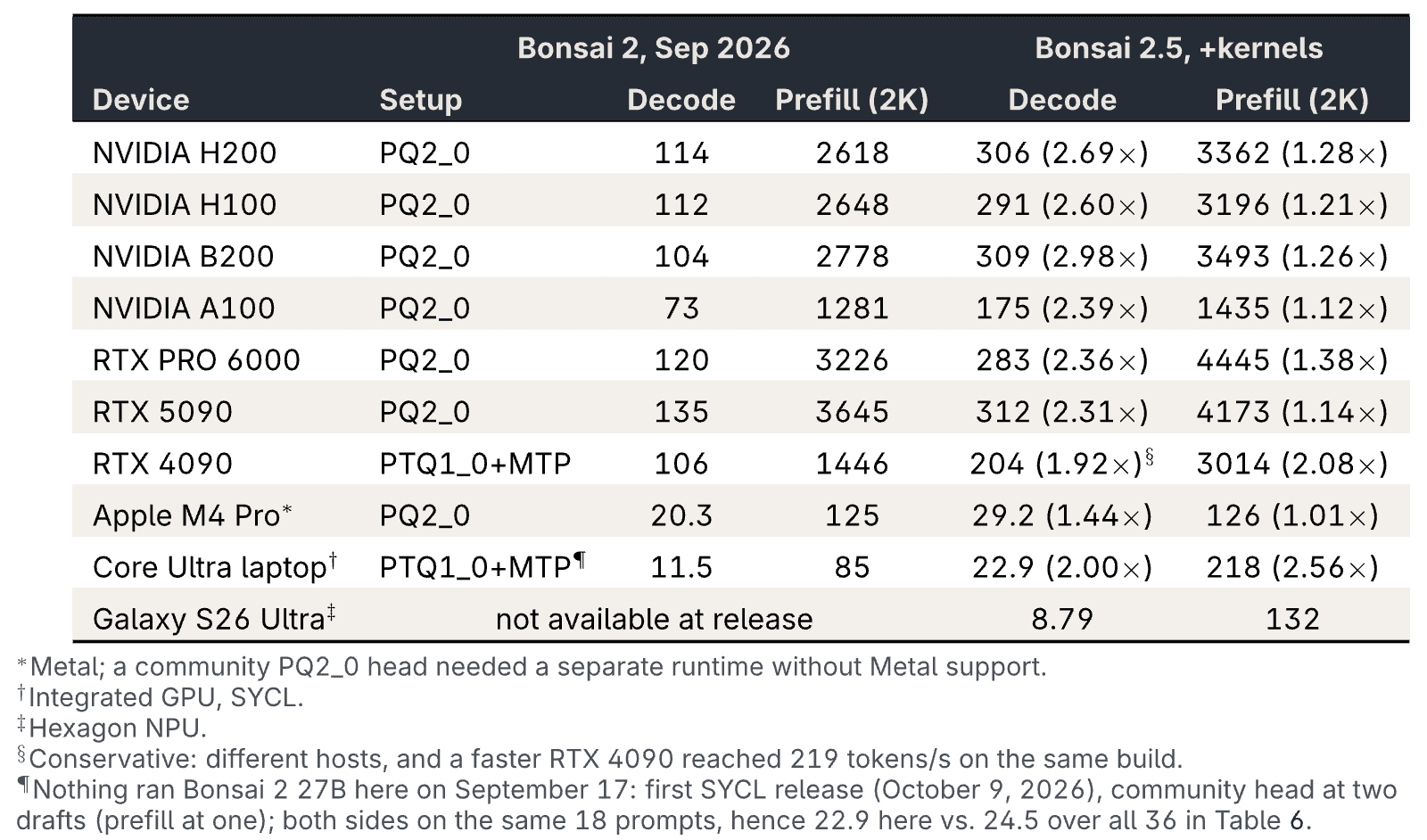
The release includes a multi-token prediction (MTP) head. This extra layer guesses the next three tokens on NVIDIA GPUs. Then the main model checks the guesses in one pass and keeps only the tokens it would have produced itself. Thus the output matches normal decoding up to rounding, while decoding gets 1.5-1.8 times faster. With kernels that are still in testing, Bonsai 2.5 27B produces 291 tokens per second on an H100, 204 on an RTX 4090 and 29.2 on an Apple M4 Pro.
Independent tests
Bonsai models are not in the Artificial Analysis index, and third-party tests of Bonsai 2.5 27B are still small. MODEL magazine ran the Q2_0 file on stock llama.cpp on a machine with eight cores, 15 GiB of RAM and no GPU. The model took about 9.5 GiB and produced 3.3 tokens per second. It handled a tool call and a simple Python function. However, a loop with a single tool call took about 48 seconds.
Kingy compared Bonsai 2.5 with Bonsai 2 on three small Python code fixes. The test ran on a MacBook Pro with an M4 Pro and 24 GB of memory. Both models passed all six attempts, but Bonsai 2.5 spent half as much time per attempt: a median of 58.5 seconds versus 118.7. Finally, according to a user report, the model took about 7.8 GB of VRAM on a 10 GB RTX 3080 with one parallel llama.cpp slot.
Bonsai 2.5 27B vs Qwen3.8-27B and Inkling
Comparisons of Bonsai 2.5 with other models rely on the developers’ numbers, and these depend on the agent harness. For example, PrismML measured 30.1% on DeepSWE for Qwen3.8-27B in the mini-SWE-agent harness. Qwen itself, however, reports 42.2% in Claude Code. Therefore, it is fairer to compare each model’s share of the Qwen3.8-27B result within the same developer’s measurements. The closest rival in size is Inkling 2 Mini from Thinking Machines Lab, a 20 GB open model for agents.
| Model, data source | Weights, GB | SWE-bench Verified | Terminal-Bench 2.1 | DeepSWE 1.1 |
|---|---|---|---|---|
| Bonsai 2.5 27B, PrismML | 5.93 | 75.6 | 60.1 | 27.0 |
| Qwen3.8-27B, PrismML | 53.8 | 80.6 | 70.8 | 30.1 |
| Inkling 2 Mini, Thinking Machines | about 20 | 79.2 | 71.6 | 48.2 |
| Qwen3.8-27B, Thinking Machines | 53.8 | 77.8 | 73.0 | 42.2 |
Share of solved tasks, %. PrismML measured the first two rows in one harness. The last two come from the Thinking Machines table, where harnesses may differ.
In PrismML’s measurements, Bonsai 2.5 keeps 85-94% of the Qwen3.8-27B results. Meanwhile, in the Thinking Machines table, Inkling 2 Mini stays at or above the Qwen level, at 98-114% (our calculation). On the other hand, the Bonsai 2.5 weights need 3.4 times less memory. In the independent Artificial Analysis index 5.0.2, Inkling 2 Mini and Qwen3.8-27B also tie at 20 points.
Despite their names, Inkling Small and Inkling 2 Small are server models with 276 and 594 billion parameters. According to Thinking Machines, the first solves 80.2% of SWE-bench Verified tasks, and the second solves 72.1% of DeepSWE tasks. In the Artificial Analysis index, they score 10 and 31 points.
Who Bonsai 2.5 27B is for
PrismML names Terminal-Bench 2.1 as the model’s weak spot. Its next release will focus on tasks that take many hours, such as MLE-bench and SWE-bench Pro. Even so, Bonsai 2.5 suits a local agent on a GPU or a Mac with 10-24 GB of memory. According to PrismML, it handles tools as well as the original model. However, if you can spare 20 GB of memory, Inkling 2 Mini is stronger in agentic coding by the developers’ numbers.