Tencent’s WeChat AI lab has released the weights of WePocketModel 1.0 (WePM), a family of compact multimodal models in 2B and 4B sizes built to run on the user’s own device. One model stands in for three separate ones: it searches across images and text, answers questions about images and text, and makes decisions by picking from predefined options. In an example the developers provide, a customer has received the wrong item and asks for a replacement, and the model chooses among three responses: arrange a replacement, ignore the request or refuse. According to the technical report, WePM-4B keeps pace with the best specialized models: its average embedding score is 72.86 against 72.83 for Qwen3-VL-Embedding-8B, its generation score is 62.41 against 61.83 for Qwen3.5-4B, and its decision score is 61.11 against 61.06 for d3-mini-4.5B. Among models that combine retrieval and generation, it raised the best joint score from 38.15 to 52.74. Tencent has published the weights on Hugging Face and the inference code on GitHub under the Apache 2.0 license; training code and training data are not part of the release.
In BF16, the WePM-4B weights take up about 8 GB, while the most compact of the three-model stacks it is compared against needs 21 GB.
What WePocketModel 1.0 can do
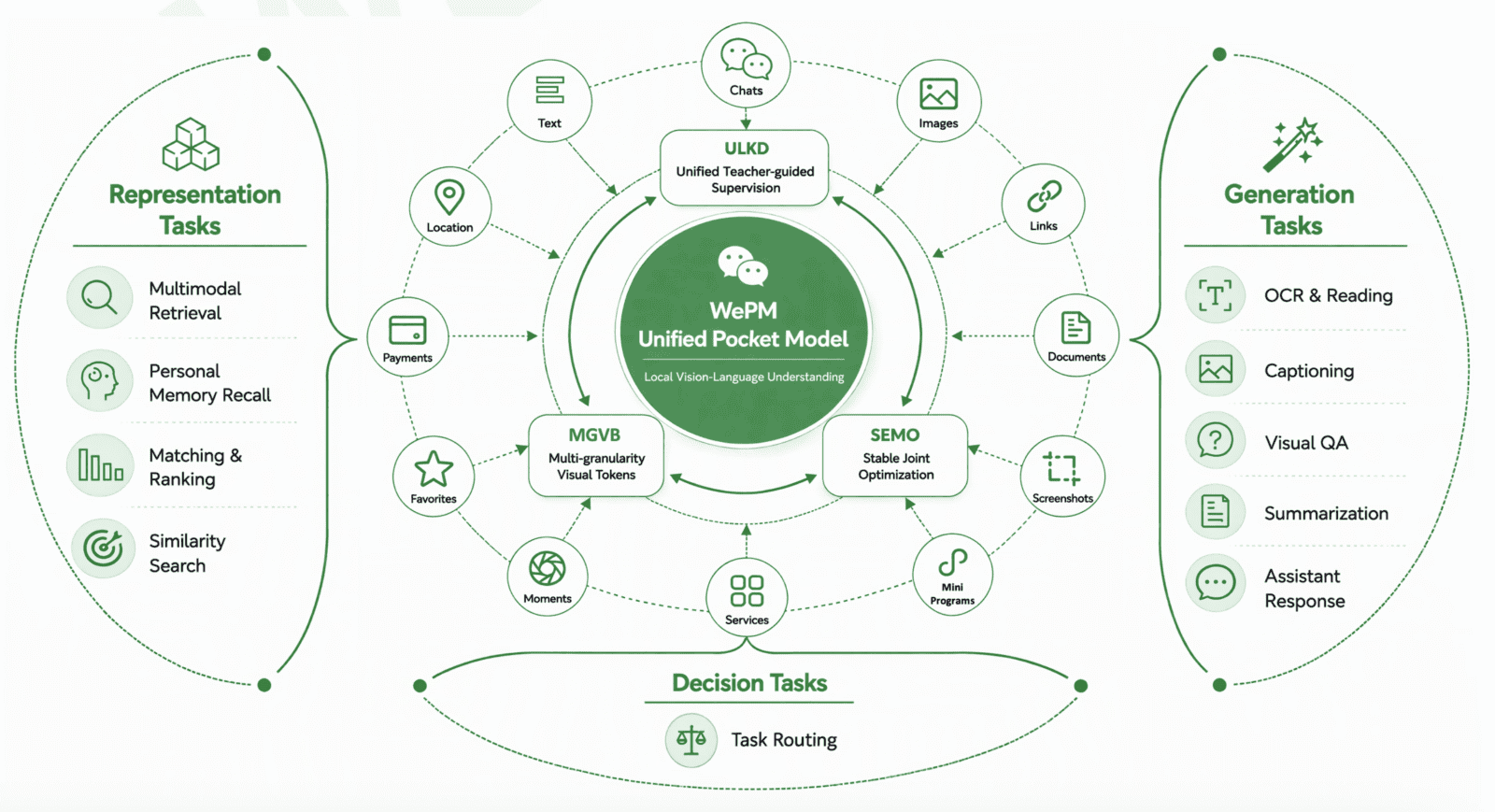
A local assistant needs three skills at once: find the right item among personal photos and texts, answer based on what it found, and choose the next action. If each skill gets its own model, the device ends up holding several copies of an image encoder and a language backbone. In WePM those are shared, and only the outputs differ.
Search relies on embeddings of 64 to 2,048 values: the closer the vector of a photo or text is to the vector of the query, the higher it ranks in the results. Based on what it finds, the model answers in text; the same way, it reads text in images and describes pictures. Decisions work like a multiple-choice test: the app describes the situation and supplies ready-made options, and the model returns one of those options rather than free text. The app receives the selected option and can act on it right away. Scoring on a scale and yes-or-no answers work the same way. For a scale, the app lists a range of options – for example, from “not suitable” to “fully suitable” – and the model picks one.
How the model is built
Both versions are fully fine-tuned Qwen3.5-4B and Qwen3.5-2B models. According to the authors, 4B is close to the practical upper limit for a dense model on devices in the Apple M3 class. Training used roughly 100 million samples with sequences of up to 8,192 tokens, and generation, embedding and decision batches were sampled in a 7:5:1 ratio.
The tasks need different levels of image detail, and their gradients pull the shared weights in different directions. The authors address this with three mechanisms and tested each one separately on 16 benchmarks. Without them, joint training reaches a Joint score of 37.77 (the average of the retrieval and generation scores):
- MGVB splits a budget of 512 visual tokens between the overall view of an image, its regions and fine-grained fragments, choosing regions and fragments based on the text of the query. Result: 41.90;
- ULKD adds guidance from two frozen teachers: Qwen3.5-27B scores the texts the student itself generates, and the WeMM-9B embedding model shows how to rank candidates. Result: 51.70;
- SEMO fixes each task’s weight and its share of batches in advance and accumulates gradients one batch at a time. Result: 49.78 versus 46.23 for the adaptive FAMO method. This sequential computation uses up to 76.23 GiB of GPU memory, while running the batches concurrently would require 209.98 GiB on cards with 96 GiB.
Results and comparisons
There are no independent evaluations of WePM yet, and the competitor numbers in Tencent’s report differ noticeably from official figures in places. WePM-4B’s lead over the nearest competitor on average score is small: 0.03 to 0.58 points (our calculation). But the competitors here are three different models: its own base, Qwen3.5-4B, in generation; Qwen3-VL-Embedding-8B, twice its size, in embeddings; and d3-mini-4.5B in decisions. The comparison does not include OmniEVIE-4B, Tencent’s retrieval-only model that is also built on Qwen3.5-4B: it came out after the report.
| Model | Generation (39 benchmarks) | Embeddings (30 benchmarks) | Decisions (7 benchmarks) |
|---|---|---|---|
| WePM-4B | 62.41 | 72.86 | 61.11 |
| WePM-2B | 55.69 | 70.73 | 55.81 |
| Qwen3.5-4B | 61.83 | — | 40.19 |
| MiniCPM-o 4.5 (9B) | 60.79 | — | 44.22 |
| Gemma-4 E4B-it | 50.02 | — | 39.62 |
| Qwen3-VL-Embedding-8B | — | 72.83 | — |
| d3-mini-4.5B | — | — | 61.06 |
Average scores from Tencent’s report. A dash means the model was not evaluated.
Against models that also combine retrieval and generation, WePM-4B was tested on the same 16 benchmarks. The Joint score rose from 38.15 for ULME to 52.74. Most of the lead over the strongest competitors comes from generation (up to +30.44 points in math); in retrieval it is more modest: +7.17 for image retrieval and +2.64 for text retrieval. The authors reproduced the competitors’ results themselves.
Tencent also compared WePM-4B with six stacks of three specialists: a Qwen3.5-4B or MiniCPM-o 4.5 generator, an embedding model from 2B to 8B, and d3-mini-4.5B. The stacks need 21 to 43 GB for BF16 weights and reach a harmonic mean across the three task groups of 64.21 to 64.82; WePM-4B needs 8 GB and scores 65.06. For comparisons like this, the authors introduced a metric called HCD: the number of task groups multiplied by that mean and divided by memory. For WePM-4B it is 0.244, 2.64 times higher than for the best stack. Memory was counted at two bytes per parameter, excluding the KV cache and activations.
Where WePM-4B falls behind Qwen3.5-4B
Even in Tencent’s own measurements, WePM-4B trails its base model in visual math, scientific charts, instruction following and function calling. The authors acknowledge that the model’s agentic skills have degraded: it was not separately fine-tuned for tool use.
| Benchmark | WePM-4B (Tencent) | Qwen3.5-4B (Tencent) | Qwen3.5-4B (Qwen) |
|---|---|---|---|
| Knowledge, MMLU-Pro | 66.00 | 59.69 | 79.1 |
| Science questions, GPQA Diamond | 54.04 | 44.44 | 76.2 |
| Visual math, MathVista | 68.90 | 81.00 | 85.1 |
| Scientific charts, CharXiv | 42.56 | 52.20 | 70.8 |
| Text recognition, OCRBench | 85.70 | 86.10 | 85.0 |
| Instruction following, IFEval | 51.44 | 55.76 | 89.8 |
| Function calling, BFCL v3 | 60.80 | 70.60 | — |
Official figures are from the Qwen3.5-4B model card, which lists MathVista (mini) and CharXiv (RQ), and BFCL only in its V4 version.
The third column shows the numbers Qwen itself publishes for Qwen3.5-4B, and in places they differ sharply from Tencent’s measurements. On GPQA Diamond, WePM-4B scores 54.04, while its base model gets 44.44 in Tencent’s runs and 76.2 on Qwen’s model card. Against the first figure WePM-4B is ahead by almost 10 points; against the second it trails by 22. Measured against the official numbers, it beats its base model only on OCRBench. There is one more such case outside the table: on HallusionBench, WePM-4B scores 72.28, while the Qwen3.5-4B model card lists 65.0.
The report does not explain the discrepancy, since it does not disclose evaluation settings. One possible cause is reasoning mode: Qwen3.5 thinks before answering by default, and this mode may have been turned off in Tencent’s runs. This explanation is supported by the fact that the gap is large on knowledge and science tests and nearly disappears on OCRBench, where the model only has to read text from an image. So the comparison with the official numbers is not like-for-like.
How to run it on your own computer
The 4B and 2B versions are available in Transformers and GGUF formats, and also in MLX for Apple silicon. For 4B on an Nvidia GPU, the developers recommend at least 16 GB of VRAM; on a CPU, where the model runs in FP32, they recommend 24 GiB of RAM. According to the model card, on an M3 Pro the MLX version of 4B in BF16 peaks at 8.99 GiB of memory and generates 13.9 tokens per second, and with 4-bit quantization it uses 4.25 GiB and generates 30.6 tokens per second.
In the GGUF version of 4B with the language part in Q4_K_M, the weight files take 3.42 GB on disk versus 9.14 GB in BF16; for the 2B version, it is 1.98 GB versus 4.48 GB. The image encoder and task heads are not quantized. GGUF runs through WePM’s own runtime on a pinned revision of llama.cpp; once it is built (CMake 3.20+ and a C++17 compiler are required), the following command starts generation on the CPU:
WEPM_MODEL=tencent/WePocketModel1.0-4B-GGUF bash examples/cpu/generation/run.sh single_textThe bottom line
WePM-4B suits apps that need search over their own data, answers about images and choice of the next action all on the device: according to Tencent, a single model with 8 GB of weights holds the level of a stack of specialized models totaling 21–43 GB. For agents with tool calling, visual math and scientific charts, the base Qwen3.5-4B is the better choice.