Alibaba has added Qwen-Audio-3.1-Live to QwenCloud – a voice model for assistants and support lines that keeps the conversation going while the user’s request is being processed. It listens, asks follow-up questions and responds by voice in real time, while a background model looks up an order, checks stock levels or adds up a bill. The background role can be filled by Qwen4-Max or another model from the QwenCloud catalog. Once the result is ready, the voice model reads it out. An hour of conversation costs $2.56, and the background model is billed separately. What Live really adds is a way to split work between models. OpenAI shipped the same design first: GPT-Live-1 reached its API two and a half months earlier.
Qwen has not published benchmark results for Live, and there are no independent measurements yet. The previous generation is the closest reference point: at launch, Qwen-Audio-3.0-Realtime Plus topped the Artificial Analysis Speech to Speech index with 84.1% against 79.1% for GPT-Realtime-2.1 High, BetaNews reported.
How Qwen-Audio-3.1-Live splits work between models
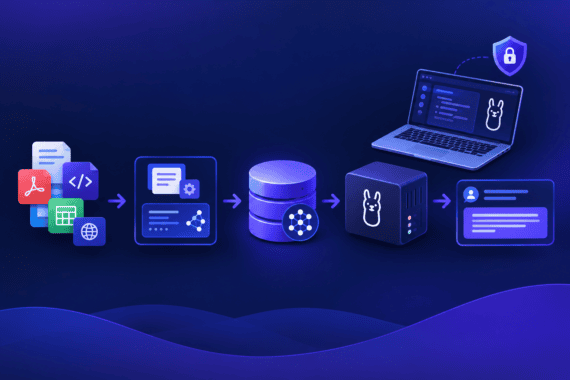
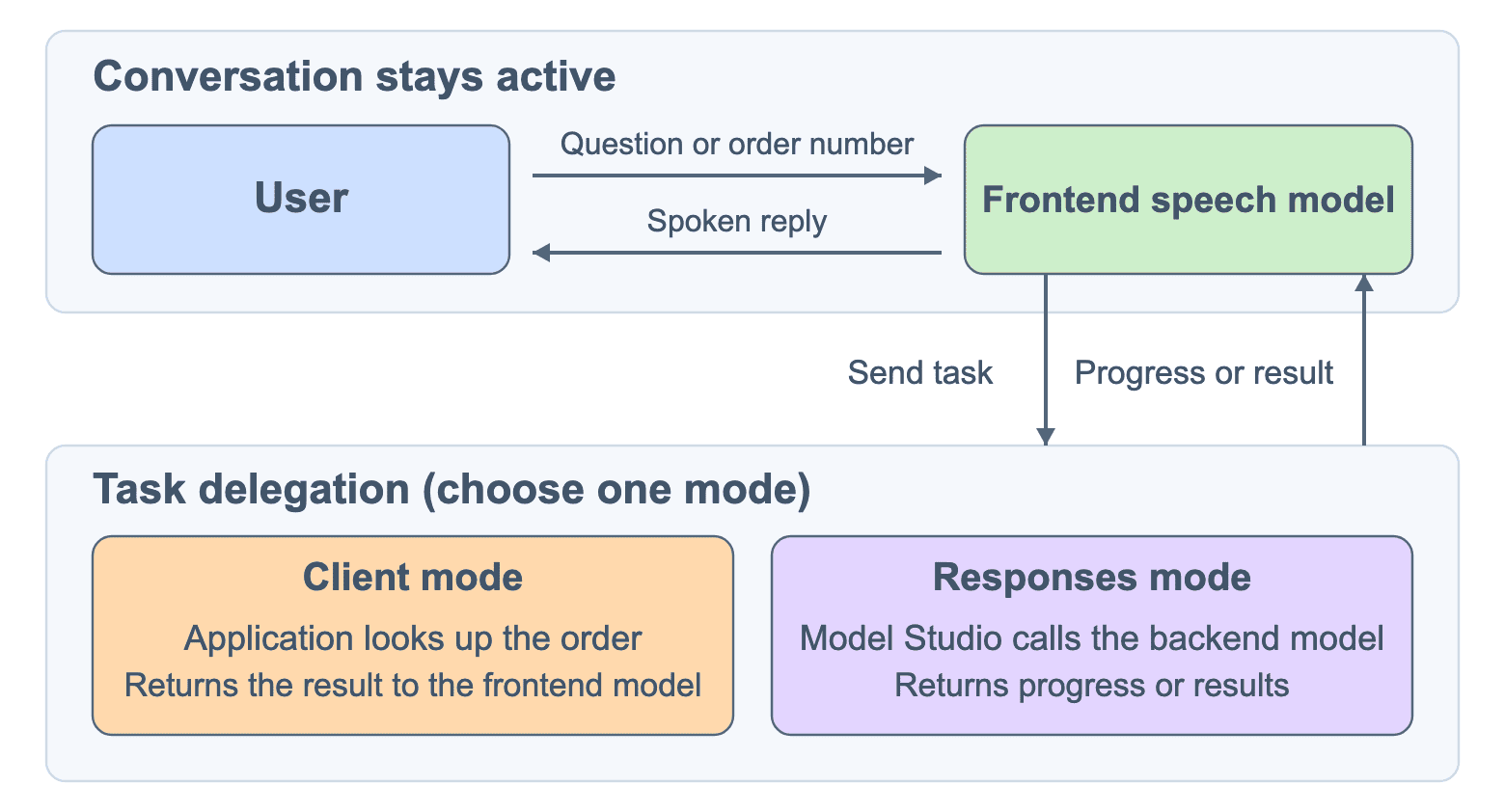
A voice agent in Live has two parts. The frontend is the voice model: it runs the dialogue, asks for missing details and speaks the answers. Tasks that need business APIs or heavier reasoning are handed off, and the frontend keeps talking to the user while it waits. In the guide’s example, the user gives an order number, and the model reports on the progress of the lookup and then reads out the result.
Who does the task depends on the mode. In Client mode, the application handles it – through its own API, workflow or agent – and can validate, combine or filter the result before the model speaks it. In Responses mode, QwenCloud itself calls the designated background model with its own instructions and tools. In the documentation’s example that model is Qwen4-Max: it works out the cost of 13 items at 327 yuan each, and the voice model reads out the total of 4,251 yuan.
Tools can be attached on both sides. For simple actions where speed matters, such as a request to play music, the documentation recommends leaving them to the frontend: it calls the function and the application executes it. Multi-step tasks – for example, rescheduling a trip, which means checking the booking, the change rules and available departures – are better given to the background model, with the voice model only presenting the options.
Audio travels over WebSocket alone or over WebSocket plus WebRTC or AOQ, and mid-call the user can add details as text – for example, typing a product name. For duplex conversations, where both sides can interrupt each other, the documentation’s examples use qwen-audio-4.0-realtime-preview as the frontend. That model does not yet appear in the QwenCloud changelog or price list.
Live vs GPT-Live-1, xAI and Qwen’s realtime models: quality and price
Live’s closest counterpart is OpenAI’s GPT-Live-1, which works the same way: a voice model runs the conversation and hands reasoning and tool use to a background model. It has the same two delegation modes under the same names, Responses and Client, and the background model can be GPT-6 Astra, Luna or a third-party model.
The quality of Live’s answers depends on which voice and background models you pick. For the previous Qwen-Audio-3.0-Realtime Plus, Artificial Analysis measurements showed both a strength and a weakness. It led all three parts of the index – speech reasoning, conversational dynamics and agentic tasks – but took roughly 4 seconds to start responding, against 1.14 seconds for GPT-Realtime-2 High. The company has not disclosed latency for Live itself.
On price, Live lands in the middle. To compare, we converted the rates into the cost of an hour of conversation: Qwen realtime models bill audio in tokens at 12.5 tokens per second, xAI’s voice API charges per minute, and OpenAI, like Qwen with Live, meters session time by the second.
| Model | Billing basis | Rate | One hour of conversation, $ | Concurrent sessions | Built-in web search |
|---|---|---|---|---|---|
| qwen-audio-3.1-live | Session seconds, including pauses | $0.000710 per second | 2.56 + background model | 5 WebSocket connections | No |
| qwen-audio-3.1-realtime-plus | Audio tokens | $6.4 / $24 per 1M (input / output) | 1.37 | — | Yes |
| qwen-audio-3.1-realtime-flash | Audio tokens | $0.93 / $1.87 per 1M (input / output) | 0.13 | — | Yes |
| gpt-live-1 (OpenAI) | Session seconds, cheaper on standby | $0.05 per minute, $0.02 on standby | 3.00 + background model | 50–500, by account tier | — |
| xAI Speech to Speech API | Session minutes | $0.08 per minute | 4.80 | 10 per team | Yes |
Rates from the QwenCloud price list (Singapore region) and the OpenAI and xAI documentation. The hourly cost for the realtime models is an editorial estimate: 45,000 audio tokens in and the same out, with no text tokens. The hourly cost for Live is the per-second rate multiplied out; for GPT-Live-1, it is the per-minute rate for an active session. A dash means no data.
A minute of Live costs $0.0426 – about 15% less than GPT-Live-1’s $0.05 and almost half of xAI’s $0.08. With both Live and GPT-Live-1, the background model comes on top. Qwen’s own realtime models are cheaper: even with audio flowing both ways for the full hour, realtime-plus comes to $1.37 and realtime-flash to $0.13. That makes Live roughly 1.9x and 20x more expensive respectively – the price of delegating tasks without gaps in the conversation (editorial estimate).
Use cases
The main use case is voice support and assistants that need to reach into a business system mid-conversation: check an order or stock levels, move a booking. Client mode suits companies that already have their own API or agent, since the answer can be checked before the customer hears it. In Responses mode, the background model with its instructions and tools is set in the session configuration, so there is no need to call it from your own code.
Live’s weak points lie in its limits. Only five WebSocket connections can be open at once, and every conversation takes at least one; xAI’s limit is 10 sessions per team, and OpenAI allows 50 to 500 concurrent sessions depending on the account tier. Live has no built-in web search, structured output, context caching, batch inference or fine-tuning, and system instructions plus function descriptions for the voice model are capped at 65,536 tokens. On the other hand, session length is unlimited, whereas xAI caps sessions at 120 minutes.
You pay for the entire connection time, including silence, pauses and text messages, and every session is billed for at least 3 seconds. If an assistant keeps the line open for long stretches, the bill grows even without any talking. xAI applies the same rule in its mode with automatic turn detection, while in push-to-talk mode it charges only for audio sent and received. OpenAI lowers its rate from $0.05 to $0.02 per minute while inference in a WebRTC session is paused.
Pricing and access
Qwen-Audio-3.1-Live is available through the QwenCloud API in the Singapore and Beijing (China North 2) regions under the ID qwen-audio-3.1-live. A five-minute call costs $0.21 for the voice part (editorial calculation). The service reports the accumulated session duration every 5 seconds and the final figure when the session closes, so costs can be tracked inside the application.
The background model is billed for its own tokens. Qwen4-Max in Singapore costs $1.5 per million input tokens and $4.5 per million output tokens. A task with 10,000 input and 1,000 output tokens (editorial assumption) comes to about $0.02, and a five-minute call with two such tasks to about $0.25. With five conversations running at once, an hour at full load costs $12.78 for the voice part alone (editorial estimate: 5 × $2.556).
For developers already using Qwen-Audio-Realtime, the documentation includes a migration guide: business interfaces and tool implementations stay as they are, while event handling and task logic change.
The bottom line
Live makes sense where a voice agent has to call business systems or a heavy model like Qwen4-Max mid-conversation and a pause while the task runs is unwelcome. Per minute of voice it charges about 15% less than GPT-Live-1, which works the same way, and almost half what xAI does, but noticeably more than Qwen’s own realtime models, so for simple dialogue without long-running tasks realtime-flash or realtime-plus is the cheaper choice. For a high-volume call center, the cap of five concurrent connections will be the bottleneck; for scenarios that need internet search, the lack of built-in search will be. There are no independent measurements of Live’s quality or latency yet, so until they appear it can mostly be compared on price.