Researchers from Tencent’s WeChat Vision team and Nanjing University have introduced WeVisForensics, an AI agent for AI-generated video detection. A main agent picks from six experts for appearance, physics, common sense, on-screen text, voice and speech. It also decides which part of the video to show them and when it has enough evidence for a verdict. The experts reply with timestamped reports, so anyone can check the decision against the frames. Unlike earlier agent-based detectors, WeVisForensics also trains its visual experts on the main agent’s own requests. Built on Qwen3.5-4B, the agent averages 95.2% accuracy on four benchmarks, 9 points above the previous leader, VideoVeritas. On the new AgenticCue benchmark with clips from Sora 2, Veo 3.1 and Kling 3.0, it scores 97-98.8% in all five artifact categories, while VideoVeritas gets 69.3% on audio.
The inference code, the demo and the LoRA adapters are open under Apache 2.0. A single GPU with 24 GB of memory is enough to run the agent. However, the ForenCue-30K dataset and the training code are not public, and the authors promise to release AgenticCue later. The code is on GitHub, the weights are on Hugging Face, and examples are on the project page.
How AI-generated video detection works in WeVisForensics
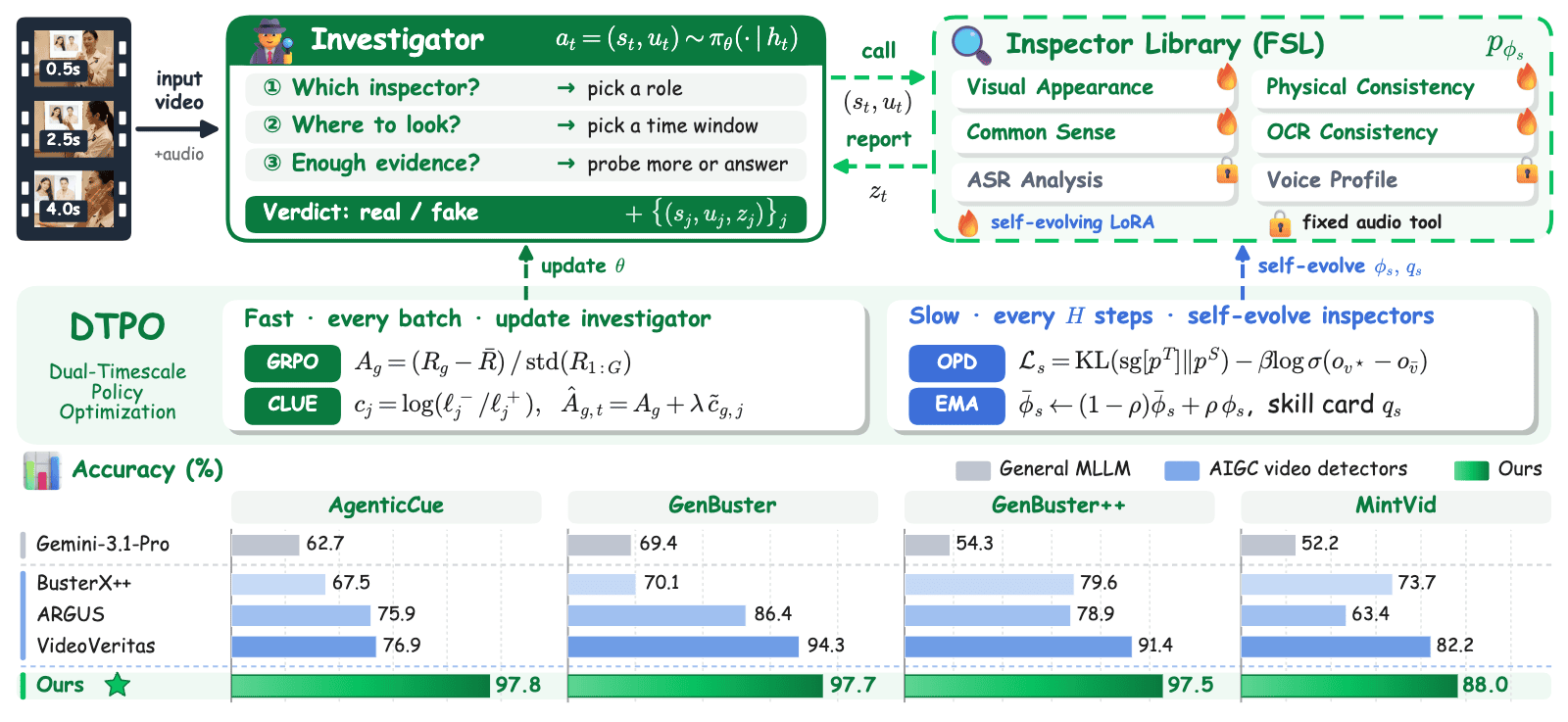
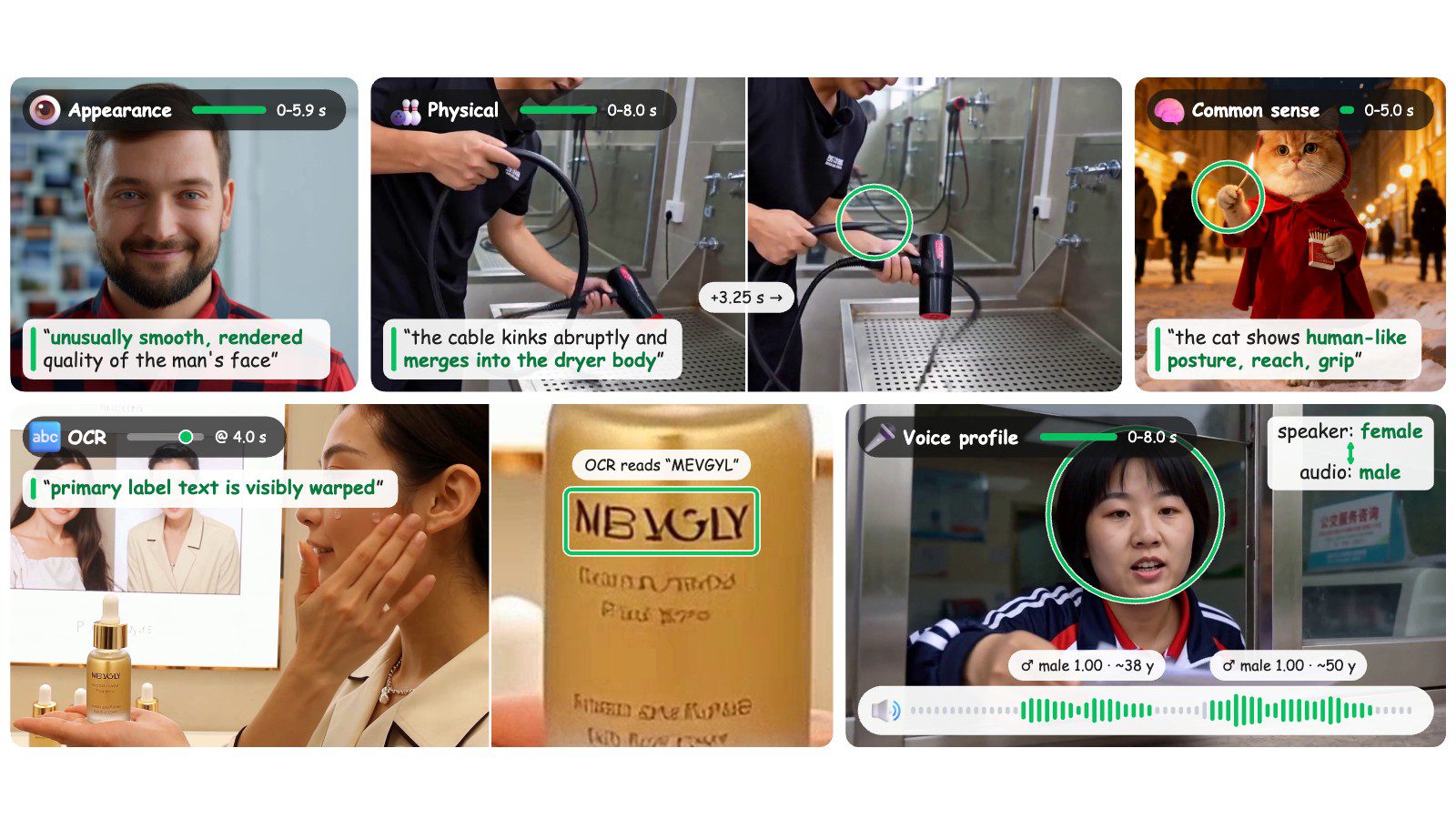
First, the main agent skims the clip. It sees up to 16 frames sampled evenly across the whole video and learns how long the video is and whether it has sound. At each step, it writes down its reasoning and then either calls an expert or gives a verdict. It can make at most four calls across the six experts and cannot repeat a call. The four visual experts run on the same Qwen3.5-4B as the main agent, but each has its own LoRA adapter:
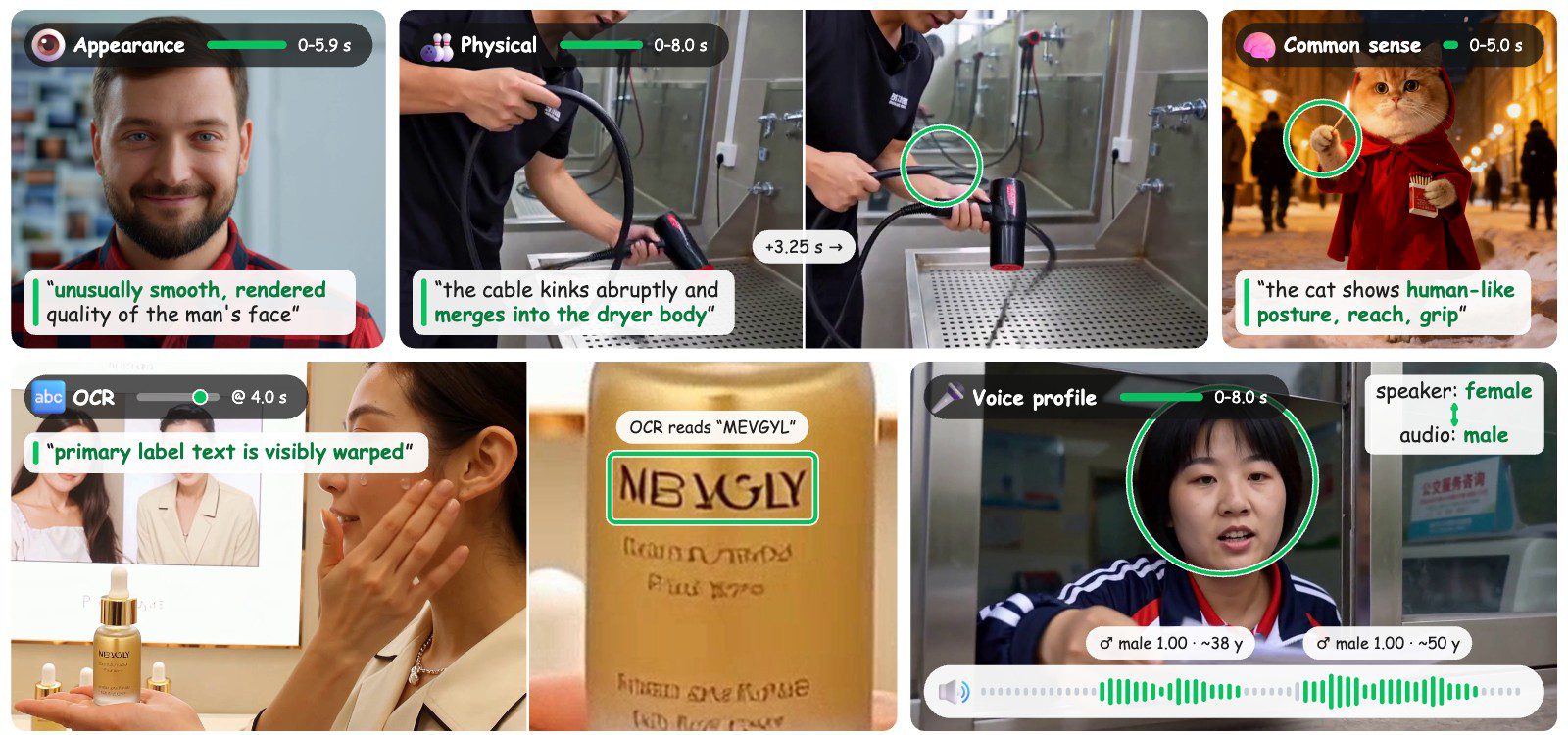
- Appearance: texture in motion, hair, fingers, teeth, lighting, shadows and reflections;
- Physics: body motion, object shapes, contact between objects, liquids and objects that vanish behind obstacles;
- Common sense: cause and effect, the order of events and implausible scenes such as a cat behind the wheel;
- On-screen text: PaddleOCR finds the text, and the expert looks for merged or broken letters in zoomed-in crops;
- Voice and speech: two fixed tools estimate the speaker’s gender and age and look for an unnaturally even speech rhythm in the transcript.
The first three experts view the chosen window at 2 frames per second. Each one answers with a verdict (artifact found, no artifact or cannot tell), a confidence level and an explanation that cites specific seconds. Motion blur, compression and stylization do not count as signs of generation.
Why the experts need training too
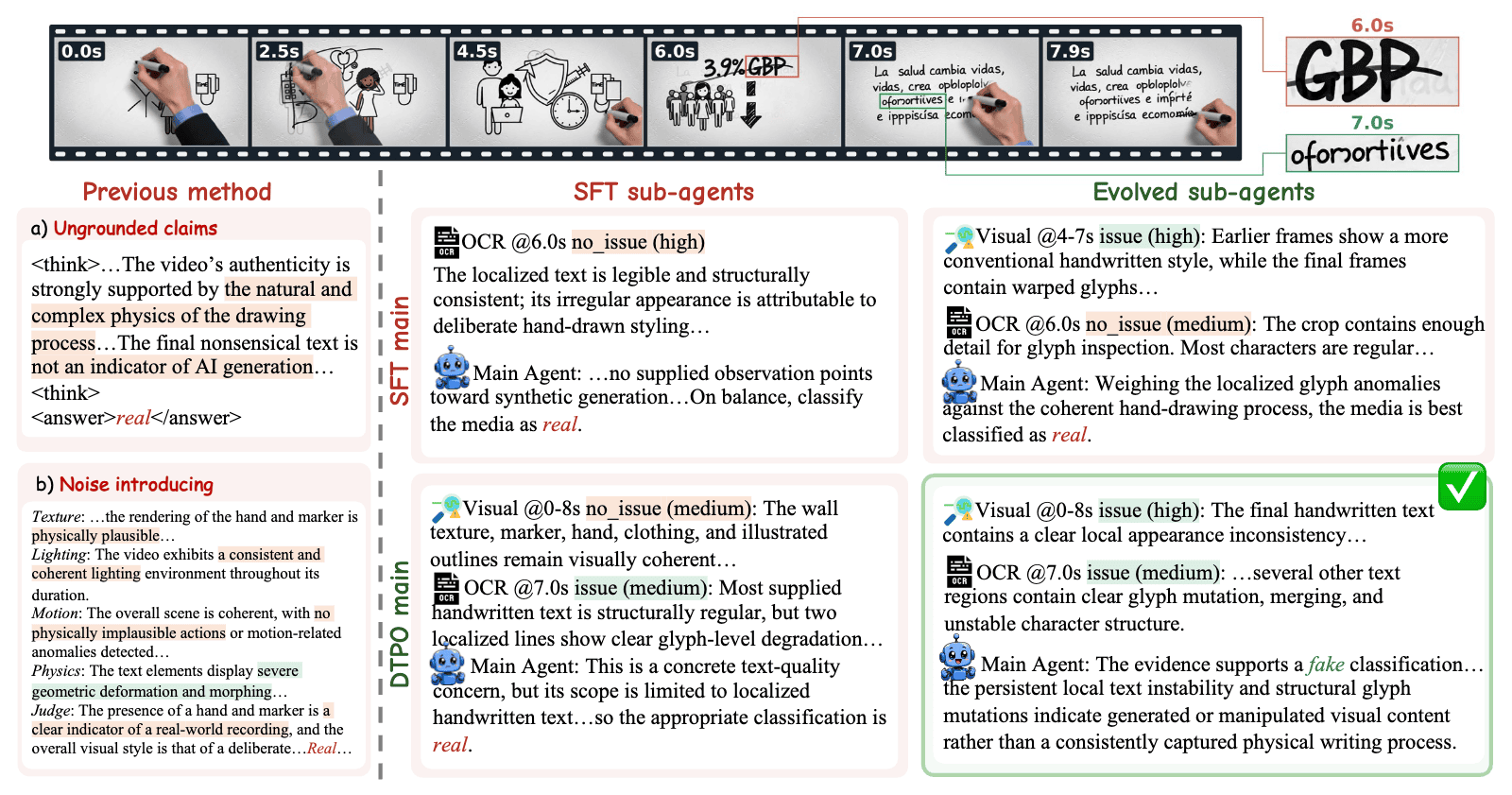
Chain-of-thought detectors look at the whole video in a single pass. As a result, they miss artifacts that last only briefly or cover a small part of the frame. Agent-based approaches to AI-generated video detection, such as ARGUS, train only the orchestrator on top of frozen experts. However, if an expert cannot see an artifact, no amount of routing will fix that. Updating both sides on every batch does not work well either. The main agent decides what the experts see, while their answers change its decisions, so each becomes a moving target for the other.
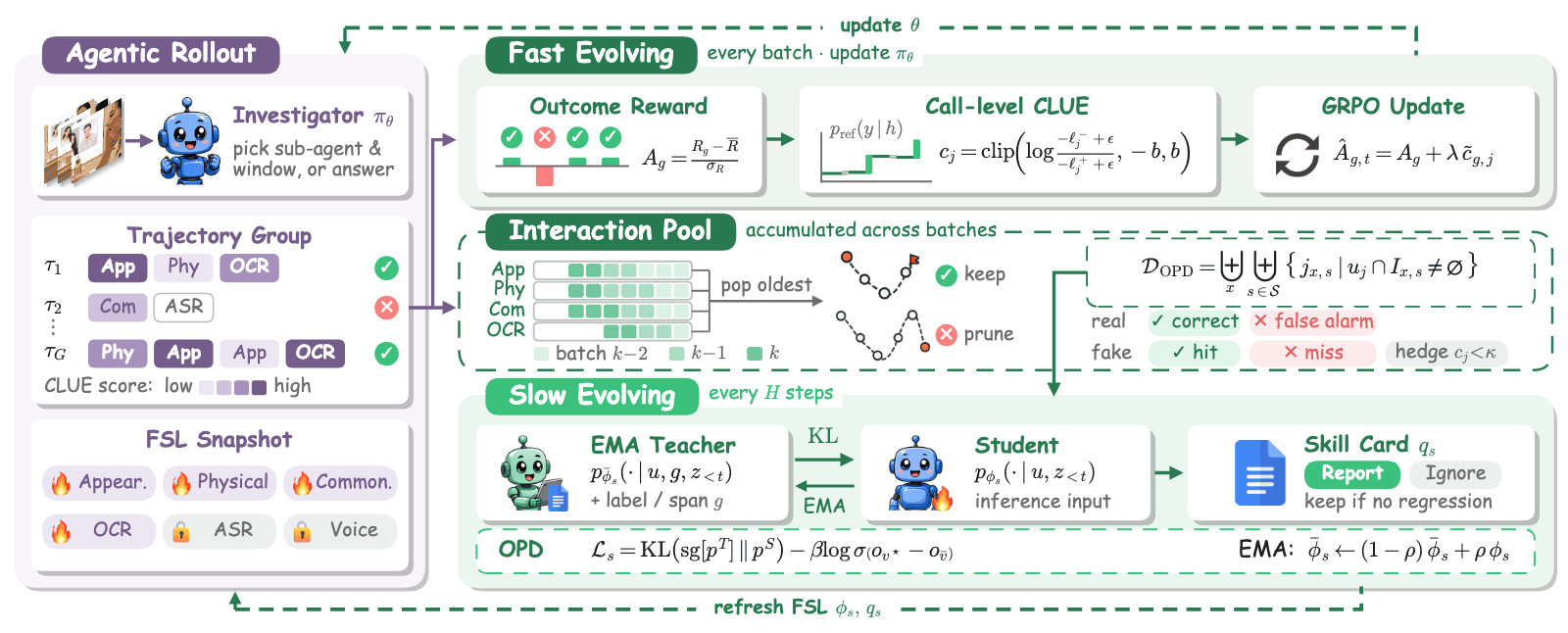
DTPO: fast and slow training
After supervised fine-tuning (SFT) on ForenCue-30K, the agent and the experts train together with DTPO (Dual-Timescale Policy Optimization):
- Fast process. The main agent updates on every batch through GRPO and earns a reward for a correct verdict that follows the protocol. In addition, CLUE scores each call: a frozen Qwen3.5-4B checks how much the expert’s report raised the probability of the right answer;
- Slow process. Every 20 steps, the experts fine-tune on stored calls whose window overlaps an annotated artifact. The teacher, a slowly updated copy of the expert, sees the frames, the label and the artifact intervals. Meanwhile, the student sees only the frames and pulls its answers toward the teacher’s (distillation with privileged information);
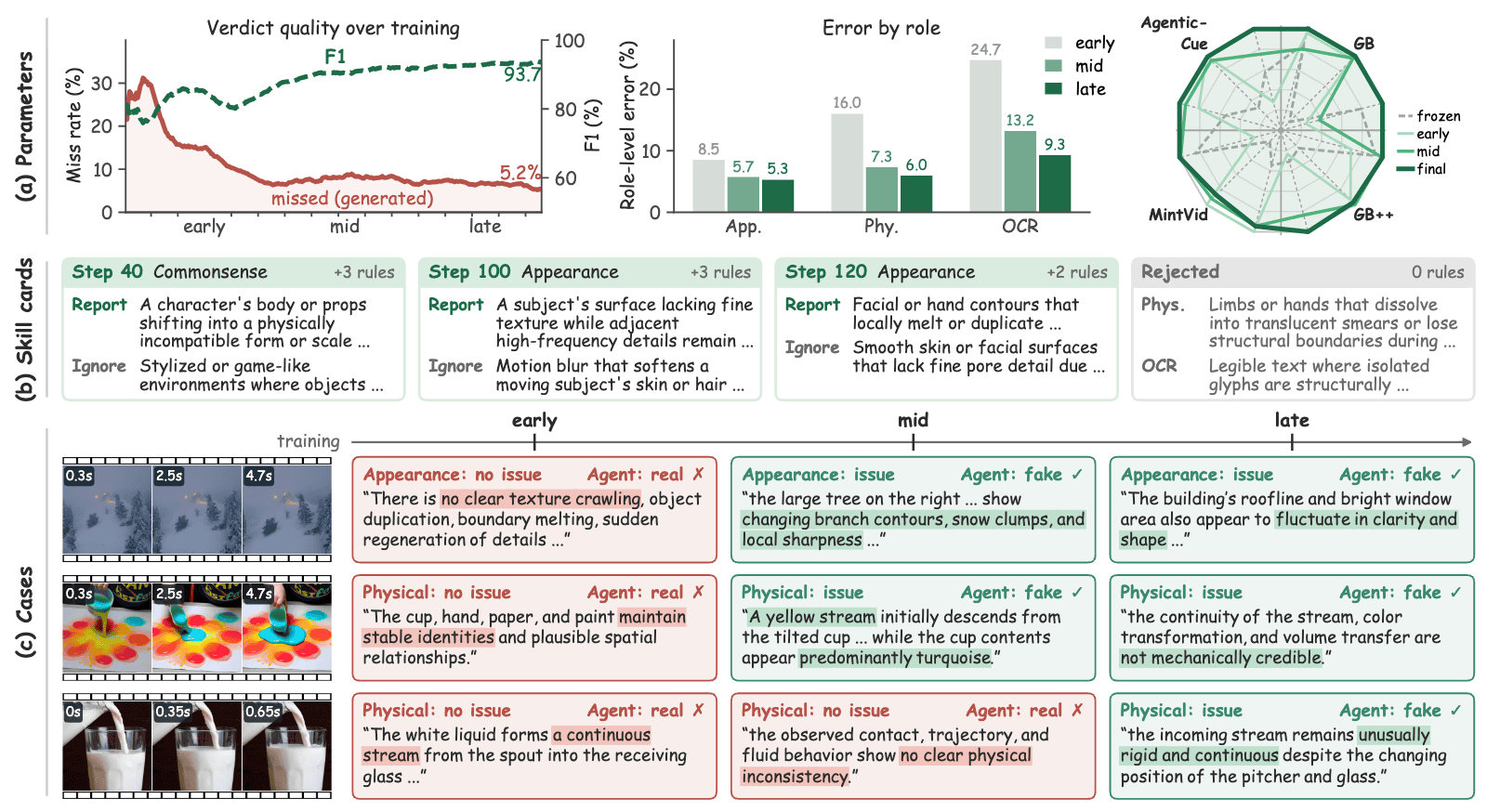
- Skill cards. A frozen LLM reviews the expert’s mistakes and proposes “report” or “ignore” rules, for example not to treat hair blurred by fast motion as a defect. A new rule stays only if it adds correct verdicts and breaks none of the old ones.
Joint training takes about a day on the authors’ cluster, although the paper does not name the GPUs.
The ForenCue-30K dataset and the AgenticCue benchmark
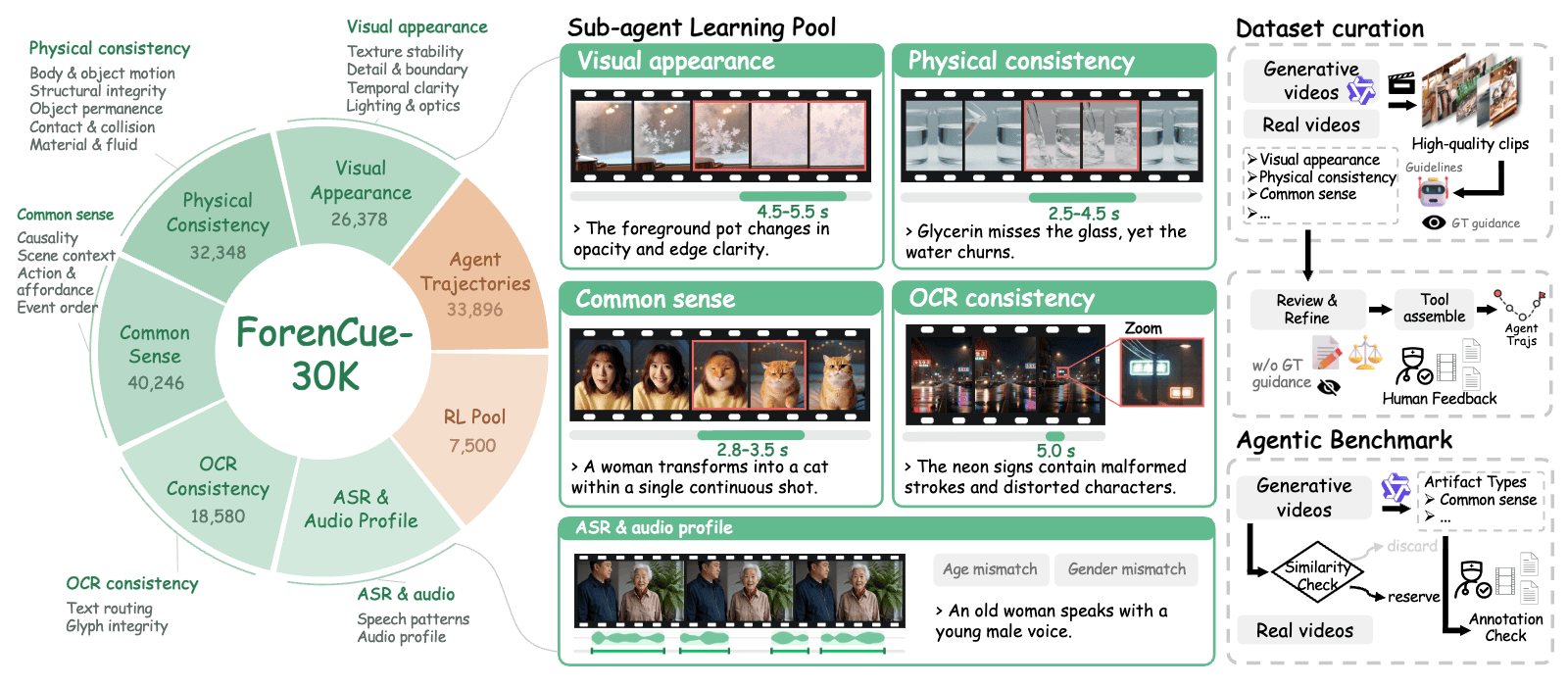
ForenCue-30K, a dataset for AI-generated video detection, contains 30,000 videos. CogVideoX, HunyuanVideo, Wan 2.1/2.2, Kling 1.0/1.5, Veo 3 and other models made the generated clips, while the real ones come from OpenVid-1M, Koala-36M, Pexels and Pixabay. Each video carries a separate annotation for every expert: a verdict, a confidence level, an explanation and the artifact interval. A VLM writes the annotations, a VLM from another model family checks them, and people review a sample. Reviewers labeled the audio by hand. In an audit of 340 video-role pairs, the frames at least partly confirmed 99.1% of the labels. Finally, the authors built the main agent’s trajectories from real expert calls rather than invented answers.
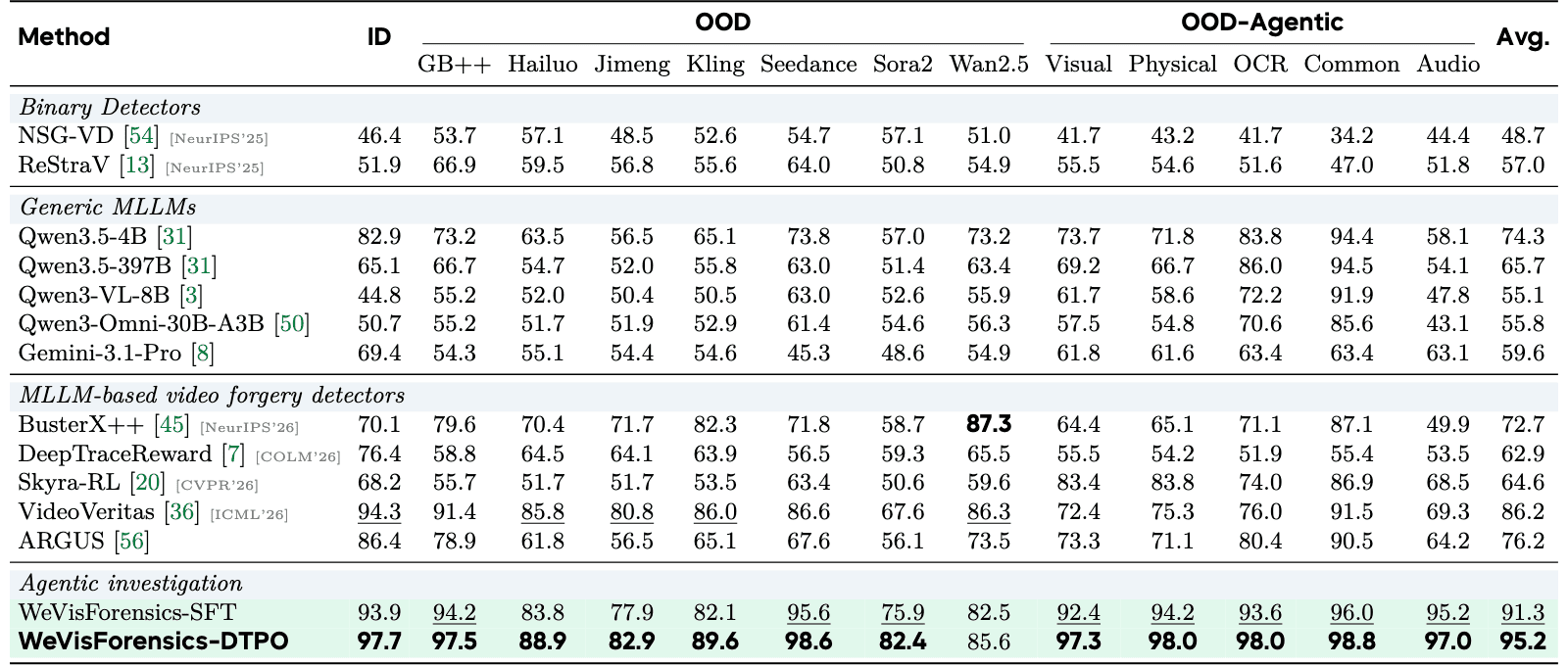
AgenticCue tests generalization to newer models such as Veo 3.1, Kling 2.5/3.0, Seedance 1.5/2.0, Hailuo 2.3, Wan 2.6 and Sora 2. It also covers digital avatars, face swaps and mismatched voices. Each of its five categories has 500 generated videos, and all of them share the same 500 real ones. Besides accuracy, the benchmark checks whether the agent called the right expert.
How accurate WeVisForensics is at AI-generated video detection
GenBuster-Bench is close to the training data, whereas GenBuster-Bench++, MintVid and AgenticCue include generators the agent never saw in training. The binary detectors NSG-VD and ReStraV, trained on the same data, stay at chance level: 46.4% and 51.9% on GenBuster-Bench. By contrast, WeVisForensics scores 97.7% there versus 94.3% for VideoVeritas. It also reaches 97.5% versus 91.4% on GenBuster-Bench++ and 88.0% versus 82.2% across the six MintVid generators. Without fine-tuning, the base Qwen3.5-4B averages 74.3%.
General-purpose multimodal models are much weaker at AI-generated video detection. For instance, Qwen3.5-397B scores 94.5% in the AgenticCue common sense category but only 54.1% in the audio category. Gemini-3.1-Pro catches 99% of the fakes on GenBuster-Bench++, yet it also rejects real videos, so its accuracy is only 54.3%. After DTPO, the agent makes 2.19 calls per AgenticCue video instead of 2.50 after SFT. Moreover, when it calls the physics, text, common sense or audio expert, the video really contains that type of artifact in 94.3-99.7% of cases.
What the evolving experts add
To see where the gains in AI-generated video detection come from, the authors tested all four combinations of the agent and the experts before and after DTPO. Training only the experts raises average accuracy from 91.3% to 92.0%, and training only the agent lifts it to 93.2%. Training both brings it to 95.2%. So the joint gain is 1.3 points larger than the sum of the separate gains. The trained agent asks sharper questions, and the experts give more useful answers.
The physics expert changed the most. Its F1 on GenBuster-Bench rose from 66.5% to 97.8%, and its share of “cannot tell” answers fell from 26.9% to 0.3%. In a blind review of 200 answer pairs, people preferred the trained experts in 65 pairs and the original ones in 20. In addition, the share of flawed answers dropped from 30.5% to 8.0%. Finally, updating the experts on every batch instead of every 20 steps lowers accuracy on all six MintVid generators.
Limitations: where AI-generated video detection still falls short
On unfamiliar commercial generators, the agent is cautious. It labels every real MintVid clip as real, yet it catches only 64.6% of Sora 2 fakes and 67.0% of Jimeng fakes. The audio tools stay frozen, since there are too few labeled audio fakes to train them. The authors also warn that the model is for research only and should not make important decisions about people on its own.