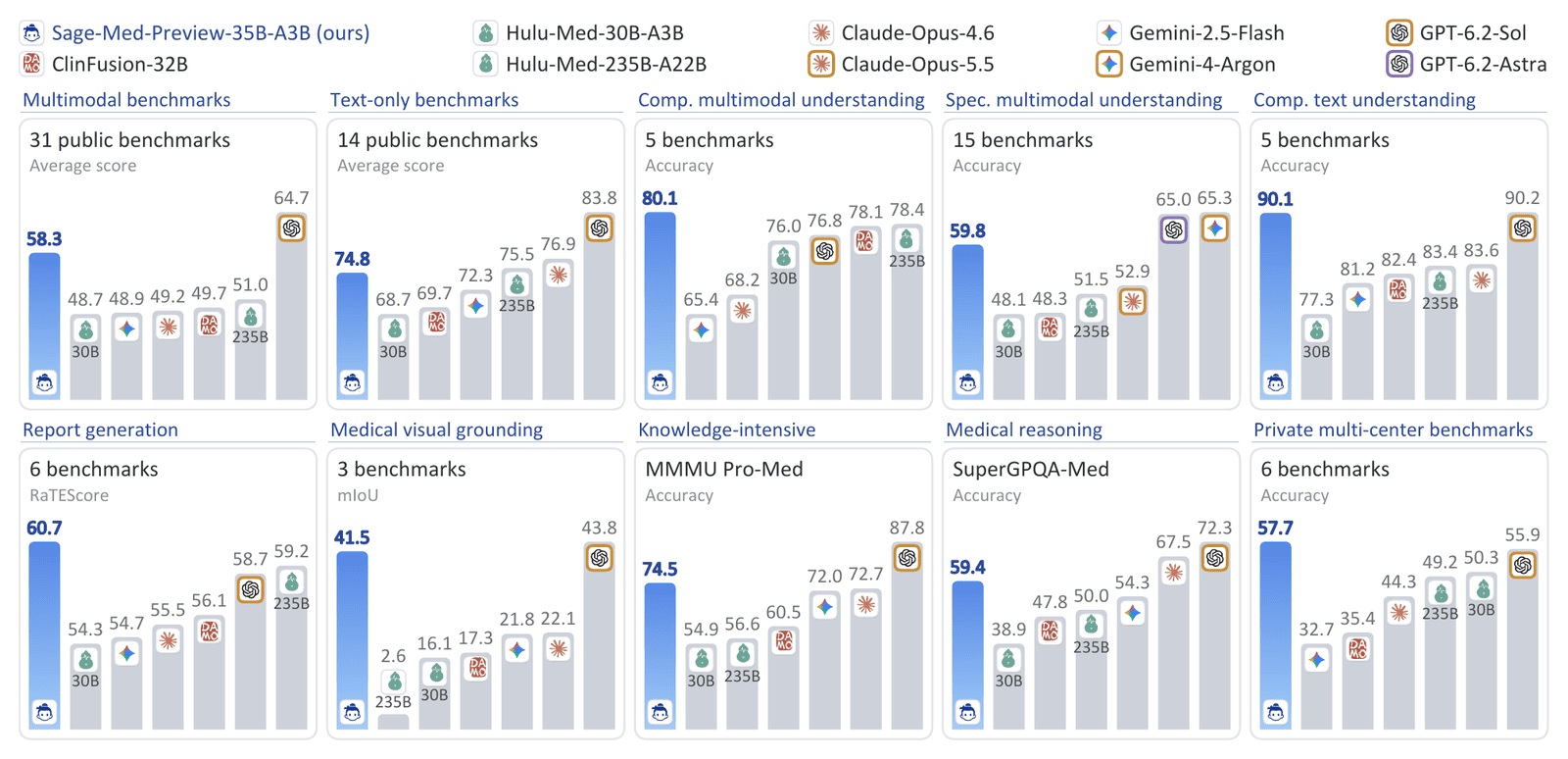
The Sage-Med team at Shanghai AI Laboratory has released Sage-Med-Preview, an open medical multimodal model. It answers questions about CT, MRI, X-ray, ultrasound, histology and endoscopy images. It also draws a box around the abnormality it finds and writes a report. Under the hood, it is a Mixture-of-Experts model built on Intern-S2-Preview. Only 3 of its 35 billion parameters are active for each token. Medical models usually trail general-purpose ones. Sage-Med-Preview, however, beats every open model on average. It scores 58.26% on 31 public multimodal benchmarks, while its base model scores 52.24%. The previous best medical model, Hulu-Med-235B-A22B, scores 50.99% with 7 times more active parameters. Moreover, on data from 14 hospitals unseen in training, Sage-Med-Preview beats even the proprietary GPT-6.2-Sol: 57.72% versus 51.24%. The weights are open on Hugging Face, the launch guide is on GitHub, and the leaderboard covers 78 models.
Why medical models lag behind general-purpose ones
First, the authors tested 77 models on 238 clinical tasks from 74 benchmarks. The test included general-purpose models without special training on medical data. There were 28 open ones, such as Qwen3-VL and InternVL3.5, plus the proprietary GPT-6.2-Sol. On average, 22 medical models trail them in all 11 categories and on 43 of 45 public benchmarks. For example, the best medical model, Hulu-Med-235B-A22B, scores 59.84% on these benchmarks. Meanwhile, the open Intern-S2-Preview, the base of Sage-Med-Preview, scores 59.90% with 3 billion active parameters versus 22 billion.
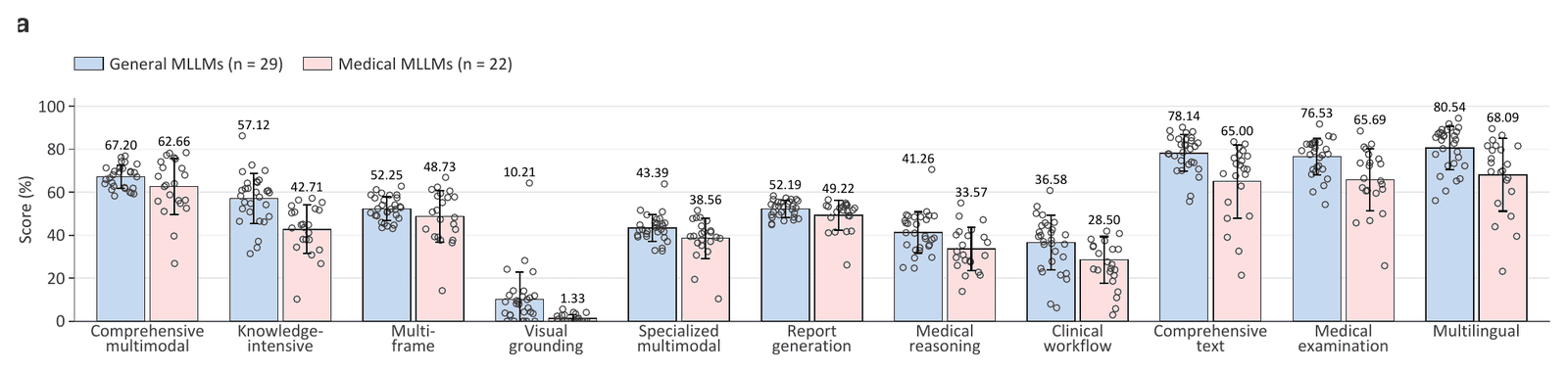
Scaling up the model does not close the gap. Across 10 model families, the largest version beats the smallest one in text understanding by 9.9 points on average. In image understanding, however, the gain is only 4.3 points. Reasoning mode does not help perception either: on 22 perception benchmarks, models score 48.09% with it and 47.55% without it. Localization is the weakest skill. On MedSG-Bench, 68 models place a correct box in only 5.56% of cases on average. The authors blame the data: open corpora contain few high-quality image-text pairs.
Where the data comes from
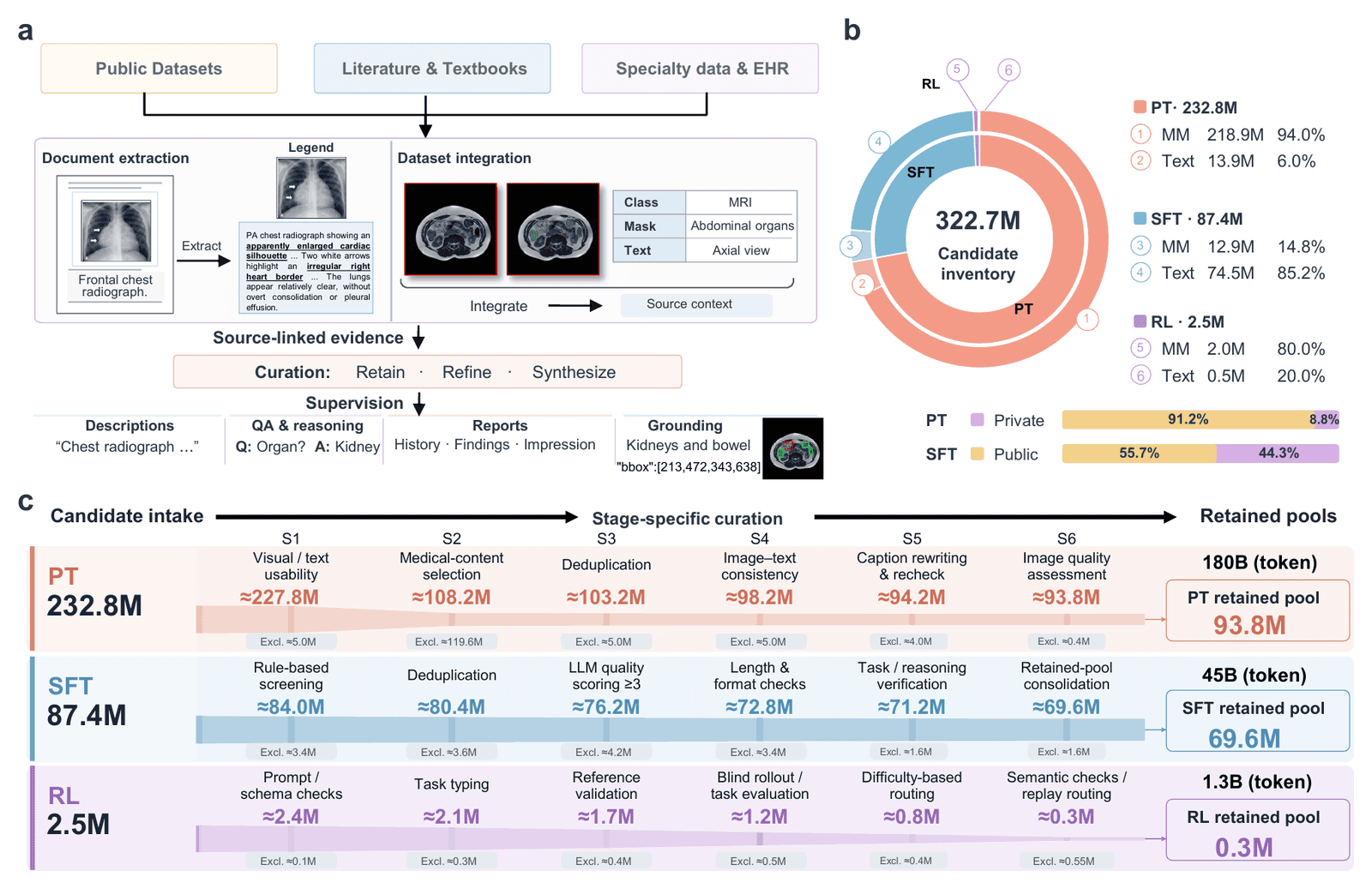
To train a medical multimodal model, the authors collected 322.7 million candidate training examples. They came from more than 200 open medical datasets, more than 100 private sources and 25 million documents (PDFs, books and web pages). In addition, the team linked figures from PDFs to their captions and in-text references. Then it turned them into four task types: description, question answering, report writing and localization.
Each training stage has its own six-step filter. For pretraining, the filter removes duplicates, checks that the caption matches the image and drops poor images. For RL, the model solves each task eight times without seeing the answer. Then the authors prioritized tasks solved two to six times. GRPO compares answers within a group, so if all eight are equally right or wrong, there is no learning signal.
How the team trained Sage-Med-Preview
First, continual pretraining on 83.8 million examples links images with descriptions. Then mid-training on 28.1 million examples adds tasks in a question-and-answer format. Next come three stages of supervised fine-tuning (SFT). The first stage uses 6.1 million examples to teach the model to follow instructions. After that, the second adds 9.6 million examples with image tasks, and the third brings 6.2 million hard examples and reasoning chains.
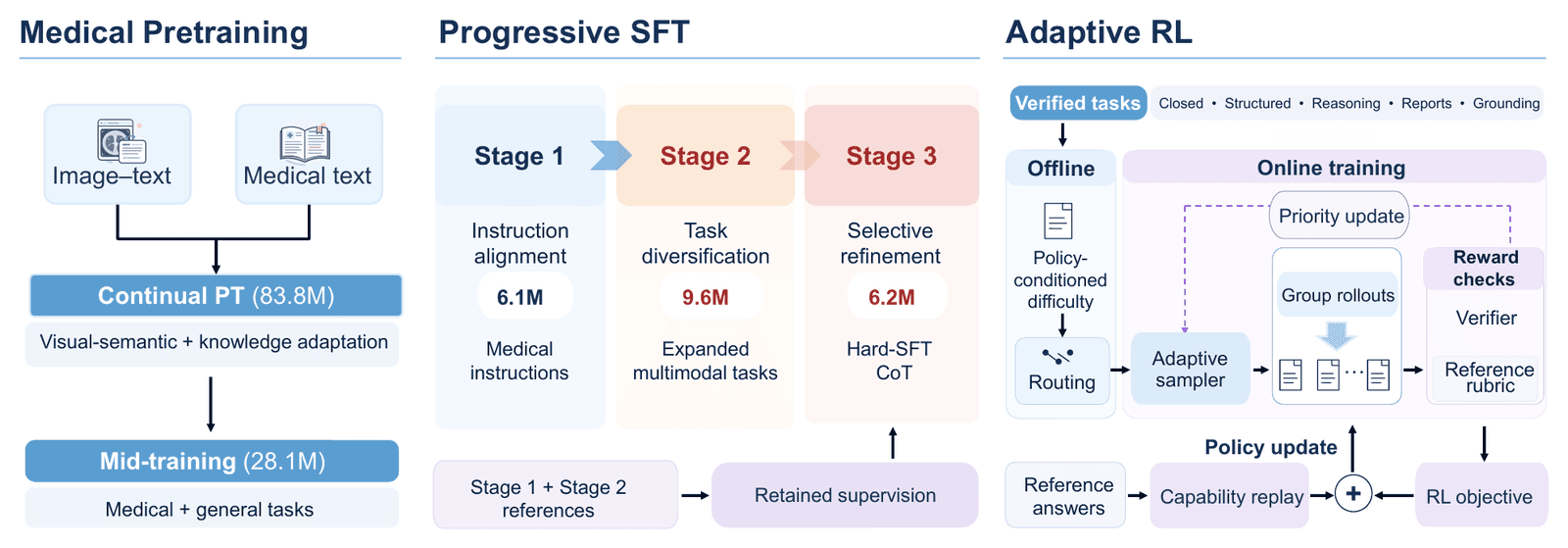
The final stage is reinforcement learning with GRPO on 298 thousand tasks of five types. Verifiers check closed-ended answers, while a judge model grades open-ended ones using rubrics and a reference answer. Meanwhile, the pipeline recomputes task difficulty from the model’s latest answers. In addition, it adds the standard SFT loss on reference answers to the GRPO loss (reference replay).
Sage-Med-Preview results on public benchmarks
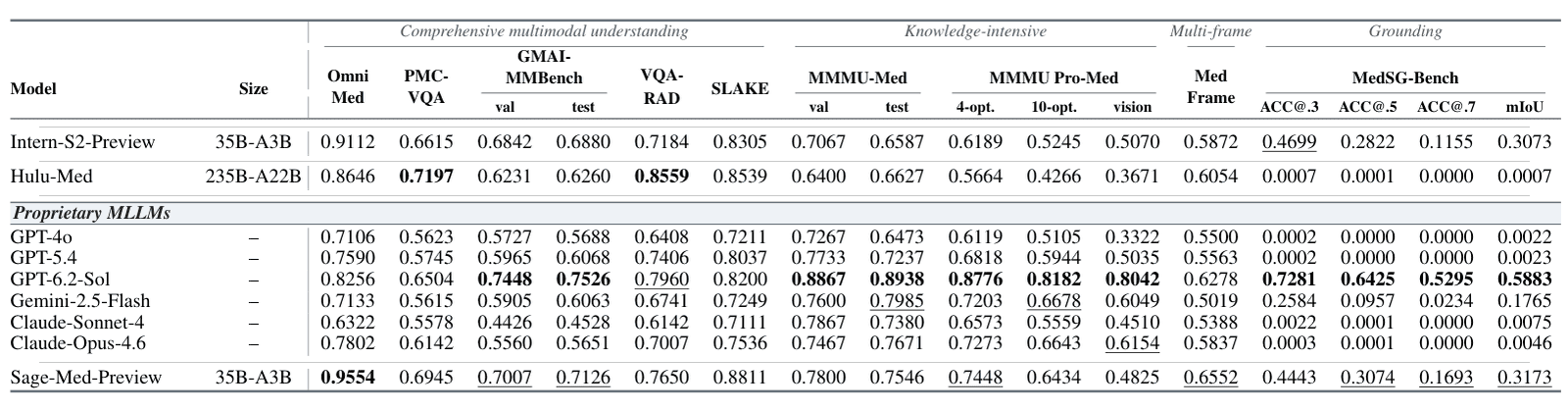
The comparison covers eight open models and four proprietary ones: GPT-5.4, Claude-Opus-4.6, Gemini-2.5-Flash and GPT-6.2-Sol. In short, Sage-Med-Preview usually ranks first among open models, but GPT-6.2-Sol is stronger on average.
Where Sage-Med-Preview wins:
- Questions about images. Identifying the organ, finding or diagnosis on an image: 80.05% correct answers on five benchmarks, more than all 12 rivals. GPT-6.2-Sol gets 76.81%.
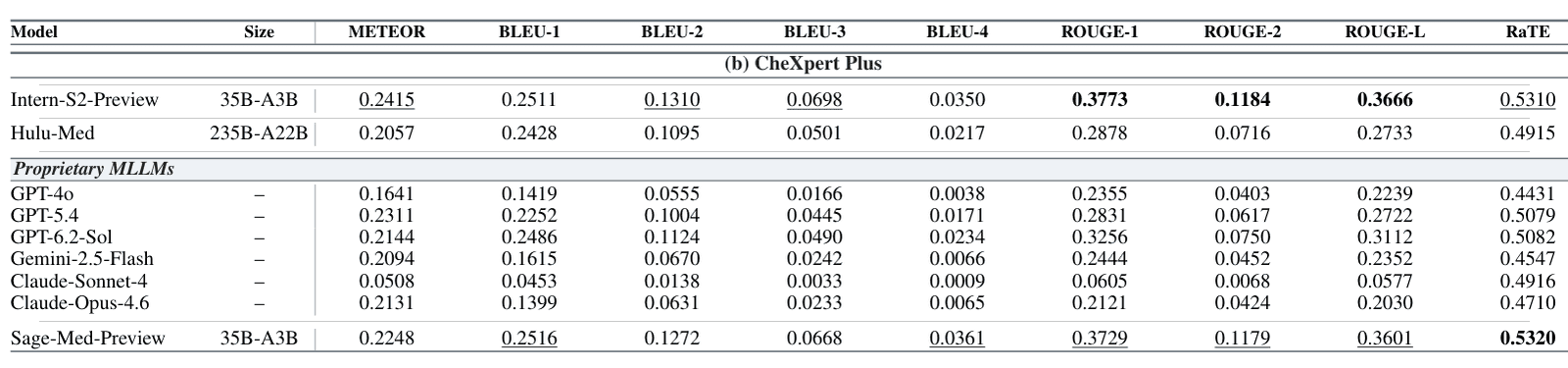
- Reports on CheXpert Plus. The best RaTEScore among 69 models: 53.20%, versus 53.10% for Intern-S2-Preview.
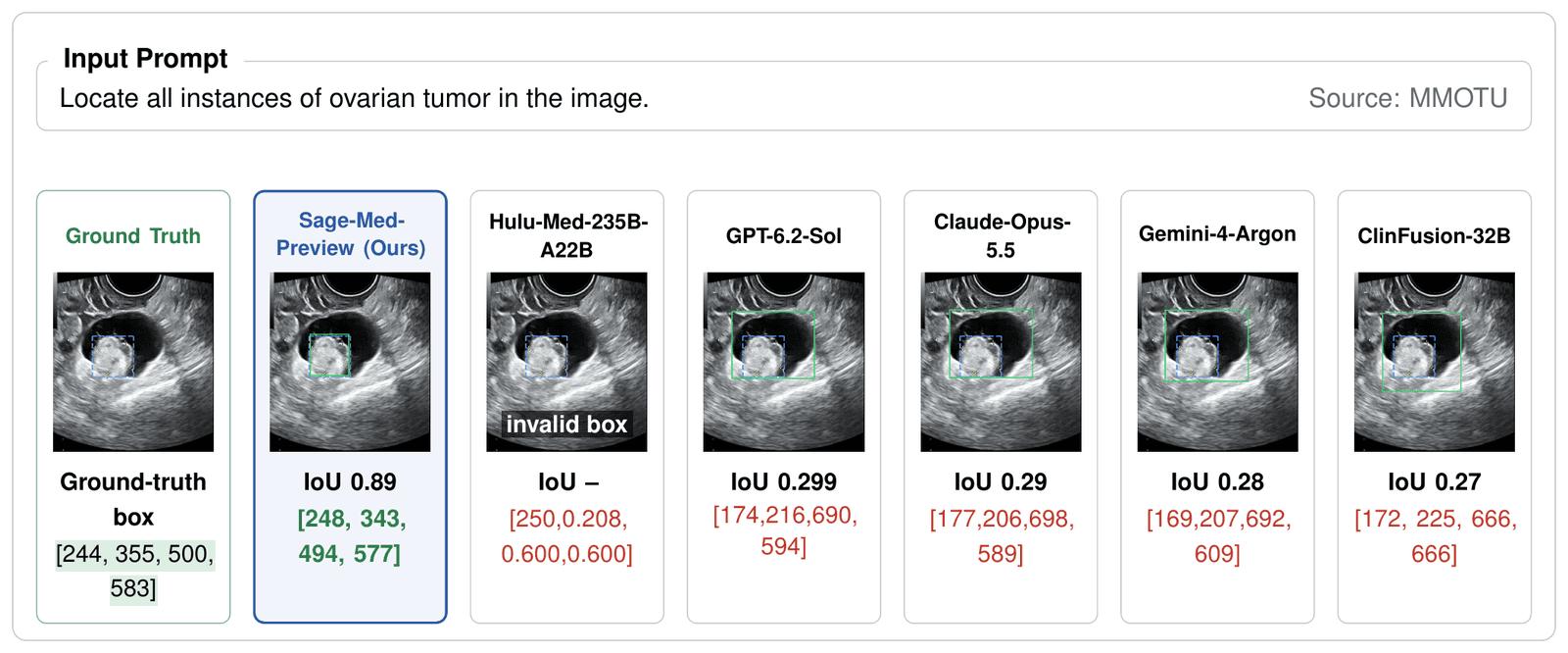
- Localization among open models. On MedSG-Bench, 30.74% of its boxes are correct, versus 28.22% for the runner-up. On eight other tasks, its mean IoU is 36.45% versus 25.63%.
- Specialized images. 59.81% on 15 benchmarks, versus 54.27% for GPT-5.4 and 51.62% for the best open rival.
Where it loses:
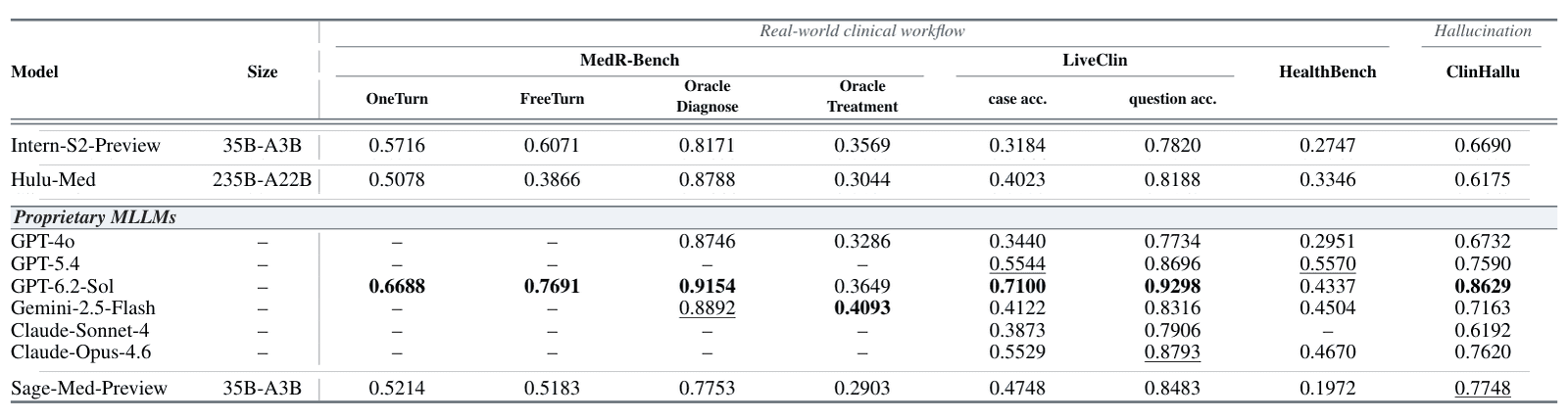
- To GPT-6.2-Sol almost everywhere. GPT-6.2-Sol scores 64.7% versus 58.3% on 31 multimodal benchmarks and 83.8% versus 74.8% on 14 text benchmarks. It is twice as accurate on MedSG-Bench (64.25%) and scores 71.00% versus 47.48% on LiveClin clinical cases.
- To newer proprietary models on specialized images. Gemini-4-Argon scores 65.33%, GPT-6.2-Astra 64.95% and GPT-6.2-Sol 63.82%.
- To its base, Intern-S2-Preview. On IU X-ray reports, its RaTEScore is 57.84% versus 62.40% (Table 7c). On HealthBench dialogues, it scores 19.72 points versus 27.47.
RaTEScore checks whether the diagnoses, findings and anatomical regions match the reference report.
IoU measures localization accuracy: the overlap of the predicted and correct boxes divided by their combined area. A box counts as correct when its IoU exceeds 0.5.
On LiveClin, a case counts only if the model answers every question correctly, from examination to follow-up.
Testing Sage-Med-Preview on data from 14 hospitals
The private part of the evaluation includes 13 benchmarks from 14 hospitals and institutes. The authors kept all of them except PET/CT separate from the training data, both by institution and by patient. On the 11 scores available for all rivals, Sage-Med-Preview averages 57.72%. GPT-6.2-Sol gets 51.24%, and the rest score 42.97% at most.
However, two tasks create most of the gap. On laparoscopy frames, Sage-Med-Preview finds the area the surgeon is looking at in 78.85% of cases with an IoU above 0.3. The best rival, GPT-5.4, manages 58.90%. On otoscope images, Sage-Med-Preview recognizes ear diseases in 41.40% of cases, versus 23.00% for GPT-6.2-Sol. Without the surgery task, the lead over GPT-6.2-Sol shrinks to 1.6 points (our calculation from Table 8). GPT-6.2-Sol also recognizes fundus diseases and intracranial tumors on MRI more accurately.
What each training stage contributed
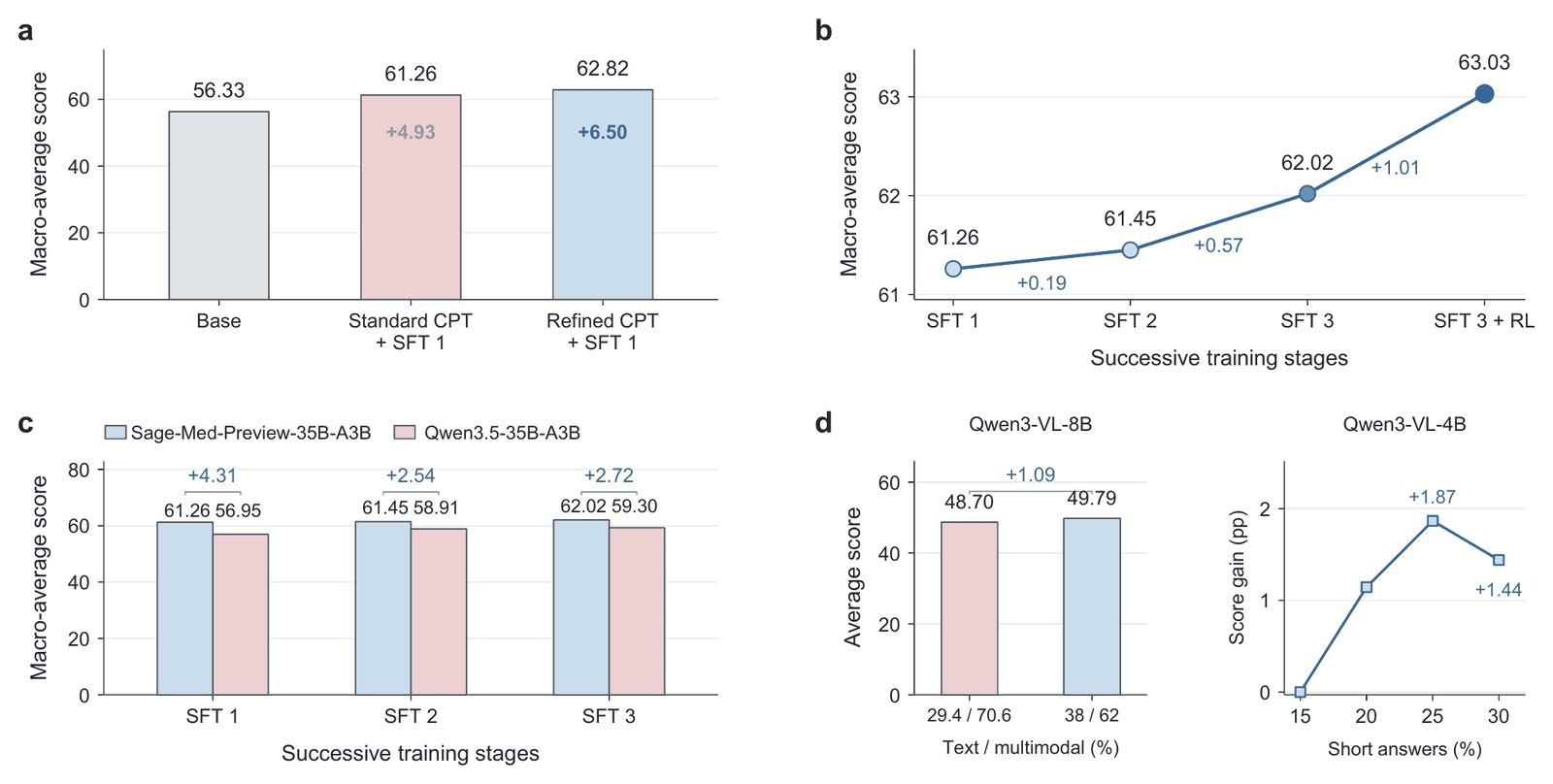
The authors compared two pretraining recipes, each followed by the first SFT stage. A curated, modality-balanced set of 30 million examples scored 62.82 points on average across 20 benchmarks. The full dataset scored 61.26, so the smaller but balanced corpus proved more useful. Starting from 61.26, the second and third SFT stages added 0.19 and 0.57 points. RL then added another 1.01, reaching 63.03.
Limitations and how to run the model
The authors have not derived scaling laws yet. There is only one model size. Also, the share of images in the data changed together with the task mix, so the effects are hard to separate. Moreover, the paper does not describe checking the training datasets for overlap with public benchmark test sets. Leakage isolation covers only the hospital data.
The weights use FP32 and take up about 131 GiB. The developers run the model with vLLM on a single NVIDIA H200 in BF16 with a 32,768-token context. According to the model card, the medical multimodal model is for research: clinical use requires review by specialists first.
We previously covered the medical models Baichuan-M3 and MedSAM2.