AI video generation has evolved from an experimental technology into a mainstream content production system. In 2026, businesses, creators, educators, and marketing teams are increasingly relying on the best AI video tools to automate workflows, reduce production costs, and scale content creation across multiple platforms.
The rapid growth of short-form video platforms such as TikTok, YouTube Shorts, and Instagram Reels has accelerated demand for AI-generated media. According to recent industry reports, the global AI video generation market is projected to reach $18.6 billion in 2026, while 78% of marketing teams already use AI-generated video in at least one campaign each quarter.
Why AI Video Generation Is Growing So Fast in 2026
Short-form video has become the dominant online content format. Brands now need a constant stream of ads, product videos, tutorials, and social clips to remain competitive. Traditional production methods cannot keep up with this demand because they require editors, actors, voice talent, cameras, and long editing cycles.
Generative AI changes the economics of video creation. Modern AI systems can generate scripts, visuals, voiceovers, subtitles, music, and transitions automatically. Some reports estimate that AI video workflows reduce production costs by up to 91% and shorten publishing time by 68%.
The growth is also driven by creator adoption. Futuresource Consulting estimated that there were 246 million online video creators globally in 2025, and the number continues to rise as AI tools simplify production workflows.
What Technologies Power the Best AI Video Tools
The best AI video tools are built on several core AI technologies, including diffusion models, transformer architectures, computer vision, and neural voice synthesis.
Diffusion Models and Text-to-Video Generation
Diffusion models are currently the foundation of most advanced AI video generators. These systems create videos frame by frame by gradually refining visual noise into coherent scenes.
Modern platforms such as OpenAI Sora, Runway Gen-3, Kling AI, and Google Veo use diffusion-based architectures to generate cinematic motion, realistic lighting, and scene consistency. According to the 2026 State of AI Video Creation report, text-to-video workflows now account for more than 65% of AI video generation usage.
Transformer Architectures and Multimodal AI
Transformers help AI systems understand relationships between text, images, motion, and audio simultaneously. This multimodal capability allows AI video tools to maintain character consistency, synchronize voiceovers, and generate more natural scene transitions.
Multimodal AI is one reason why modern AI videos look significantly more realistic than early-generation systems from just a few years ago.
AI Avatars and Neural Voice Synthesis
AI avatars have become widely used in marketing, training, onboarding, and customer communication. Neural voice systems can now generate natural speech in dozens of languages with realistic emotional tone and lip synchronization.
Platforms focused on business communication increasingly use AI presenters instead of traditional filming. Community discussions on Reddit also show strong demand for avatar-based video systems for SaaS onboarding and educational content.
Computer Vision and Motion Prediction
Computer vision models help AI systems understand objects, backgrounds, and movement. Motion prediction improves animation quality and reduces flickering between frames.
These systems are especially important for realistic character movement and smooth cinematic scenes.
Features That Define the Best AI Video Tools in 2026
The most competitive AI video platforms now offer complete end-to-end workflows instead of isolated generation features.
Core capabilities include:
- Text-to-video generation
- Image-to-video animation
- AI avatars and talking presenters
- Automatic subtitles and dubbing
- AI music generation
- Viral social media templates
- AI editing and smart transitions
- Multi-language localization
Many creators now prioritize automation over raw generation quality. Reddit discussions in 2026 increasingly focus on workflow efficiency, publishing speed, and scalable content operations rather than only cinematic realism.
Short-form vertical content is also becoming dominant. Industry data shows that 9:16 vertical AI videos now represent nearly 44% of generated content globally.
Real-World Industries Using AI Video Tools
AI video generation is no longer limited to social media creators. Multiple industries now integrate AI-generated video into daily operations.
Marketing and Advertising
Marketing teams use AI-generated ads, UGC-style videos, and product explainers to test campaigns faster and reduce creative costs.
Some businesses now generate hundreds of video variations for A/B testing within hours instead of weeks.
eCommerce
eCommerce brands use AI video systems to create product demos, lifestyle ads, and marketplace videos automatically.
This is particularly valuable for businesses managing large product catalogs.
Education and Training
Educational organizations use AI presenters and multilingual dubbing systems to localize courses and training materials.
Research from arXiv also shows growing interest in using generative AI to transform academic papers into short-form educational videos.
SaaS and Enterprise Communication
SaaS companies increasingly use AI-generated onboarding videos, customer tutorials, and internal communication content.
As businesses scale globally, AI localization significantly reduces translation and production costs.
How AI Inspo Fits Into the New AI Video Ecosystem
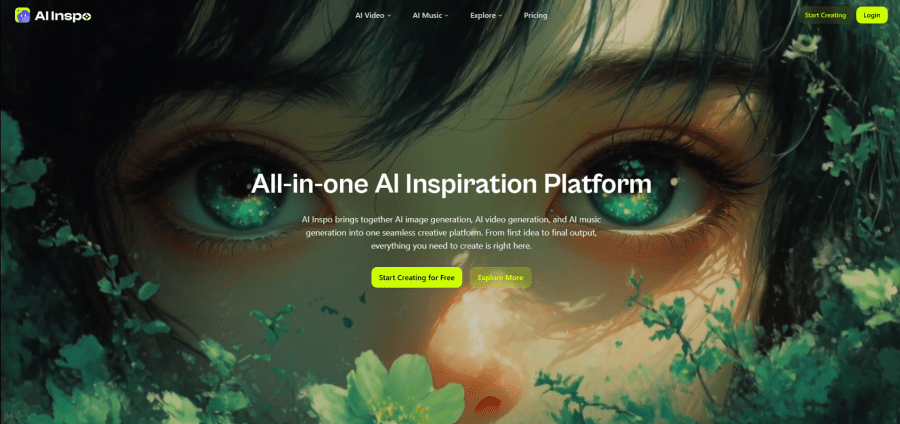
Platforms like AI Inspo are part of a broader shift toward unified AI content ecosystems. Instead of using separate tools for avatars, music, templates, and editing, users increasingly prefer integrated workflows.
AI Inspo combines multiple AI-powered creation systems, including:
- AI video generation
- AI avatars
- Viral video templates
- AI music creation
- Automated creative workflows
This integrated approach helps creators and businesses scale content production more efficiently while reducing manual editing work.
For startups and marketing teams searching for the best AI video tools, unified platforms provide a major advantage because they simplify production pipelines and accelerate publishing speed.
Challenges and Limitations
Despite rapid progress, AI video generation still faces several challenges.
Temporal consistency remains difficult in long scenes, especially with character movement and object interaction. Some AI-generated videos still show visual artifacts or unrealistic physics.
Copyright and AI ethics are also major concerns. Governments and technology companies continue debating rules around training datasets, deepfakes, and synthetic media disclosure.
Infrastructure costs remain another barrier. High-quality AI video generation requires massive GPU resources, making large-scale inference expensive for many providers.
The Future of AI Video Generation
The next stage of AI video development will likely focus on real-time generation, AI agents, and personalized media experiences.
Future systems may automatically generate entire marketing campaigns, including scripts, visuals, music, voiceovers, and localization with minimal human input.
Industry analysts also expect AI-generated content to become deeply integrated into entertainment, advertising, education, and enterprise communication workflows over the next few years.
Generative AI is no longer just a creative experiment. In 2026, it has become the infrastructure layer powering the future of digital media. As models continue improving, the best AI video tools will become faster, more realistic, and more accessible to creators and businesses worldwide.