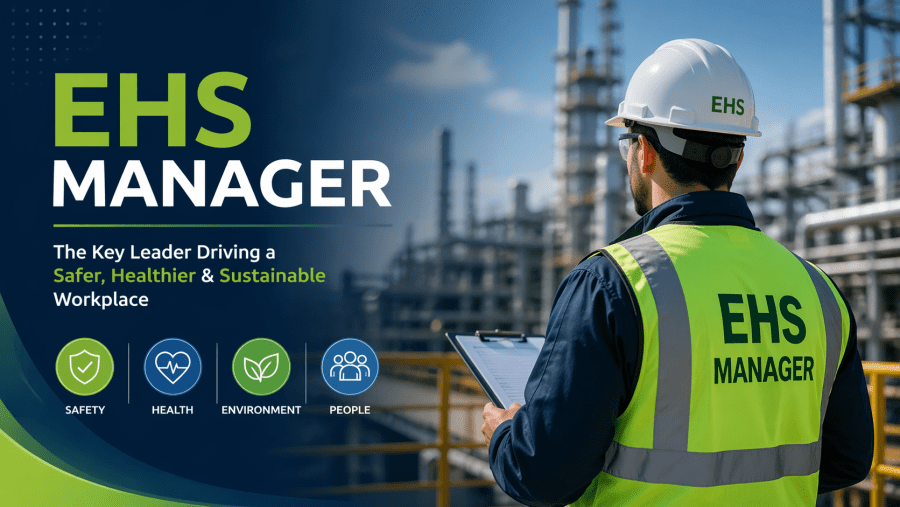
Hiring an EHS manager is one of the most important decisions an industrial employer can make. The right person helps reduce risk, improve reporting quality, strengthen compliance, and build trust across the site. The wrong hire may keep paperwork moving while missing the conditions that lead to injuries, weak corrective actions, and poor follow-through on the floor. That is why employers need to assess more than technical qualifications alone.
A strong EHS manager should understand regulations, but that is only the baseline. They also need to influence operations, interpret risk patterns, communicate clearly with frontline teams, and turn findings into action. In practice, the best candidates combine compliance knowledge with practical judgement, site credibility, and the ability to guide change under real production pressure.
Look beyond certifications and years of experience
Credentials and industry tenure matter, but they do not tell the full story. A candidate may know the standard language of audits, recordkeeping, and incident review while still struggling to lead in a busy facility. Employers should look for evidence that the person has improved conditions in real environments, not just maintained a reporting calendar.
Ask how the candidate identified a recurring hazard, what data they used, who they involved, and what changed afterward. Strong answers usually show an ability to connect formal safety requirements with operational reality. Weak answers tend to stay generic, focus only on policy ownership, or rely on broad claims with little detail about action and outcomes.
OSHA compliance knowledge is essential, but employers should test how that knowledge holds up in a real site context where pace, staffing, and process variation create pressure on safe execution.
Prioritize judgement in risk identification
A capable EHS manager should be able to spot more than obvious hazards. They need to recognize patterns before those patterns become recordable injuries or enforcement issues. That means understanding how layout, behavior, supervision, traffic flow, training gaps, and weak follow-up can combine into higher exposure.
For example, a candidate should be able to explain how they would investigate repeated near misses between pedestrians and forklifts, or how they would respond if one shift showed more unsafe behaviors than another. Employers should listen for structured thinking. Does the candidate talk about area-level review, trend analysis, observation quality, and corrective-action ownership. Or do they jump straight to retraining everyone and sending another reminder email.
The best hires usually show they can separate symptoms from causes. They know that repeated incidents often point to broader process weakness rather than a single careless act.
Test for influence across operations, not just safety knowledge
EHS managers rarely succeed through authority alone. They need cooperation from site leaders, supervisors, maintenance teams, and frontline workers. That means employers should assess how well a candidate can influence decisions across operations. A good EHS manager can explain risk in a way that connects with productivity, staffing, and workflow, rather than presenting safety as a separate agenda.
In interviews, this often shows up in how candidates describe conflict. Ask about a time they had to push for a change that operations initially resisted. Strong candidates can describe how they built the case, what evidence they used, and how they kept the relationship workable. Some employers can also incorporate an AI interview process to help standardize candidate evaluation, reduce bias in early screening, and surface patterns in how candidates respond under structured questioning. This can be particularly useful when assessing technical knowledge depth and communication clarity across a large applicant pool. However, AI-assisted tools should complement, not replace, the in-person assessment of site credibility and practical judgment that defines a strong EHS hire. They understand that credibility comes from practical recommendations, timely follow-up, and clear communication rather than vague warnings.
- Look for examples of cross-functional problem solving.
- Ask how the candidate handled resistance from operations leaders.
- Check how they explain safety impact in business terms.
- Listen for evidence of follow-through, not just diagnosis.
This matters because safety performance improves faster when EHS leaders can align risk reduction with operational discipline and site priorities.
Assess how they use data and reporting
Modern EHS leadership requires more than incident logs and monthly summaries. Employers should look for candidates who can use data to guide action, not simply document what happened. That includes understanding lagging indicators such as TRIR, but also knowing how to use near misses, audits, behavior trends, and corrective-action status to form a better picture of risk.
A strong candidate should be able to explain how they compare sites or departments, how they decide what needs attention first, and how they communicate findings to different audiences. Senior leaders may need a concise performance view. Site supervisors may need a focused weekly action list. A capable EHS manager adjusts the message without losing accuracy.
Imagine a candidate describing a site with acceptable recordable rates but rising unsafe traffic patterns in one loading zone. A strong answer would show how they used earlier signals to intervene before a more serious event occurred. That kind of thinking matters because it shows the person can move from reactive reporting toward earlier prevention.
Make sure they can build accountability without losing trust
An EHS manager has to hold standards without becoming detached from the workforce. Employers should look for candidates who can coach, challenge, and escalate when needed, while still maintaining trust on the floor. People are more likely to report hazards and near misses when they believe the response will be fair, useful, and timely.
Good candidates usually describe accountability in practical terms. They talk about clear expectations, visible follow-up, site presence, and consistent handling of repeat issues. They avoid language that places all responsibility on worker behavior while ignoring layout, process design, or management response. That balance is important because overly punitive approaches often suppress the very reporting employers need to understand risk properly.
Use interviews to reveal how they think under pressure
The best interview process does not just verify credentials. It reveals how a candidate thinks through real workplace challenges. Scenario-based questions are especially useful because they show how someone prioritizes, investigates, and communicates under pressure. That gives employers a much better view of likely performance than a list of generic strengths.
For employers building a more rigorous hiring process, practical sets of EHS interview questions can help surface the judgement, influence, and data skills that matter most. The goal is not simply to hire someone who understands safety requirements. It is to hire someone who can turn those requirements into stronger action, sharper visibility, and safer day-to-day performance across the site.