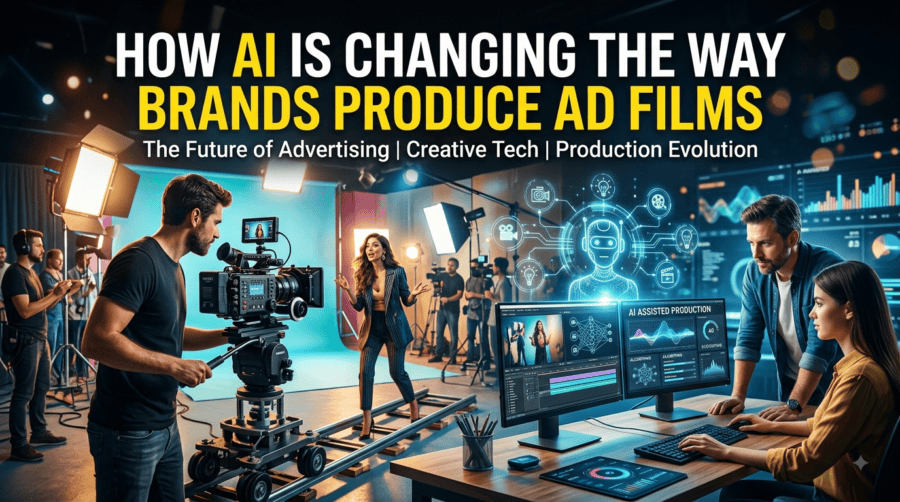
For years, producing an ad film meant coordinating a long chain of people, equipment, locations, and approvals. A campaign could begin with a simple idea and eventually involve writers, directors, cinematographers, actors, editors, sound designers, and multiple production teams.
That process is still valuable for many campaigns, but it is no longer the only way brands can develop video content.
AI is changing what happens between the first creative idea and the final film. Teams can now explore visual concepts before a shoot, generate supporting scenes, create multiple versions of an idea, and make changes without rebuilding the entire production.
The result is not necessarily a world where traditional filmmaking disappears. Instead, brands are gaining another way to approach production, particularly when they need more content, faster experimentation, or variations for different audiences.
The First Change Happens Before the Camera Rolls
A traditional production often requires a concept to be relatively clear before filming begins. Changing the location, visual style, or story later can become expensive.
AI makes early experimentation easier.
A creative team can take a campaign idea and explore different settings, characters, visual styles, camera movements, or story directions before deciding what deserves production time.
This can be useful during pitches, too. Instead of explaining how an ad might look, teams can create visual references that help stakeholders understand the direction.
The goal is not to replace storyboarding or creative direction. It is to give those decisions something tangible to work with earlier in the process.
From a Creative Brief to a Working Film
Brands rarely start advertising projects with nothing. They may already have a brand book, campaign brief, product information, reference videos, scripts, previous advertisements, and visual guidelines.
Invideo agent can bring these different inputs into one creative workflow. It can help with scripting, scene planning, video generation, editing, voiceovers, music, and other production tasks.
Its access to 200+ AI models gives creative teams flexibility when developing different shots, visual concepts, and campaign variations. This can also be useful for creating AI-generated UGC ads when brands need different versions of a product-focused campaign.
Invideo agent two approach adds project memory. Instead of treating every conversation as a separate task, it can remember the project’s creative decisions, references, characters, visual rules, and other details as the work develops.
It can also read PDFs, brand books, scripts, videos, rough cuts, and uploaded footage. That means a creative team can work with the material it already produces instead of constantly converting everything into prompts.
For larger campaigns, teams can create specialist agents for roles such as a DOP, storyboard artist, casting director, or creative producer. These agents can work from the same project context, making it easier to handle different parts of a production.
Ad Films Can Become More Iterative
One of the biggest changes AI brings to advertising is the ability to test more ideas before making a final decision.
Imagine a brand has three possible openings for a campaign. Traditionally, the team might choose one based on the script, moodboards, and discussion.
With AI, all three can be explored visually.
The same applies to locations, product presentations, characters, pacing, and visual treatments. A creative team can compare rough directions and decide which one is worth developing.
This does not mean every generated version needs to be polished. Early versions can simply answer an important question: Does this idea work on screen?
That can make creative discussions more practical.
Production Becomes Less Dependent on One Location
Locations can be one of the most complicated parts of commercial production.
A brand might want an ad set in a luxury hotel, a mountain landscape, a futuristic city, or somewhere that does not exist at all. Traditional production may require travel, set construction, permits, or extensive visual effects.
AI-generated environments can provide another option.
Teams can experiment with locations before deciding whether to film traditionally or build parts of the environment digitally. For some campaigns, the final film may combine real footage with AI-generated backgrounds or scenes.
This hybrid approach can be especially useful when a brand wants the authenticity of real production while still exploring visuals that would be difficult to capture practically.
One Campaign Can Produce More Versions
Modern advertising rarely ends with one film.
A campaign might need a hero video for YouTube, shorter versions for social media, vertical cuts for Reels and TikTok, product-focused edits, and variations for different audiences.
AI can help teams adapt a core idea into multiple formats.
Instead of rebuilding each version from scratch, the team can keep the central campaign concept and adjust the duration, framing, script, opening, or product focus.
This is particularly useful for performance marketing, where brands may need to test multiple creative variations and replace weaker ads quickly.
The challenge is maintaining consistency. More versions should not mean that the campaign starts looking like completely different brands.
Post-Production Is Changing Too
AI’s role does not end when filming is finished.
Editors can use AI-assisted workflows to work with rough cuts, remove repetitive tasks, generate supporting material, create alternate versions, and make changes to existing footage.
This can shorten some of the less creative parts of post-production and leave more time for decisions around pacing, storytelling, sound, and visual quality.
It also becomes easier to revisit older campaigns.
A brand might have a successful advertisement from a previous season but need a new version for a different market or product. Existing footage and references can become starting points instead of having to recreate the entire concept.
Brands Can Work With Smaller Production Teams
AI also changes the economics of production.
A brand does not necessarily need a large team for every stage of every campaign. Some repetitive tasks can be handled through AI-assisted workflows, allowing smaller creative teams to take on projects that previously required more production resources.
This does not mean fewer people automatically produce better films.
A strong creative idea still needs direction. Someone needs to understand the audience, make visual decisions, review generated content, maintain brand consistency, and know when an AI-generated result is not good enough.
The difference is that the team can spend more time on those decisions instead of managing every manual production task.
What AI Still Cannot Replace
There is a tendency to view AI video as a complete replacement for filmmaking. Advertising is more complicated than that.
An AI tool can generate a visually impressive shot, but a good ad film needs a reason for that shot to exist.
The campaign still needs a clear message. The product still needs to be represented accurately. The story needs to connect with the audience. The final film needs to feel appropriate for the brand.
Human taste becomes even more important when production becomes easier.
When a team can generate dozens of options, the real skill is knowing which one deserves to stay.
The New Ad Film Workflow
The emerging model is less about choosing between traditional production and AI.
A brand might use AI to explore concepts, create storyboards, develop difficult visual sequences, and test different versions. It might then use a traditional crew to capture actors and products, followed by AI-assisted post-production.
Another campaign may be mostly AI-generated from beginning to end.
The workflow can change depending on the creative requirement.
That flexibility is perhaps the biggest shift. Brands no longer have to use exactly the same production process for every advertisement.
Final Thoughts
AI is changing advertising by making the production process more flexible.
Ideas can be visualised earlier, more creative directions can be tested, difficult scenes can be explored without a full shoot, and one campaign can be adapted into more versions.
Platforms such as Invideo agent bring many of these capabilities into a single workflow, while access to 200+ AI models gives creative teams more options for developing different shots and visual directions.
But technology does not remove the need for creative thinking. If anything, it makes creative judgment more important.
The brands that get the most from AI will not necessarily be the ones generating the most content. They will be the ones using AI to spend less time on production friction and more time deciding what the ad should actually say, show, and make people feel.