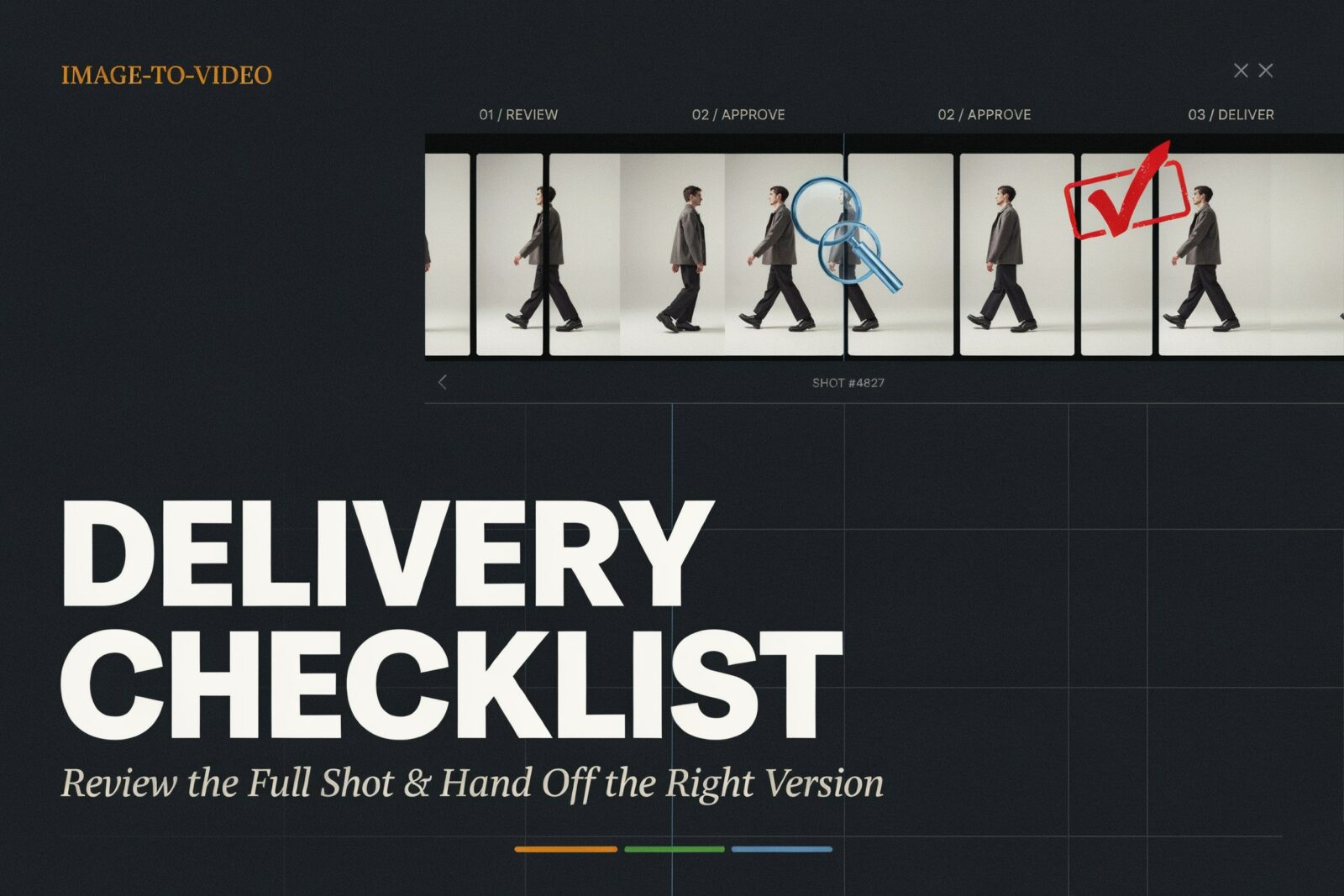
An image-to-video clip can pass a visual review and still become the wrong delivery. An editor receives an earlier export. A vertical crop cuts off the subject that was approved in the wide master. A producer sees “approved” in a message but cannot tell which file it refers to.
For AI production and creative teams, acceptance needs to travel with a specific deliverable. This guide proposes a manual handoff process: define the output, review its full duration and intended crop, assign the decision, then package the exact version that passed. It is not a report of generation tests.
Disclosure: This article was prepared for MixVio and includes a link to its image-to-video tool.
1. Define the delivery, not just the generation request
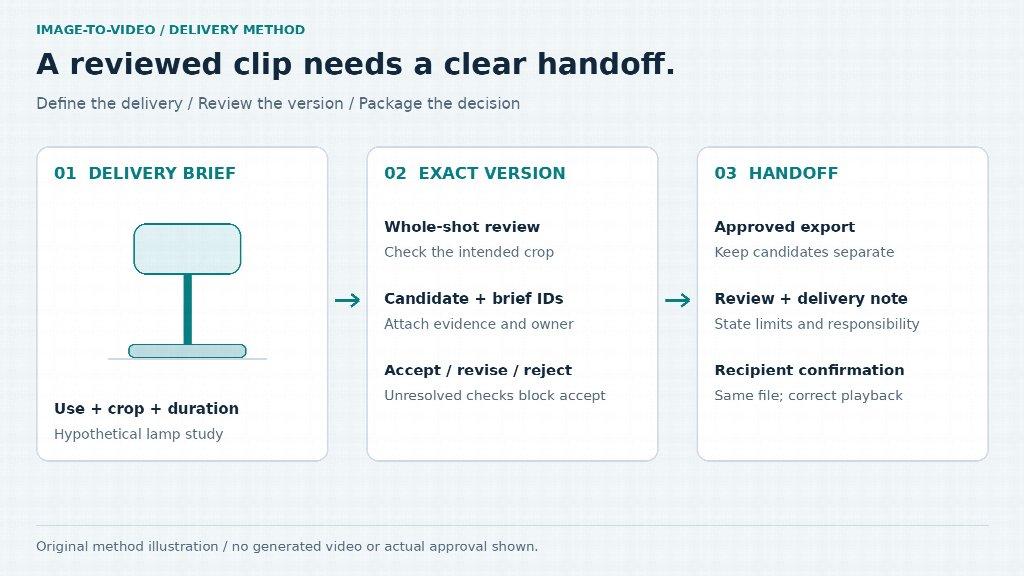
Before generating, write what the next person needs to receive. Specify intended use, requested duration, delivery aspect ratio, minimum usable dimensions, sound requirements and whether further editing is expected. Distinguish a creative preview from a final public asset.
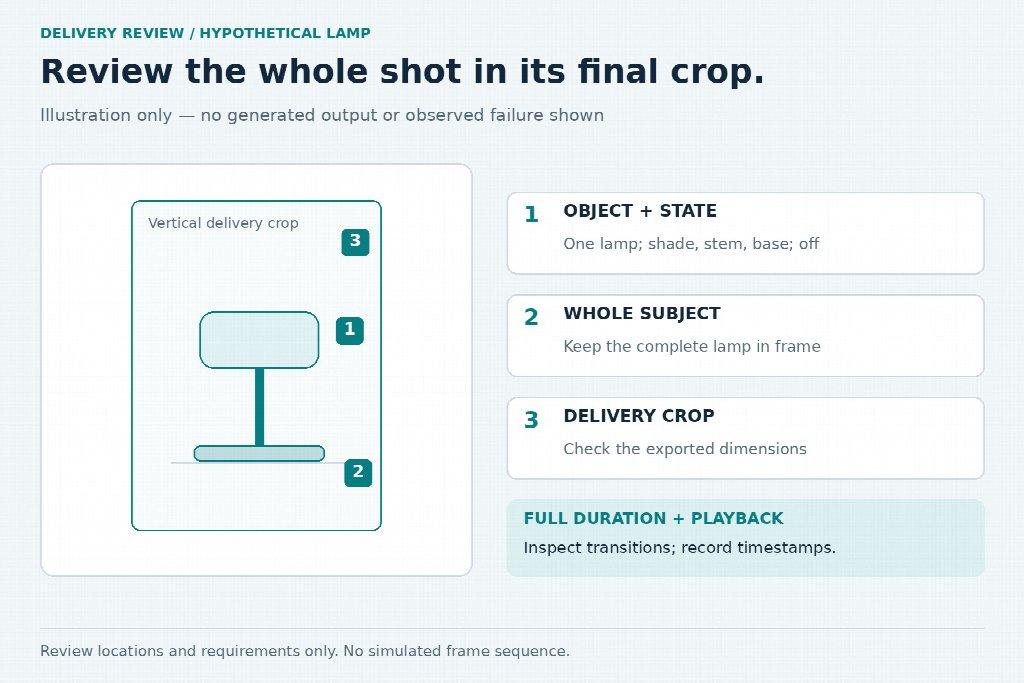
Hypothetical assignment: A design team needs a six-second, silent vertical motion study of an unbranded desk lamp for an internal presentation. The lamp sits on a desk and stays fully inside the intended crop while the camera moves gently sideways. The lamp remains off. Its shade, stem and base must remain recognizable, with no extra lamp appearing. This is a proposed brief, not a description of generated footage or a tested product capability.
The delivery owner should approve these requirements before work begins. If the chosen generation route cannot provide a requested setting, revise the brief openly rather than silently delivering a different specification.
The page for MixVio’s image-to-video tool describes authorized image upload, motion instructions, model and format selection, a credit quote before generation and private MP4 delivery. Downloading that MP4 starts the handoff process; it does not establish that the file meets the team’s delivery requirements. Its public limitations include possible drift in identity, fine details and brand fidelity.
2. Assign responsibility and identify each version
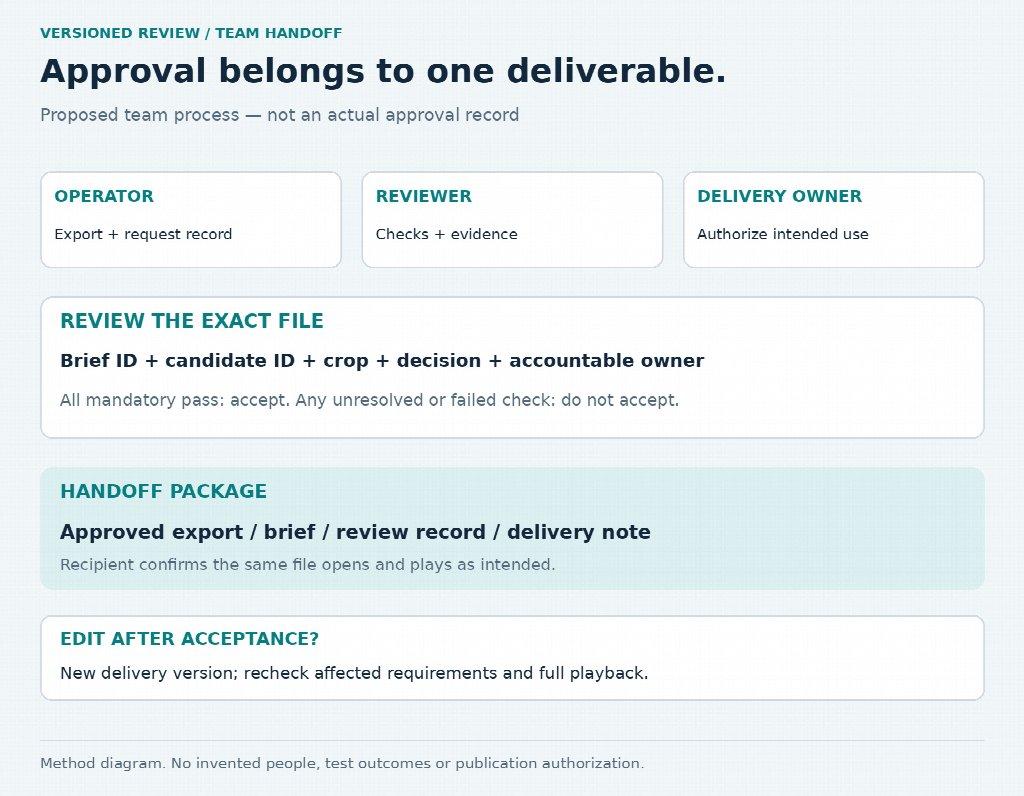
Use explicit roles, even when one person performs several of them. The operator prepares the request and export. The reviewer checks the candidate against the brief. The delivery owner authorizes its intended use. The recipient confirms that the package is understandable and opens correctly. These are proposed team responsibilities, not platform permission features.
Give the brief and each candidate a version identifier. Keep an unchanged copy of the source image you are authorized to animate. Record the request date, prompt, selected route and exposed settings alongside the resulting file. Where a setting is unavailable, say so.
Avoid ambiguous filenames such as “final-new-final.” A simple scheme like `lamp-study_brief-b02_candidate-c03_vertical.mp4` links the export to its brief. The labels are hypothetical examples, not existing assets. If useful, record a file checksum so a recipient can distinguish identical filenames with different contents; a checksum identifies bytes, not visual quality or rights.
Do not overwrite an accepted export when making another attempt. Preserve the earlier file and mark which later candidate supersedes it. A decision about one candidate does not transfer automatically to its replacement.
3. Review the complete shot in its delivery context
Watch the entire candidate at normal speed, not only a contact sheet. Inspect opening and closing states, transitions, occlusions and suspicious moments. Add timestamps to observations so someone else can locate them.
Then review the actual delivery crop. A wide source can look acceptable while the vertical deliverable loses the lamp’s base. Check the dimensions and duration reported by the exported file, and open it in the playback environment the recipient expects to use. If the recipient will add titles or overlays, agree those reserved areas in advance.
For the hypothetical lamp study, the reviewer would inspect the following requirements. The final column describes evidence to collect; no outcomes have been filled in.
| Requirement | What the reviewer must establish | Evidence to record |
| Whole subject | Shade, stem and base remain inside the vertical crop throughout | Candidate ID and any boundary timestamps |
| Stable object | One recognizable lamp persists without structural changes | Time range and specific observed change, if any |
| Requested state | Lamp remains off and movement follows the brief | Lighting and motion observations across the shot |
| Complete delivery | Full requested duration, intended dimensions and silent delivery | Export properties and playback check |
Do not replace a failed requirement with a softer one after seeing an attractive clip. If the team changes the purpose or tolerance, issue a new brief version and review against it.
4. Attach a decision to the exact candidate
Mark each mandatory check pass, fail or needs review. An uncertain observation stays unresolved until someone examines it. “Needs review” must not be treated as a polite pass.
The whole-clip decision is separate: accept only when mandatory checks pass; revise when a specific request or export change is justified; reject when the candidate is unsuitable or further work should stop. Record who made the decision and which brief, candidate and delivery crop it covers.
A hypothetical handoff record could contain these fields:
- Scope: brief b02; candidate c03; vertical internal presentation study.
- Operator: designated person, to be recorded by the team.
- Checks: reviewer records pass/fail/needs review with timestamps; currently unassessed.
- Decision: pending, not approved; no actual candidate has been reviewed here.
- Next action: reviewer inspects the complete export; delivery owner confirms intended use.
This example is deliberately unapproved. It shows how to avoid a convincing-looking fictional approval record. In real work, replace the role descriptions with accountable team members and preserve the decision date.
If someone trims, crops, retimes or changes sound after acceptance, create a new delivery version. Review the affected requirements and the edited file’s start-to-finish playback before reissuing approval. Do not assume a previously accepted master validates every derivative.
5. Package evidence so the next person can act
Keep the handoff small but complete. Include the exact approved export, the applicable brief, the review record and a short delivery note. Separate working candidates from approved files so the recipient does not need to infer which one to use.
A useful delivery note answers four questions: What is this file for? Which version passed? What changes are permitted without another review? Who should resolve a problem? Identify unresolved limitations explicitly instead of hiding them in a long conversation thread.
Keep source permissions and applicable usage conditions accessible to the delivery owner. Do not expose private prompts, faces or account-scoped download links in a public document. Share only what the recipient is authorized to access, using the team’s approved storage and access process.
Ask the recipient to confirm the filename or checksum, opening and playback, intended crop and understanding of the decision. Receipt confirmation is not a replacement for the reviewer’s acceptance. If the package is incomplete, return it for clarification rather than guessing.
6. Close the job without losing the accounting
Record generation spending as a supporting production record, not as proof of quality. For a defined job, cost per accepted full clip is net actual generation charges for all attempts divided by accepted complete clips. Include charged rejected attempts; exclude uncharged reservations. A released hold is not a refund to subtract again.
Keep different services’ credit units separate unless actual charges are converted on a documented currency basis. With zero accepted complete clips, the ratio is undefined. Log usable excerpts and human review time separately. These records describe the job, not a model ranking.
Before external publication, verify source, face, brand and audio rights and the applicable plan and provider terms. Free access does not automatically permit commercial use. An accepted internal motion study is not evidence of real physical performance, nor approval for an unrelated advertising use.
Close the job when the recipient has the right file, the delivery owner has authorized the intended use and the record identifies what was accepted. If no candidate meets the brief within the agreed budget, keep the still or revise the assignment. A clean handoff should remove uncertainty, not pass it to the next person.